

Head of new united Arab party aims to prevent right-wing election win
Ayman Odeh claims joint slate, polling at 12 seats, ‘stronger than Liberman’; Tibi calls on Israeli Jews to vote for new alliance
 Add ToI as a Preferred Source on Google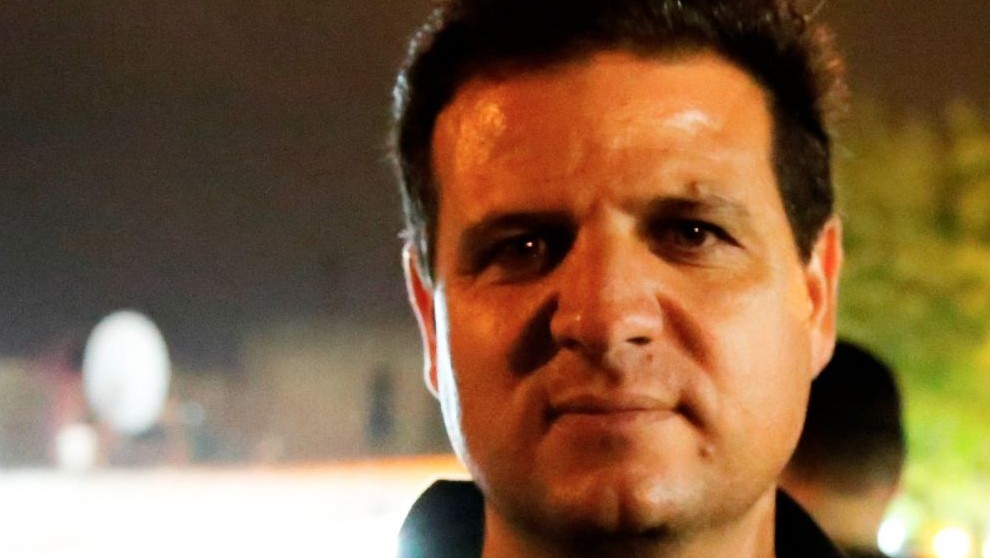
A day after Israel’s Arab parties signed a historic unity deal to run on a single ticket in March’s Knesset elections, the joint list presented its Knesset candidates on Friday and asserted it be would be the third largest faction in the Israeli parliament, “stronger than [Foreign Minister Avigdor] Liberman’s” Yisrael Beytenu. Its leader said the goal was to prevent the Israeli right-wing from winning the coming elections.
The joint list includes Balad, Ra’am-Ta’al, the socialist, Arab-Jewish Hadash party and the Islamic Movement.
The new party, set to be called the United Democratic Party, is headed by Haifa attorney Ayman Odeh, a political newcomer who was elected head of Hadash — the Democratic Front for Peace and Equality — on Saturday. He will be followed on the list by Ra’am-Ta’al representative Masud Ghnaim, Balad head Jamal Zahalka, and Ra’am Ta’al’s Ahmad Tibi.
Slots five to 11 on the list will be given in order to a representative from Hadash, then the Islamic Movement, followed by Balad, then Ra’am-Ta’al, then back to top of the order. Seats 12 and up will alternate between Ta’al and the Islamic Movement. .
The controversial Balad lawmaker Hanin Zoabi will run in the seventh slot. Hadash’s Dov Khenin, who was placed eighth on the list, will likely be the only Jewish person on the list with a realistic shot at winning election
“The right is called the ‘nationalist camp,’ [Isaac] Herzog and [Tzipi] Livni founded the ‘Zionist Camp,’ and we just founded the ‘democratic camp,” said Odeh at a press conference in Nazareth Friday.”Arabs are a big percentage of the population, and we will put all our weight behind the effort to prevent the right from winning the elections.This will be our contribution.” Some 23% of Israel’s 8-million citizens are not Jewish.
“We oppose the Arab vs. Jew and Jew vs. Arab approach. Our Knesset list, which has Jews and Arabs, is not against Israeli society, it fights for Israeli society to become [more] democratic, equal, [a society that] pursues peace,” Odeh said.
MK Tibi (Ra’am-Ta’al), who had been considered a favorite to lead the unified slate and who placed fourth, called on Jews as well as Arabs to vote for the new alliance.
“We call on the Arab public, as well as the Jewish public who believes in our way, to vote for us. Our list is not in any danger. Liberman’s list is at risk,” said Tibi, in reference to the foreign minister’s shrinking support in the polls in the wake of large-scale graft scandal.
Recent surveys have given Yisrael Beytenu fewer than 10 seats in the March 17 elections, while several polls have shown a joint Arab-majority party garnering up to 12 seats.
Zoabi said the Arab parties’ union was a “historic achievement” and the new faction would be the “only party that is in favor of full equality.”
“We are facing a racist policy and a racist regime that sidelines Palestinian citizens of Israel. I think this [union] restores the Arab public’s trust in politics. Those who opted not to vote in the past, will vote now,” she said.
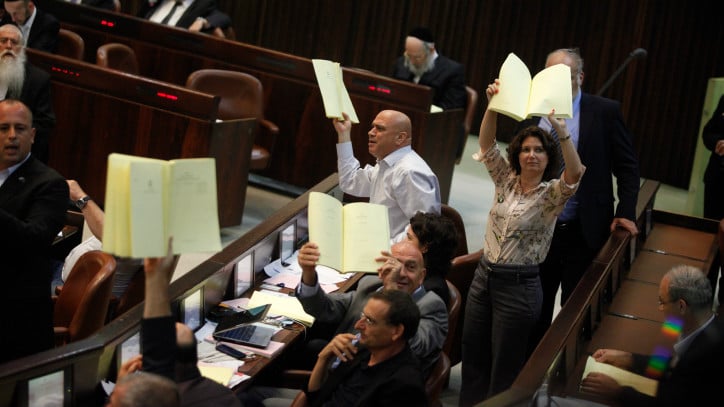
Legislators worked for weeks to overcome their own deep ideological differences and construct a shared “pan-Arab” list that would stand a better chance of clearing the 3.25 percent electoral threshold which passed into law last year.
Israel’s Arab-majority political parties reportedly recently rejected an offer by Isaac Herzog, head of the Zionist Camp faction — the joint Labor-Hatnua list — to join a potential coalition led by him should he win the premiership in March’s national elections.
Adiv Sterman contributed to this report.



The Times of Israel Community.