

Israel releases Palestinian ex-negotiator after brief arrest
Cartographer Khalil Tufagji accused of conducting illegal political activity on behalf of the Palestinian Authority in East Jerusalem
 Add ToI as a Preferred Source on Google
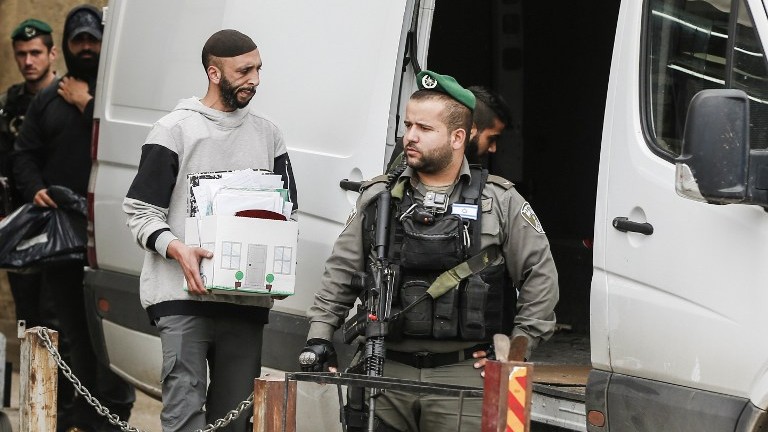
AP — Israeli police on Tuesday burst into the offices of a former Palestinian peace negotiator and detained him for several hours, accusing him of conducting illegal political activity in East Jerusalem on behalf of the Palestinian Authority, before releasing him.
It was believed to be the first arrest of its kind since Israel banned the Palestinian Authority from carrying out official business in East Jerusalem in 2001, and illustrated the deep sensitivities over the area.
Khalil Tufagji, a prominent Palestinian cartographer, said police entered his office early Tuesday and confiscated computers and files before taking him away.
In a statement, Israeli police accused Tufagji of conducting official research for the Palestinians on Israeli land activities in East Jerusalem and presenting them as “land theft.”
They claimed that he was in “constant contact” with Palestinian security forces and that his research included details on Palestinians who intend to sell East Jerusalem properties to Israelis. Palestinians consider such land sales treasonous.
“Activity by the Palestinian cartography office is part of the Palestinian Authority’s plan to harm our sovereignty in Jerusalem and even to threaten Arabs selling real estate to Jews in the city,” said Public Security Minister Gilad Erdan. “I will continue to act decisively in order to prevent a foothold of the Palestinian government in Jerusalem.”
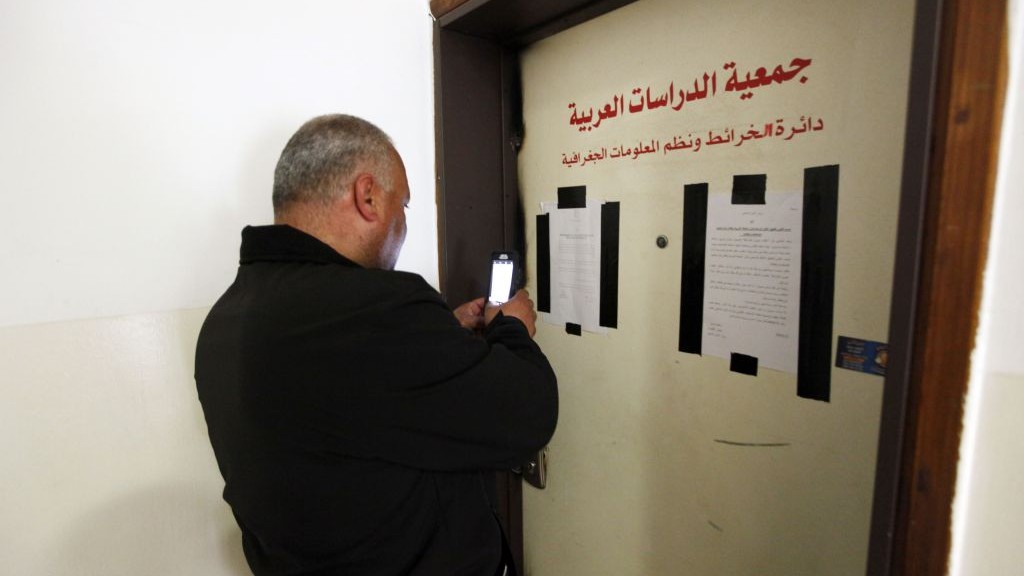
His statement said Tufagji’s office would remain closed for six months. But several hours later, Tufagji was freed and told The Associated Press that he would be permitted to reopen his office later this week.
“I proved that I have no direct connection with the Palestinian Authority. We are an NGO funded by foreign donors, not the Palestinian Authority,” he said.
Tufagji is a former peace negotiator and is considered the foremost Palestinian expert on Israeli settlement activity in the West Bank and East Jerusalem, areas claimed by the Palestinians for a future state.
He said he receives funding from Arab donors, though he shares his research, including a vast database on Israeli settlements, with Palestinian officials. He said he has no contact with Palestinian security forces.
Tuesday’s incident reflected the deep sensitivities on both sides over the status of East Jerusalem.
Israel captured East Jerusalem, home to Jewish, Christian and Muslim holy sites, in the 1967 Six Day War and annexed the area. It considers all of Jerusalem to be its capital. The Palestinians claim East Jerusalem as the capital of a future state. The conflicting claims lie at the core of the conflict and have at times spilled over into violence.
Following interim peace accords with the Palestinians in the 1990s, Israel allowed the Palestinian Authority, based in the West Bank, to have a limited presence in East Jerusalem.
But after the outbreak of the second Palestinian uprising in 2001, it banned the Palestinian Authority from carrying out any political activities in the city and closed the offices.
Tufagji’s arrest was the first of its kind, but over the years, Israel has enforced the ban in other ways, said Jawad Bulous, a Palestinian lawyer who defends such cases.
For instance, he said Israel has arrested a handful of Palestinian policemen who lived in East Jerusalem.
In 2005, Israel briefly detained a West Bank activist who was running in the Palestinian presidential election who tried to campaign in East Jerusalem, accusing him of illegally entering the city.
Copyright 2017 The Associated Press






The Times of Israel Community.