

 From the Liveblog of
Monday, November 23, 2026
Netanyahu accuses rivals of ‘minimizing’ security threats for political reasons, says danger is ‘immediate’
 Add ToI as a Preferred Source on Google
Ariela Karmel is a political correspondent at The Times of Israel. She previously reported for Calcalist and Haaretz. She holds an MA in Middle Eastern and African History from Tel Aviv University and a BA in Political Science from the University of British Columbia.
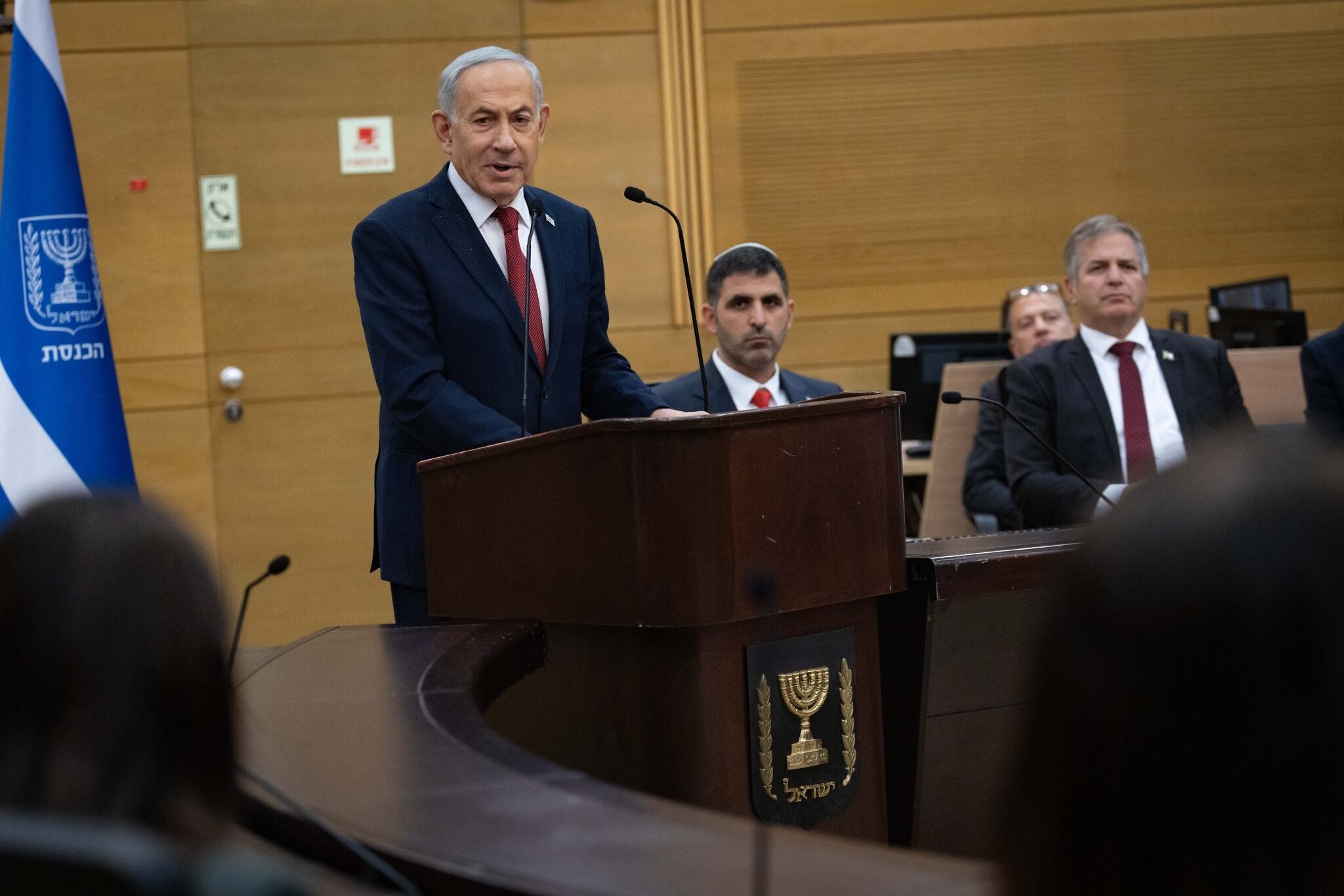
Prime Minister Benjamin Netanyahu accuses his political opponents of “minimizing” security threats facing Israel for political reasons and repeats his call for a unity government.
Netanyahu’s remarks, in a rare statement to the press ahead of Likud’s weekly faction meeting at the Knesset, come shortly after his rival Gadi Eisenkot said there was no immediate threat against Israel from Iran.
“Our ability to ensure the existence of the state against the great threats surrounding us depends on our unity,” he says. “Whoever derides, whoever minimizes these threats — those surrounding us that are immediate, tough and severe — is doing so for political reasons.”
The caretaker premier calls for a national unity government that includes the ultra-Orthodox parties, insisting that all sides must demonstrate flexibility on military conscription, which the ultra-Orthodox parties oppose and Eisenkot’s bloc favors.
“To bring about a national unity government, every side must show the flexibility needed to reach agreements, including on the issue of military conscription, where we must reach an agreement together with our ultra-Orthodox brothers. They must be part of the unity government,” Netanyahu says.
His Likud party is in the midst of negotiations with Eisenkot’s Yashar over forming a coalition, though little progress has been reported. Netanyahu’s previous calls for a unity government have demanded that his entire outgoing coalition remain part of the government, and that he remain prime minister.
In parallel, Netanyahu has made efforts to renew military action against Iran, which have reportedly been blocked by the IDF. Opponents have accused him of seeking another confrontation to delay the formation of a new government.
The premier, who does not take questions from reporters, reiterates his opposition to any government reliant on Arab-majority parties, accusing their lawmakers of supporting terrorism and claiming that such a government would be unable to confront Hamas or Iran.
“A Zionist government cannot be controlled by Ahmad Tibi, Ofer Cassif or their associates,” he says, naming lawmakers for the Arab-led Joint List, insisting that “a government that wants to fight for the future of the Jewish state cannot depend on those who want to destroy the Jewish state. This is not a matter of religion, race or gender. It is a matter of ideology.”
Netanyahu, whose outgoing coalition lost its majority in last month’s election, has sought to delegitimize the Arab parties and portray them as supporters of terrorism, amid efforts by Eisenkot’s bloc to assemble a coalition that could depend on their parliamentary support.




The Times of Israel Community.