

Presidential hopeful Perry says he wouldn’t keep Iran nuke deal
Despite not having announced candidacy, Texas governor talks of a hard hand with Tehran if elected
 Add ToI as a Preferred Source on Google
Stuart Winer is a breaking news editor at The Times of Israel.
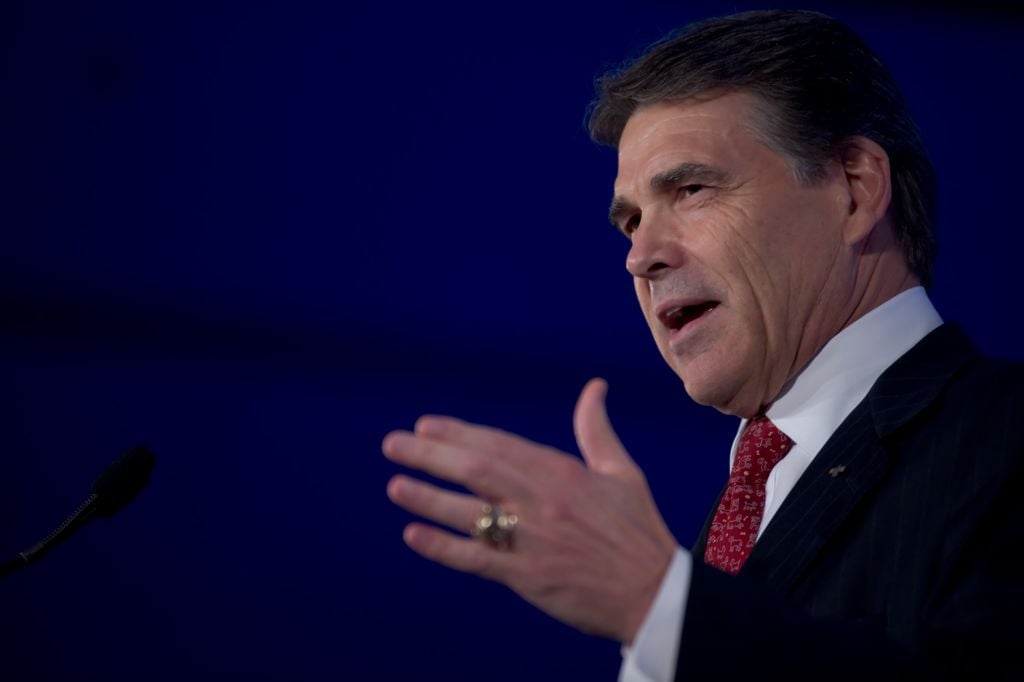
Prospective Republican presidential candidate Rick Perry said Monday that he would tear up the recently drafted nuclear deal with Iran should he be elected, and would instead up the pressure on Tehran — through tough economic measures and covert programs — to support local dissidents who oppose the regime.
During a speech to the Republican Society at South Carolina’s Citadel military college, Perry, who hasn’t formally thrown his hat into the ring, told cadets that the framework, which seeks to curb Iran’s ability to produce nukes, was more of a danger than a safeguard.
“Should I run for president, and be so fortunate to be elected, one of my first actions in office would be to invalidate the president’s Iran agreement, which jeopardizes the safety and security of the free world,” the Texas governor said of the deal that was unveiled earlier this month.
Speaking to reporters before the address, Perry explained that he would replace the deal with further sanctions to punish Iran’s economy and, if required, would resort to a military strike against Iranian nuclear strikes.
“The message needs to be: As soon as that election result comes in November of 2016, any agreement between the president of the United States and the Ayatollah is a worthless piece of paper,” he told the Bloomberg news agency.
“The Israelis have dealt with this twice, to take out their ability to use their nuclear facilities, and that certainly is an option that needs to be on the table,” he said, referring to Israeli strikes on the Iraqi reactor near Baghdad in 1981 and a purported Syrian nuclear site in 2007.
Perry said continued Iranian sponsorship of terror was blocking any progress and suggested that the US should flood international oil markets with crude oil to further hit Iran’s oil-industry-dependent economy.
Should he win the 2016 presidential race, Perry said he’d provision covert programs to support opposition groups and dissidents that oppose the Iranian government.
The governor also took a crack at former US secretary of state Hillary Clinton for — he claimed — not doing her job and failing to show more support for Israel during her term in office from 2009-2013.
“She’s either going to have to stand up and say ‘I was a complete and utter failure as secretary of state,’ or she’s going to have to take ownership of these issues,” Perry said. “Our oldest friend and most vibrant democracy in the Middle East, Israel, is being put in jeopardy and she was part of that.”
Clinton, who is also rumored to be considering a bid, but for the Democratic nomination, has not yet declared if she will join the race.
Florida Governor Jeb Bush — another potential Republican runner who said last December he would think about campaigning — has criticized the nuclear deal, but has not revealed what he would do about it if he were elected president.
“Nothing in the deal described by the administration this afternoon would justify lifting US and international sanctions, which were the product of many years of bipartisan effort,” Bush, the son and brother of former US presidents, said last week. “I cannot stand behind such a flawed agreement.”
The framework agreement reached last Thursday by US-led negotiators with Iran aims to cut significantly into Tehran’s bomb-making technology while giving Iran relief from international sanctions. The commitments, if implemented, would substantially pare down Iranian nuclear assets for a decade and restrict others for an additional five years. Iran would also be subject to intrusive international inspections.
Republicans have criticized the fact that the deal allows Iran to keep several thousand centrifuges, continue its research and development program and maintain a controversial underground laboratory at Fordo, a point of view also taken by Israeli officials who strongly condemned the agreement for being inadequate.








The Times of Israel Community.