ROME — Visitors to Rome’s Jewish Museum can now “walk” streets as they were before the ghetto neighborhood’s demolition in the 1880s.
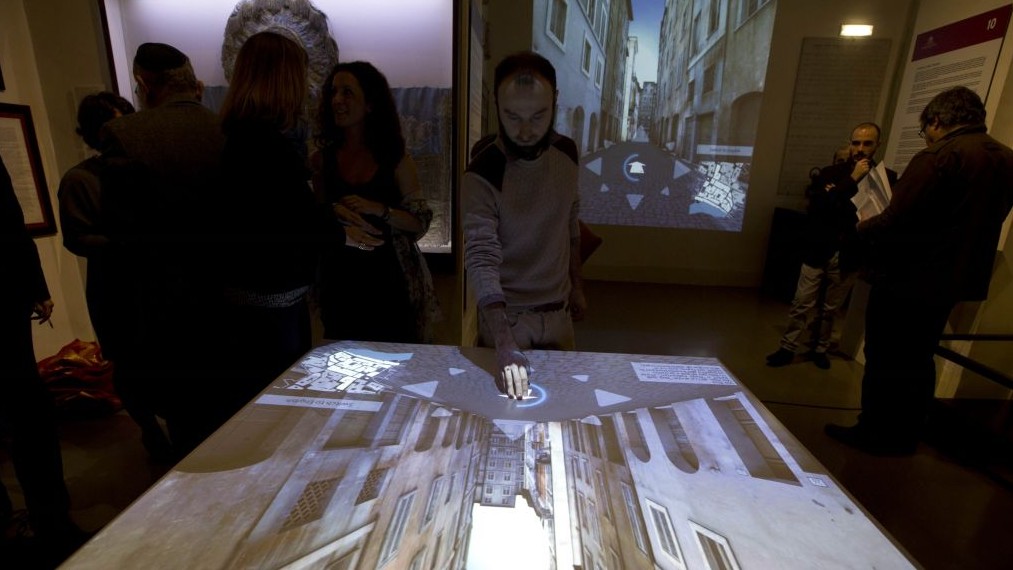
Tucked behind Rome’s main synagogue, the museum on Thursday evening unveiled an interactive table that enables people, with hand movements, to simulate strolling the Old Ghetto.
Researchers studied watercolor landscapes from the times, city property records as well as photographs taken before the district was demolished during Rome’s makeover to be modern Italy’s capital.
The neighborhood is home to one of the world’s longest continuously-inhabited Jewish communities. Sixteenth-century Pope Paul IV ordered Jews confined there; papal edicts enforced the Ghetto’s duration until the mid-18th century.
Many streets today look remarkably unchanged, but the interactive table shows how the Tiber lapped up against Ghetto buildings before river embankment construction.
Get The Times of Israel's Daily Edition
by email and never miss our top stories
By signing up, you agree to the
terms
Copyright 2014 The Associated Press
Help us report truthfully on social media

As a multimedia journalist, my job is to take the quality, fact-based journalism produced by The Times of Israel newsroom and make it accessible across every platform — from Instagram posts to podcasts to short-form videos.
This is how many, especially young people, consume news these days. But misinformation is rampant on social media. Our team at ToI produces accurate, responsible short-form reporting on Israel and the Jewish world.
If you believe in the importance of factual social media journalism, please consider joining our reader support group, The Times of Israel Community. Your financial support is essential to sustain responsible multimedia reporting.
— Gabriella Jacobs, multimedia journalist
Support our work
Support our work
Already a member? Sign in to stop seeing this
You're a dedicated reader

We’re really pleased that you’ve read X Times of Israel articles in the past month.
That’s why we started the Times of Israel - to provide discerning readers like you with must-read coverage of Israel and the Jewish world.
So now we have a request. Unlike other news outlets, we haven’t put up a paywall. But as the journalism we do is costly, we invite readers for whom The Times of Israel has become important to help support our work by joining The Times of Israel Community.
For as little as $6 a month you can help support our quality journalism while enjoying The Times of Israel AD-FREE, as well as accessing exclusive content available only to Times of Israel Community members.
Thank you,
David Horovitz, Founding Editor of The Times of Israel
Join Our Community
Join Our Community
Already a member? Sign in to stop seeing this


 Add ToI as a Preferred Source on Google