

At Knesset Diaspora caucus, much ado about nothing at all
MKs gather to profess concern about weakening ties with the Jewish world, but give little indication of concrete plans to do anything about it
 Add ToI as a Preferred Source on Google
Haviv Rettig Gur is The Times of Israel's senior analyst.
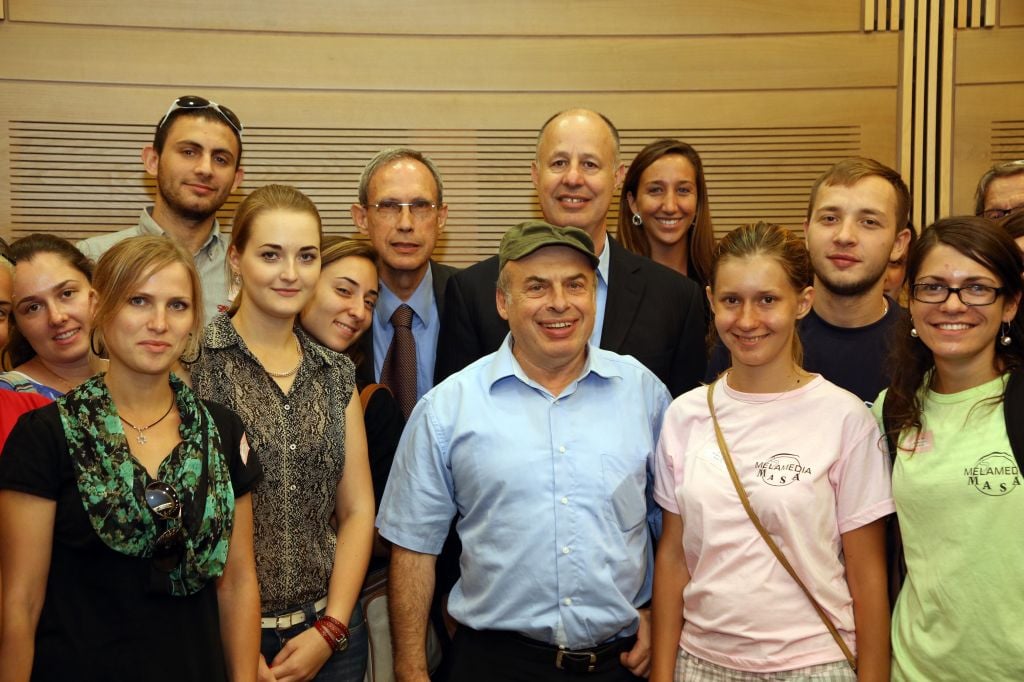
A dozen MKs announced the relaunch of the Knesset Caucus for the Strengthening of the Jewish People on Monday in a packed auditorium in the parliament’s eastern Committees Wing.
By doing so, the MKs raised the issue of Israel-diaspora relations at least to the level of 109 other caucuses in the 19th Knesset – nearly one per MK — most of them of dubious value or influence.
Even so, the “Jewish people” caucus enjoys a rare, undeniable advantage: wall-to-wall support among Jewish MKs that was clearly demonstrated by a congratulatory letter cosigned by Prime Minister Benjamin Netanyahu and opposition chair Shelly Yachimovich. Netanyahu and Yachimovich themselves acknowledged in the letter that there are few things to which they would lend their support in such a joint fashion.
Yet for all the goodwill and broad agreement that “strengthening the Jewish people” was a noble endeavor, the event was almost completely devoid of content, even, one must add, for a Knesset caucus.
For an hour and a half on Monday afternoon, key figures in what passes for Israel’s diaspora policymaking community spoke about the importance of Israel’s ties with world Jewry and, depressingly, about the need for a “new paradigm” that no longer views the diaspora as “a wallet.”
“We’ve always looked at diaspora Jewry as a wallet and a pool of [potential] immigrants,” chastised Economy and Trade Minister Naftali Bennett (Jewish Home), who also serves as diaspora minister in the current government. Both of those contributions were important at the founding of the state, he said, “but the situation has changed. Israel is no longer weak, no longer needy. So it’s time to speak openly about this — a large part of the Jewish people will remain in the diaspora, and that’s okay.”
“We must build a new relationship, one of reciprocity,” said caucus co-chair MK Nachman Shai (Labor), and called for the Knesset to welcome into its halls Jewish leaders and tour groups on their visits to Israel.
“Don’t ask what diaspora Jewry can do for us, but what we can do for diaspora Jewry,” said MK Tzachi Hanegbi (Likud), echoing former US president John Kennedy.
That was it. For an hour and a half, the discussion consisted almost entirely of a long succession of MKs and ministers professing the same intellectual awakening, the same discovery that the diaspora, which largely resides in modern Western states, is unlikely to commit a mass exodus to Israel, and that Israel is no longer dependent on diaspora funds or immigration for its survival, that a “new phase” had begun and a “new paradigm” was needed.
That would have been a welcome awakening, of course, had the event taken place 11 years ago, when then-prime minister Ariel Sharon said similar things, or seven years ago when Sharon’s successor Ehud Olmert declared a “new paradigm” in Israel’s relationship with the diaspora.
One imagines a caucus dealing with Israeli security offering similar admissions — in 2013 — that there is an Iranian nuclear program, or a conflict with the Palestinians, or that the cost of living is high. It would be hard to take such talk seriously.
To be sure, there was one idea offered at the caucus that has already proven its value: diaspora Jews’ visits to Israel. The caucus was founded at the initiative of the Jewish Agency, which in the last few years has rebuilt and retooled itself into an organization that invests massively — hundreds of millions of dollars each year — in a broad spectrum of “Israel experience” programs. Every benefit Israel might seek from the diaspora, whether immigration, advocacy, philanthropy, tourism, Jewish continuity or any other, will be strengthened by increasing the number of Jews who visit and experience Israel and Israelis, the agency has argued. (Full disclosure: This writer was the agency’s spokesman during that restructuring.)
The idea has had its defenders and detractors, but at the very least it has the merit of being a clear, specific policy idea for strengthening the Jewish people.
Yet even Jewish Agency chairman (and former diaspora minister) Natan Sharansky, who alone among Israeli leaders has actually developed and implemented a rethinking and re-funding of the Israel-diaspora relationship, used his speech before the caucus to insist that the desire for more immigration to Israel did not contradict the desire for thriving communities abroad, that aliyah did not mean the shuttering of Jewish life abroad, and in fact only increased as communities grew stronger. It was a good point, borne out by studies, but it was also an old point that Sharansky has been making for at least five years.
The Jewish Agency, like any other nonprofit in the Jewish world, has a responsibility to focus on its narrow mission. But the Knesset has the opposite duty; it is tasked with finding and implementing solutions to the entire spectrum of the Jewish people’s challenges.
MKs used the caucus launch to proclaim their distress at the weakening of ties between Israel and the diaspora, but seemed lost when it came to solutions.
“The ties are weakening,” MK Nachman Shai lamented, and offered in response that the Knesset serve as a tourist destination.
The diaspora ministry “is working on multiple tracks,” said Bennett, and promised “to bring the voice of diaspora Jewry to the Knesset.”
That last promise led some in the room to the startling realization that there were no spokespeople for diaspora communities at the launch of a caucus to “strengthen the Jewish people.” What would one make of a gay rights caucus without gays, or a disabled rights caucus without a single wheelchair in the room?
If the Jewish people is falling apart, as some MKs claimed, and Israel should bear a larger part of the burden of sustaining it, as others demanded, it may be time to start demanding more from MKs who feign so much concern.
Contrary to the impression offered by Monday’s caucus launch, the Knesset is a powerful institution. It wields a vast budget, can change the structures and missions of powerful agencies almost at will, has access to Israel’s finest experts on every subject, and retains ultimate oversight over every institution of the state. When it seeks to effect change within Israeli society, it has proven itself capable of finding and implementing solutions to some of Israeli society’s most challenging ills.
The challenges are equally massive in the broader Jewish world: the Jewish people is divided into mutually unintelligible cultural worlds; many Jewish communities face widespread poverty, few Jewish educational opportunities and declining rates of identification, and more.
The state of Israel has not completely ignored these problems. The Prime Minister’s Office, starting with Sharon and continuing with Olmert and Netanyahu, has invested many tens of millions of dollars over the past decade in programs such as Birthright and Masa.
But none of that work went through the Knesset, where MKs remain deeply committed to the “Jewish people” writ large but blissfully ignorant of the tough challenges that face world Jewry — or their solutions.
Instead of a discussion about new educational programs, new funding or the start of serious talks with the rabbis, educators and leaders of diaspora communities, MKs could only applaud on Monday their own discovery that the diaspora is a subject worthy of discussion.
Forty MKs have joined the Caucus for the Strengthening of the Jewish People in the 19th Knesset, but no one in attendance on Monday could offer a compelling reason why.







The Times of Israel Community.