

Children in isolated Gaza get tablets from UN agency to connect with the world
European Union-funded project aims at boosting students’ computer skills, to help them find tech jobs in the future
 Add ToI as a Preferred Source on Google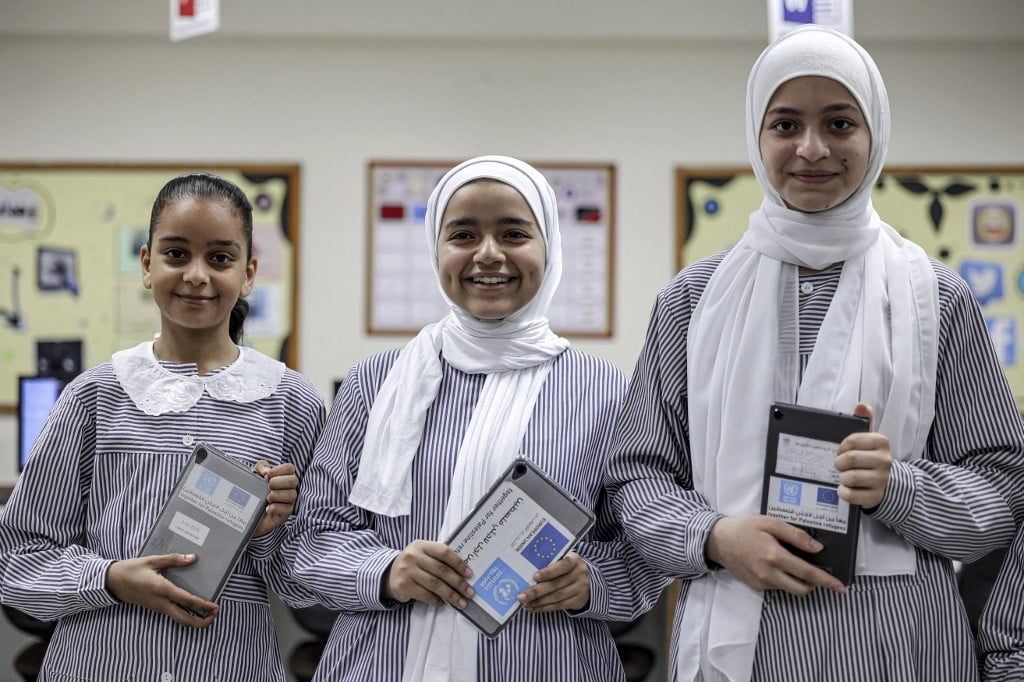
The United Nations said Wednesday it was helping connect Palestinian children in the blockaded Gaza Strip to the outside world by distributing tablets to hundreds of pupils.
Children make up nearly half of Gaza’s population of 2.3 million. Most of them have never been able to leave the coastal territory, whose Hamas rulers openly seek Israel’s destruction.
Some 890 tablets are being handed out this week at schools run by UNRWA, the UN agency for Palestinian refugees and their descendants, following a pilot that saw a few dozen devices given to children last year.
“We’re very conscious that for children as they grow, they’re going to have to be able to engage with an increasingly digitalized world,” Thomas White, the agency’s Gaza director, told AFP.
According to the Palestinian Central Bureau of Statistics, the 15-year blockade of the enclave by Israel and Egypt has crippled Gaza’s economy, leaving 74 percent of young graduates unemployed. Israel says the blockade is needed to prevent the Iran-backed Hamas, which seized control of the territory in 2007 from the Palestinian Authority in a bloody coup, from freely arming itself.
UNRWA sees the European Union-funded project to boost children’s computer skills as a way to increase their chances of getting a job in the growing tech sector, either locally or remotely.
This could “provide opportunities for young Gazans to make an income and get ahead,” White said, standing in a schoolyard in Gaza City.
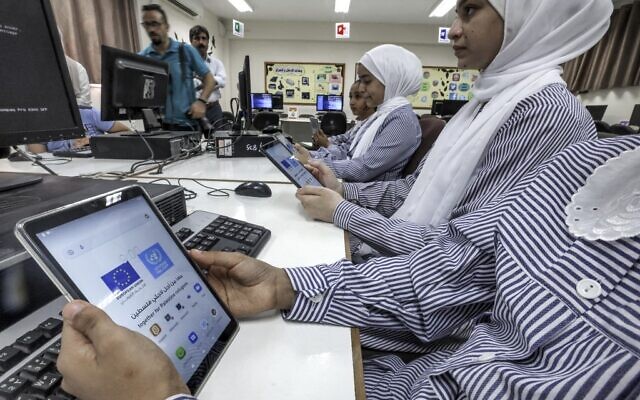
The project could help young Gazans go into coding, providing back office IT support for companies or customer support online, he added.
But Gazans still have to contend with frequent power cuts and internet access limited to 2G.
Thirteen-year-old Salma Shamiah was among those to receive a new tablet, after excelling at a tech summer school.
“I hope to learn programming in the future and have a programming company in Gaza,” she said in a classroom filled with computers. “I feel that Gaza is behind in programming. I expect in the future programming will be dominant in the world and we will do useful and beautiful things.”










The Times of Israel Community.