

Connecticut Jews mark 175 years of religious freedom amid revived anti-Semitism
The progressive state was no bastion of tolerance for its first 200 years. Even today, bigotry is on the rise at twice the national rate
 Add ToI as a Preferred Source on Google
Reporter at The Times of Israel
HARTFORD, Connecticut — Regarding religion, Connecticut has lived up to its sobriquet “the land of steady habits.” For its first 200 years, the small state remained a theocracy amid its more liberal-leaning neighbors.
“When you think of Touro Synagogue established in the 1700s in Rhode Island, you realize Connecticut was very slow in recognizing freedom of religion. It just was not progressive. New York and New York City recognized Jews early on and so did Rhode Island,” said Mary Donohue, assistant publisher of Connecticut Explored Magazine.
Although the US Constitution was clear, “Congress shall make no law respecting an establishment of religion, or prohibiting the free exercise thereof,” it was silent on whether states could have a state sponsored religion. Thus Connecticut established the Congregational Church as its official religion and denied other Christian sects and Jews legal standing as organizations.
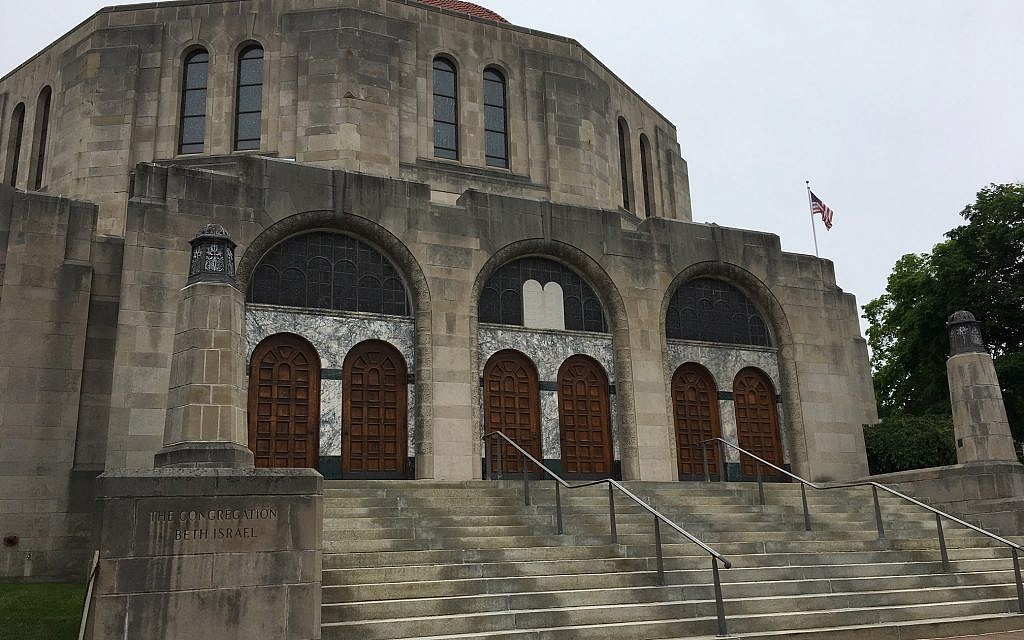
This month, the state celebrated both the 175th anniversary of religious freedom and its oldest synagogue, Congregation Beth Israel. The twin events commemorate a turning point in the state’s journey to becoming one of the most progressive in the nation.
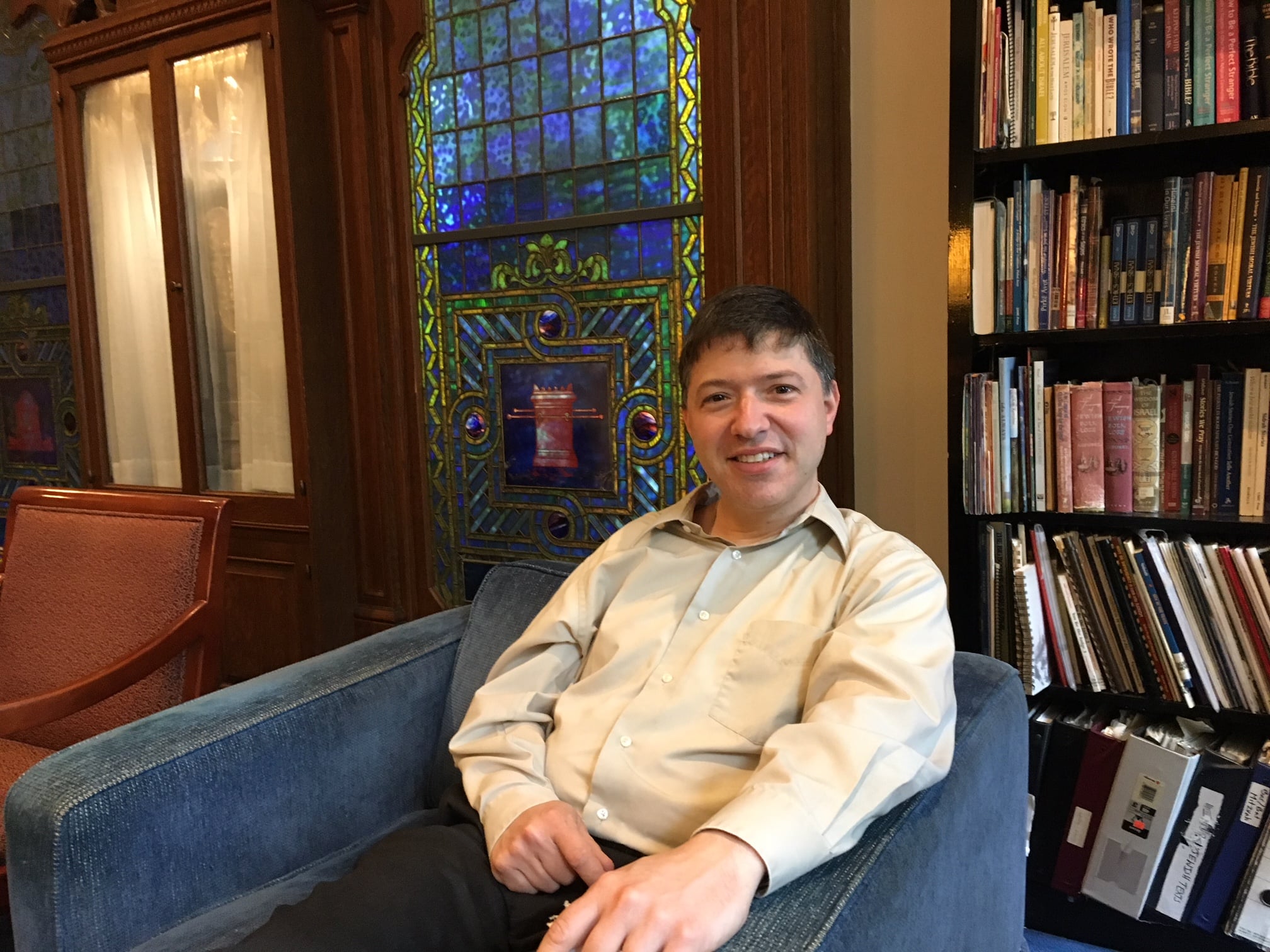
“I grew up in New Jersey and always thought Connecticut was the most progressive state in the Union. This tidbit of historical trivia is not widely known, I was blown away when I heard about it. You sort of take it [religious freedom] for granted,” said Michael Pincus, Beth Israel’s senior rabbi.
A wing and a prayer
The state took its first tentative steps toward religious freedom in 1816 with the formation of the Toleration Party. The state’s Episcopalians, Methodists, Quakers and Baptists banded together, intent on disestablishing the Congregational Church, which was the state’s official religion.
“They were irked they had to pay taxes to support the church and wanted all religious sects to be allowed to practice freely,” Donohue said.
Just as the state legislature was poised to pass the law, two lawmakers insisted the word Christian be inserted in the text so only “all Christian sects” would be allowed that freedom, she said.
“It was done to deliberately exclude Jews. It’s something that’s hard to fathom now,” Donohue said.
Consequently, Jews, who had lived in the state since 1659 and could hold public office, remained barred from public Jewish worship. They were forced to continue gathering in private homes to pray, to wed, to become a bar mitzvah. Additionally, because they couldn’t legally own property as a congregation, Jewish cemeteries were forbidden.
And so it went for more than three decades. Until 1843.
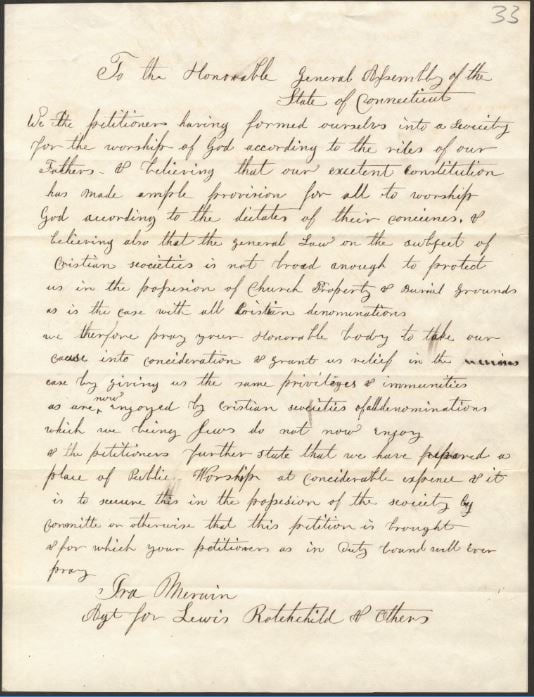
The then three-year-old Congregation Mishkan Israel of New Haven, whose members worshiped in a room above the Heller and Mandelbaum store, petitioned the General Assembly to buy land for a cemetery.
Their point man was a newly arrived immigrant, Louis Rothschild. Hailing from Bavaria, Rothschild wrote the petition on behalf of the congregation. A local resident, Ira Merwin, signed on as a gentile agent to improve its chances of passing, Donohue said.
“The Petition of Louis Rothschild and Others for Certain Religious Privileges” asked the General Assembly to “take our cause into consideration and grant us relief in this case by giving us the same privileges and immunities as are now enjoyed by Christian societies of all denominations, which we, being Jews, do not now enjoy.”
The congregation prevailed, and its cemetery remains in use today. However, a storefront does not a synagogue make, at least according to the state, and Mishkan Israel did not earn official status at that time.
Simultaneously, 38 miles away in Hartford, German-Jewish immigrants were busy founding the Orthodox Congregation Beth Israel.
For years they had met in congregants’ homes until construction on their synagogue was complete. With the help of a $5,000 gift from Rhode Island philanthropist Judah Touro, the synagogue finally opened its doors in 1843.
An island of inclusivity
In 1877 the Orthodox congregation changed course and became a founding member of the Reform movement, remaining a Reform synagogue to this day.
Pincus spoke about how the synagogue’s own path to increasing inclusivity is rooted in the anniversary.
“The synagogue is a reflection that Jewish life has changed in the state. We had the first female rabbi in the state, and the first openly gay rabbi in the state,” Pincus said, sitting in front of a deep blue and emerald green stained-glass ark taken from the synagogue’s original building.
The former, Judy Cohen, was appointed in 1984; the latter, Elissa Sachs-Kohen, in 1999.
Congregation Beth Israel now sits in West Hartford. It was listed on US national register of historic places in 1995, and has received the proclamation from the State of Connecticut for being the state’s oldest synagogue.
Today Connecticut’s 117,000 Jews have about 100 Jewish houses of worship to choose from, running the gamut from Reform to Chabad. But while the number of other religious groups has also grown, the state remains solidly Protestant.
According to the Pew Research Center, Protestants comprise 70 percent of the state’s population, Catholics 33%, and non-Christian faiths, including Jews, Muslim, Buddhist and Hindu account for 7%.
A ways to go
“On the one hand we have more religions freedom in our state. There are more Muslims, more Hindus and more Buddhists. There are signs of increasing religious tolerance if not acceptance in all sorts of places,” said Terry Schmitt, executive director of the Connecticut Council for Interreligious Understanding.
“On the other hand, there is a backlash,” he said. “There are hate groups on the ascendancy in the state and the national conversation has moved in the direction of intolerance.”
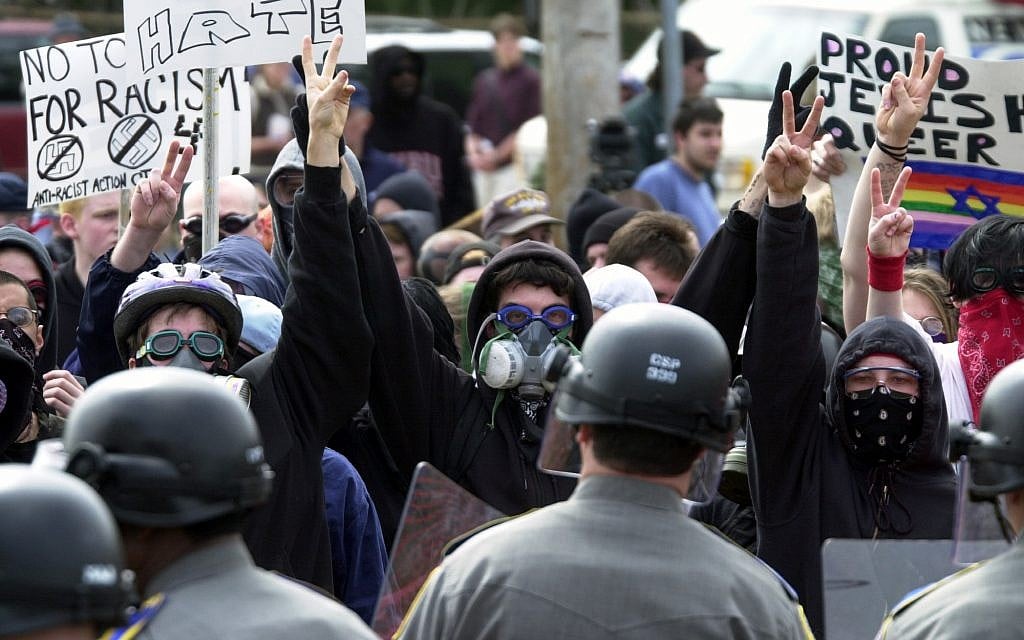
In this way, the anniversary serves as a sober reminder about the continued need for interfaith dialogue and tolerance, said Schmitt, who is also a minister for the Third Congregationalist Church.
Pincus concurred.
“People of different faiths… have more in common than we do differences. More than ever we are speaking with one voice about what is and what is not acceptable. If any religious faith is being persecuted it’s a threat to all of us,” Pincus said.
Connecticut now has the some of the strongest hate crime legislation in the nation: committing a hate crime is now a felony instead of a misdemeanor. Yet, Connecticut has seen a sharp rise in anti-Semitic crimes, according to the Anti-Defamation League. There has been a 68% rise in anti-Semitic crime from 2015 to 2017 in the state, compared with a 34% rise nationally for the same period.
“The reality is we can pass laws and give people legitimacy. But that’s different than society giving people social legitimacy. In this case the law far outpaced the acceptance of a people,” Schmitt said.









The Times of Israel Community.