

Defense minister slams ‘extortion’ by ultra-Orthodox over conscription bill
As ministers scramble to reach agreement and avoid early elections, Avigdor Liberman insists ‘we don’t compromise’ on national defense, but doesn’t say he’ll veto bill
 Add ToI as a Preferred Source on Google
Defense Minister Avigdor Liberman lashed out at ultra-Orthodox lawmakers on Friday, dismissing as “extortion” their demand to pass a law exempting religious seminary students from the military draft.
“The ultimatum to have ‘either a draft bill or a [2019] budget bill’ was made by the Haredi parties,” Liberman said in a Facebook post. “The ultimatum of ‘either the draft bill passes in its second and third readings in March, or the government is disbanded’ was also made by the Haredi parties. The bill now being negotiated is not a compromise, but a surrender to this extortion.
“Anyone who wants to surrender to extortion, go ahead and surrender. Yisrael Beytenu will only support a bill put together by the defense establishment and the Israel Defense Forces. When it comes to security, we don’t compromise,” said Liberman.
Liberman was referring to a compromise bill being hammered out by the ultra-Orthodox parties and Jewish Home leaders Education Minister Naftali Bennett and Justice Minister Ayelet Shaked.
The content of the compromise bill is not yet clear, but it appears to reduce any sanctions against draft-dodging dramatically and to allow near-automatic granting of draft exemptions to ultra-Orthodox seminary students.
The compromise bill is set to be raised in the Ministerial Committee for Legislation on Sunday, which meets after the weekly morning cabinet meeting.
Prime Minister Benjamin Netanyahu, who returned to Israel on Friday after spending much of the past week in the US, may decide by the Sunday cabinet meeting to seek to preserve his current government and try to reach a compromise, or to go to early elections.
Crucially, coalition sources noted on Friday that in several statements made by Liberman on Thursday and Friday, he never said he would veto a government-backed compromise bill, even if he insisted his party would not support it. That means the coalition may be able to push through the bill, though any vote is likely to be close.
The crisis began when ultra-Orthodox MKs from the United Torah Judaism party announced last week they would not support the 2019 budget bill unless the coalition pushed through a law that would ensure ultra-Orthodox seminary students were automatically exempted from military service.
On Thursday, Liberman said in a statement to the press that Israel was being “held hostage by a group of extremists.” He emphasized that “I do not want elections, but I will not give up on our principles.
“We will not conduct negotiations [on the draft law] with a gun to our head,” he said.
Liberman has long demanded that any military draft law be rooted in the needs of the military. He reiterated that demand on Thursday, saying a special committee in his ministry will prepare “the best version of the law for the Israel Defense Forces and the people of Israel. Let it work!”
But by the evening, coalition sources said that Liberman had signaled a willingness to consider letting the UTJ bill — or at least a compromise version of it — move ahead to the first of three votes in the Knesset.
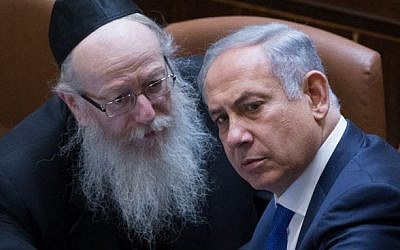
The decision Thursday by Justice Minister Shaked to place the compromise bill on the ministerial committee’s agenda sets out a preliminary timeline for resolving the crisis — if the parties wish to do so. A Haredi-backed bill could receive government support on Sunday afternoon, get a first vote in the plenum early next week, then go to committee — where a compromise version might be hammered out, and voted on, before the Knesset goes on its spring recess at the end of next week.
For his part, Netanyahu said Wednesday he is not seeking elections, but a fresh vote will be held if coalition parties can’t agree on the legislation and commit to avoid infighting over the next year and a half. Laying out his conditions for avoiding elections, Netanyahu said any bill on ultra-Orthodox enlistment must be backed by the entire coalition and must provide a long-term solution to the issue.







The Times of Israel Community.