

Despite inflamatory pro-BDS speech, British MP says he supports Israel
Conservative Alan Duncan explains why settlement support is ‘a form of extremism’ akin to racism, sexism, homophobia, and anti-Semitism
 Add ToI as a Preferred Source on Google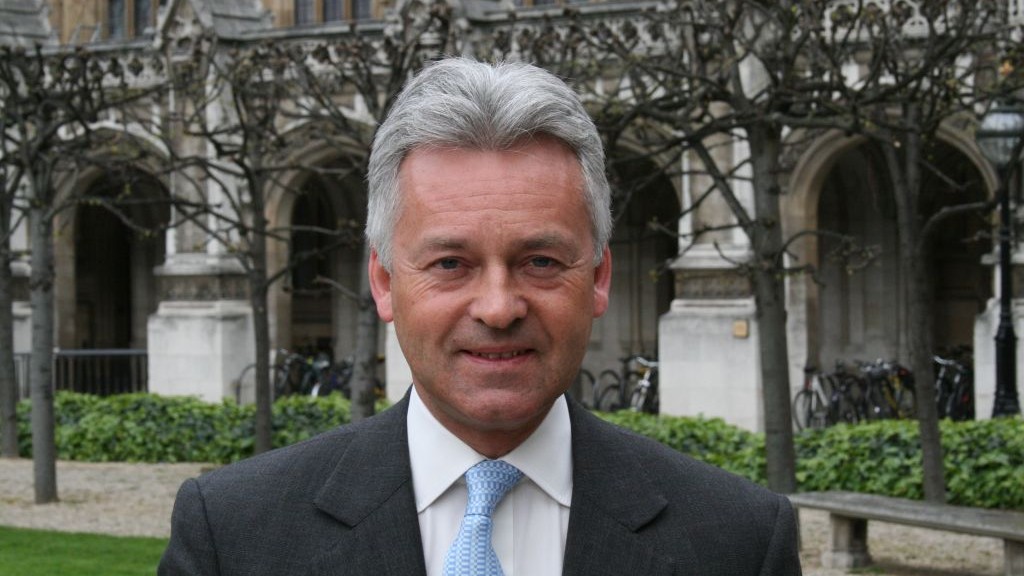
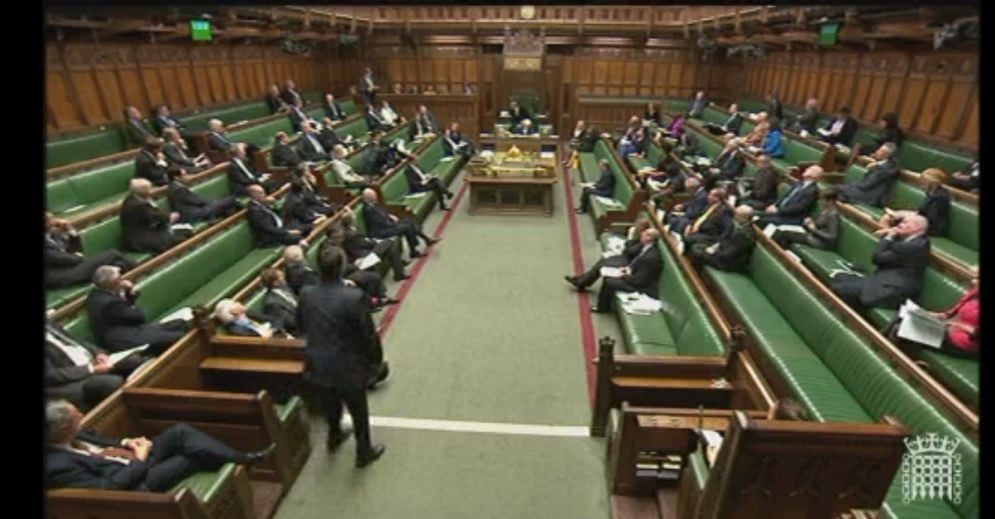
LONDON – The October 13 British Parliament vote to recognize Palestinian statehood, though non-binding, was of tremendous symbolic significance as part of a European sea-change to the Israeli-Palestinian question.
Frustrated with what they call Israeli Prime Minister Benjamin Netanyahu’s intransigence and myopia, European governments have decided that if negotiations between Israel and the Palestinian Authority continue to prove fruitless, Europe will have to play an active part in the peace process. Recognition of a Palestinian state would be one component; the labeling or even boycotting of settlement products could be next.
“I think it’s a gradual thing,” Sir Alan Duncan, the Conservative MP for Rutland and Melton and former Minister of State for International Development, told The Times of Israel this month, when asked what effect the Parliament vote may have. “It was non-binding but it did matter because it was the first time there’d been an expression of opinion of any sort” in Parliament on Palestinian statehood, he said.
I met Duncan at his office in the Houses of Parliament, where the muted television in the corner was tuned to al-Jazeera.
“I’ve taken an interest in the region for over 30 years and I’m a very strong supporter of Israel but want to see it behave in a way that is democratic and does not put its own interests at risk,” Duncan said. “I feel strongly about issues of justice and justice for Palestinians is very important.
“So, this has been brewing in my mind for many, many years. One of the things about being a minister is that you get constrained in what you can say, so having chosen to stop being a minister in the summer, I thought about this for a few months and gave the speech I’ve always wanted to give,” he said.
Unrestrained, in his address Duncan described the situation in Hebron today as “apartheid” and settlement endorsement as “a form of extremism” akin to racism, sexism, homophobia, and anti-Semitism.

“No settlement endorser should be considered fit to stand for election, remain a member of a mainstream political party, or sit in a Parliament,” he recommended. (A settlement endorser, Duncan told me, is someone “who thinks that settlements are acceptable.”)
The day after the mid-October vote in the Commons, Duncan gave an address to the Royal United Services Institute (RUSI) thinktank.
“Israeli settlements are the worst, most destructive, aspect of the military occupation,” he said in the speech. “This illegal construction and habitation is theft, it is annexation, it is a land grab – it is any expression that accurately describes the encroachment which takes from someone else something that is not rightfully owned by the taker.”
Does he not acknowledge, though, that while all settlements are illegal, some as less immoral than others? What of Gush Etzion, for example?
‘There’s no point in trying to rank settlements on a scale of wrongness’
“Not all settlements are the same,” he said. “But there’s no point in trying to rank settlements on a scale of wrongness. The fact is the broad policy of building in someone else’s land is wrong and that is where the focus needs to rest.”
Israel, he said, does not have a legitimate historical or national claim to the land some Israelis refer to as Judea and Samaria.
“They have a total claim to what they have in international law, which is the State of Israel up to the 1967 lines.”
Does an Israeli Jew not even have a theoretical right to live in Hebron?
“Anyone can live in Hebron but it is not Israel. They may have to subject themselves eventually to the law of the Palestinian state.”
Some of Duncan’s most controversial remarks, however, have concerned the British Jewish community and the influence of the Israeli lobby.
‘Jewish representative organizations are not obliged to, and nor should they, stand up for the illegal and excessive conduct of the Israeli government’
“When some British Jewish organizations unreasonably accuse people of anti-Semitism, more often than not as a diversion from the actual issues in question, they do a disservice to the necessary and valid fight against anti-Semitism,” Duncan told RUSI. “Jewish representative organizations are not obliged to, and nor should they, stand up for the illegal and excessive conduct of the Israeli government.”
Duncan’s speech to the RUSI and remarks to the BBC were condemned by the Board of Deputies of British Jews. Vice President of the Board Jonathan Arkush said in part:
“Alan Duncan attacked the British Jewish community for defending Israel. He characterizes defending Israel as equivalent to accusing people of wanting Israel’s destruction or being anti-Semitic. This is a blatantly false allegation against the leadership bodies of the British Jewish community. It is a poisonous slur which should be retracted immediately.”
“It wasn’t very clever,” Duncan said of the Board’s statement. “You should see the letters I’ve got from Jewish people in the UK objecting to the Board of Deputies for the nastiness of their reaction. They didn’t think it was sufficiently thoughtful or well-reasoned and indeed a lot of them confirmed by argument that, as soon as you express a view that’s critical of Israel or the conduct of Israel, you are accused of anti-Semitism when it doesn’t exist and that is exactly what happened. So they did a very good point in proving my point.”
On the day of the vote in Parliament on Palestinian statehood, in an interview for BBC Radio 4’s The World at One, Duncan referred to the United States as being dominated by “a very powerful financial lobby,” when he was asked by the presenter why such a vote was needed.
Although Duncan declined to name specific institutions he objected to, he told me, “Anyone’s entitled to say that the British government should have a particular attitude to Palestine or Israel, but it should be clearly decoupled from any kind of funding and any kind of political support in the UK should be British-based, focused primarily on the politics of the UK.”
Ahead of the vote, however, Duncan accused the Conservative Friends of Israel (CFI) of “opting out of the argument” by recommending its members abstain. Of the point made by ex-foreign secretary Sir Malcolm Rifkind, Conservative MP for Kensington, that one cannot recognize a state that does not exist, Duncan called it a “non-argument,” saying “something does not have to be in perfect working order in order to be recognized. It was an attempt to argue against a Palestinian state by saying this isn’t quite the time.”
But Duncan doesn’t think the CFI has an undue hold over the Conservative Party.
“There’s a weaker voice on the Palestinian side because it is not organized in the same way. But the CFI has become much less persuasive amongst Conservative MPs than it used to be. Over the last few years people have taken a deeper interest in the issue and have reached their own conclusions through their own thinking and it doesn’t necessarily fit totally with arguments put by the CFI,” he said.
‘People have felt intimidated in the past about saying what they think. There is a shifting mood and it’s certainly a significant broad shift in public opinion in many countries’
“People have felt intimidated in the past about saying what they think. There is a shifting mood and it’s certainly a significant broad shift in public opinion in many countries.”
Have people felt intimated about speaking out in the past because of the Board of Deputies?
“Quite a lot of Jewish people wrote to me and said, ‘Thank you for making that speech. I agree with you and if I were to say so, people would sneer at me in the synagogue or in my community and yet I believe what you said was absolutely right and it’s not in the interests of Israel and more of us need to say that.’ It was a very interesting reaction.”
The window has not closed on the two-state solution, Duncan believes, but the British and Americans governments, in the next couple of years as President Barack Obama’s term in office draws to a close, have to be prepared to be “more vociferous” about the first principle that settlements are “a serious obstacle to peace.”
“Possession is nine-tenths of the law and the abandonment of something you think you own, and particularly live in, is very difficult. Of course, nothing is irreversible but they are very difficult to reverse and the more of them there are, and the deeper they eat into the integrity of the future Palestine’s borders, the worse it is for the prospects of peace.”







The Times of Israel Community.