

Madness in Egypt makes headlines in Israel
The Hebrew press tries to make sense of the upheaval in Cairo, but all bets are off as to whether Morsi will survive
 Add ToI as a Preferred Source on Google
Ilan Ben Zion is an AFP reporter and a former news editor at The Times of Israel.
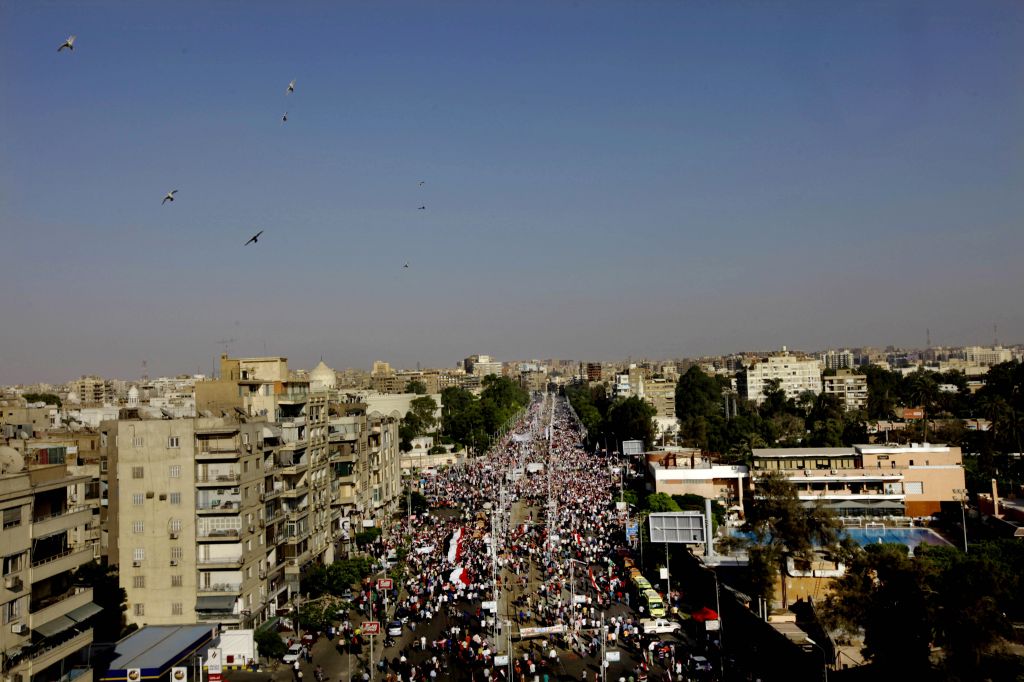
What could possibly fill the front pages of the Hebrew papers but the millions of Egyptians who took to the streets of Cairo to protest against President Mohammed Morsi and call for his resignation a year after he took office? Official Egyptian estimates soared to a walloping 3 million demonstrators, only a small portion of whom were journalists reporting for Israeli papers.
One thing that is clear from Monday’s coverage is the Hebrew media’s heavy reliance on foreign media outlets for its reportage. Yedioth Ahronoth publishes a translated CNN report; each of the other big three Hebrew newspapers plucked most of their information from Arabic or British news sources.
Haaretz lowballs the estimated attendance, saying that only 1 million took to the streets, 200,000 of whom gathered in Cairo’s Tahrir Square to call for Morsi’s ouster. Their message, promulgated foremost by the Tamrod movement, was simple, the paper writes: “No more Morsi, we want elections now,” and they were willing to stay in the streets until they got it. It also reports that a large group of former police officers and former interior ministers lent their support to the opposition and joined the protests in Tahrir Square.
Maariv devotes a paltry six paragraphs to what has been unanimously called the largest protest in modern Egyptian history. It reports that Morsi is trying to use Defense Minister Abdel-Fattah el-Sissi as a foil against the opposition, because of the latter’s popularity. El-Sissi denounced the use of violence by the Egyptian authorities against protesters during the uprising against Hosni Mubarak two years ago. The paper writes that Morsi may make El-Sissi prime minister in a bid to calm the streets and appeal to the opposition.
“In the meantime, it appeals as though Morsi’s solution has no support in the opposition, which insists on his resignation and an end to Muslim Brotherhood rule,” the paper reports.
Israel Hayom quotes an Egyptian military source’s criticism of Morsi and El-Sissi to Al Arabiya. “The army is ready and prepared for any development because the police is completely dysfunctional and many police officers are not dealing with policing, and are rather participating in the protests,” he said.
He said that the officers policing Cairo’s streets were “unarmed army and defense establishment forces.”
Boaz Bismuth writes in the paper that Tahrir Square is Egypt’s true parliament and “that is where no-confidence votes are held against the president.”
“The demonstrators last night represented a new demographic that would have been unimaginable only a year ago: the liberal youth,” he says. “The youth who saw the Muslim Brotherhood join in the January 2011 protests have allied with the remnants of the Mubarak regime and its supporters to topple Morsi.”
Although violence has been relatively low until now, Bismuth warns that “one spark could ignite the entire country.”
Yedioth’s columnist Smadar Peri writes that despite Morsi’s confidence, and that of Israeli analysts, that he’ll stay in power, the facts on the ground are far from pointing in that direction. She says that in the face of the massive social pressures against him, “Morsi has no magic solution. Fortunately for him, he also doesn’t have a replacement in the opposition camp.” He’s in a damned-if-you-do-damned-if-you-don’t situation where he can’t strike out against the protesters, but if he doesn’t he will also fall, she says.
Haaretz’s Zvi Barel comes to Morsi’s defense, noting that the president was democratically elected and “admitted to his mistakes during his rather dull speech late Wednesday night.”
“[Morsi] is also right in saying that if the public is not satisfied with his performance it should replace him the same way it appointed him — through democratic elections slated in three years. Those who purport to speak for the revolution’s principles cannot, says Morsi, act contrary to those very same principles,” he writes.
He points out that anti-Morsi demonstrators “have already taken an irreversible step” in demanding his resignation as their sole aim. “Anything less than Morsi’s resignation will be considered ‘a failure of the revolution,'” he writes. “Hopefully the number of dead in Tahrir Square or the Nasser neighborhood will not determine Egypt’s next political move.”
Ben Dror Yemini takes the opportunity to write a scathing tirade against the Muslim and Arab world which culminates with some foreign policy advice for the United States and the West. “Speak to the Muslim and Arab world at eye level. Relate to the Muslims as you would to a person and not to demeaning caricatures. It’s essential, of course, to tell them the truth: You are to blame for your circumstances. Stop blaming the whole world, the West, capitalism, and the Jews.
“So long as you continue deceiving yourselves, so long as you don’t understand that equality, basic rights, patience and tolerance, and women’s rights are not ‘Western values’ but universal values, you will not have any change,” he writes, and calls for an end to monetary aid to the Arab world until such change is enacted.









The Times of Israel Community.