

North Korea may have displayed new ICBM, analysts say
At grandiose military parade in Pyongyang, four huge green missiles catch the attention of weapons specialists
 Add ToI as a Preferred Source on Google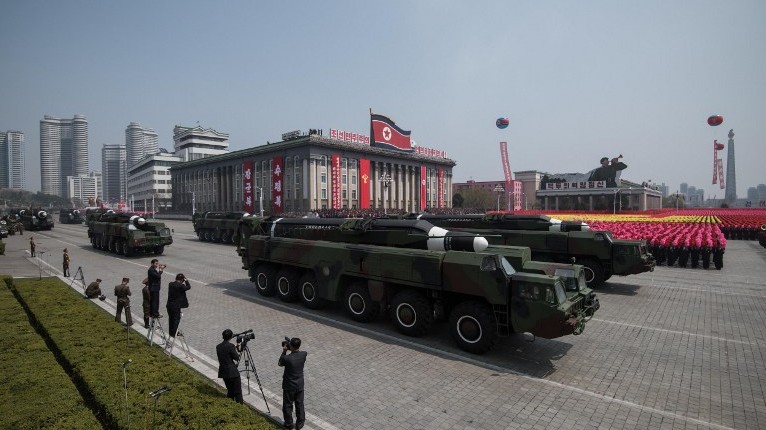
PYONGYANG, North Korea — North Korea unveiled what could be a new intercontinental ballistic missile at a giant military parade in Pyongyang on Saturday, analysts said.
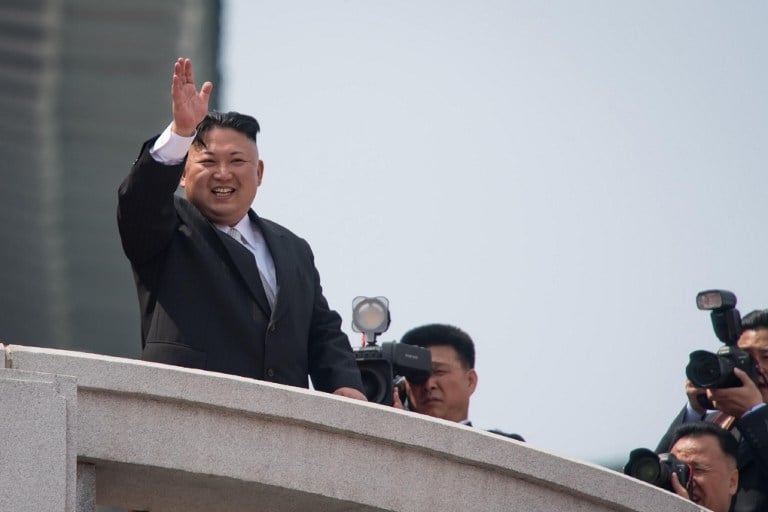
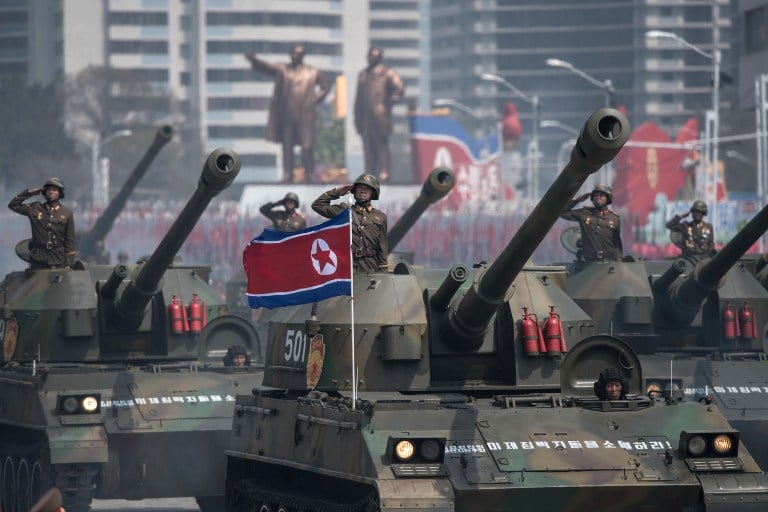
Nearly 60 missiles rolled through Kim Il-Sung Square at an event to mark the 105th anniversary of the North’s founder, in a show of strength as tensions mount over the isolated nation’s military ambitions.
Its ultimate goal is an intercontinental ballistic missile (ICBM) capable of delivering a nuclear warhead to the US mainland — something President Donald Trump has vowed “won’t happen.”
Saturday’s parade displayed devices in increasing order of range and it was four huge green missiles, rolled out on articulated trailers towards the end, that caught the attention of military specialists.
“This appears to be a new ICBM,” Yonhap news agency quoted an unidentified South Korean military official as saying, adding that they appeared longer than the country’s existing KN-08 or KN-14 missiles.
Pyongyang has yet to formally announce it has an operational ICBM, but Chad O’Carroll, managing director of specialist service NK News, said the new rockets could be liquid-fuelled intercontinental ballistic missiles, or an early prototype.
These long-range missiles would be “a big game-changer once it is deployed in service”, he said but added there would be a long testing schedule ahead before a trial launch of the missile itself.
But liquid-fuel missiles also “take hours to fuel up and if there is intelligence that they were doing that it would be quite easy to stop it before it was launched”, he told AFP.
Solid fuel ICBMs are a “much more difficult threat to prevent,” O’Carroll said, adding that risk was still “many many years” away.
But Kim Dong-Yeop of the South’s Institute for Eastern Studies said Pyongyang may have already begun developing the technology.
“Judging from the fact that it was contained in a launch tube, it is likely to be a cold-launched, solid-fuel ICBM,” he told Yonhap.
To achieve its ultimate aim of developing technology capable of hitting US targets, Pyongyang not only needs to improve the range of its missiles, but also miniaturize a nuclear device to the extent that it would fit on the tip of a warhead.
Experts differ on the details of Pyongyang’s missile capabilities, but all agree it has made rapid strides in recent years.
The North has paraded what were thought to be KN-08 ICBMs three times since 2012, and in 2015 it unveiled a new variant, the KN-14.
None has ever been launched, although Kim said in his New Year’s address that the North was in the “final stages” of developing an ICBM.
The last missiles in the parade, on giant 16-wheeler vehicles, could have been KN-14s in launch tubes.
Also on display was the Pukkuksong, a white-painted device on a blue trailer, which is claimed to be a submarine-launched ballistic missile (SLBM).
Submarine-launched devices could give the North the ability to strike without warning from a vessel somewhere in the Pacific Ocean.
They could also reduce the effectiveness of the US Terminal High Altitude Area Defense (THAAD) defence system, which Washington and Seoul are deploying to the South, to the fury of Beijing.
But the experts sounded a note of caution.
O’Carroll pointed out that the nosecone of one of the final group of missiles “wobbled quite noticeably,” raising questions about whether or not it was real.
Since only their launch tubes were visible, Lee Il-Woo, a senior analyst at the private Korea Defence Network, told AFP: “I suspect they all might be mock-ups aimed to impress the outside world.”





The Times of Israel Community.