

One of the strongest scenes in ‘Beale Street’ features a kippah-clad Dave Franco
The star, who is Jewish in real life, cameos as a landlord willing to rent an apartment to the movie’s African-American protagonists in 1970s New York
 Add ToI as a Preferred Source on Google
JTA — “If Beale Street Could Talk,” the new film from “Moonlight” director Barry Jenkins, is at heart a film about African-American love during a time of rampant racism. It’s an adaption of James Baldwin’s heartbreaking 1974 novel of the same name, which depicts a young African-American couple in 1970s New York whose love story is unjustly derailed.
But one of the film’s most powerful — and most talked about — scenes begins with a close-up of the back of the head of a yarmulke-wearing man as he walks up the stairs of a Manhattan apartment.
The narrative of “Beale Street,” which opens Friday and is considered an award season contender, alternates between the present and various stages of the couple’s life together. The scene in question takes place almost two-thirds of the way through, and the kippah wearer is named Levy.
Levy, played by Dave Franco, is a prospective landlord for Fonny (Stephan James) and Tish (Kiki Layne). It has been established in an earlier scene that Fonny and Tish, who are looking for an apartment together after learning they are expecting a child, have been rejected repeatedly by other landlords because they are black.
“Sometimes Tish and I go together, sometimes I go alone, but it’s always the same story, man,” Fonny tells a friend (Brian Tyree Henry) in the earlier scene.
Levy is different — not only does he not reject them, he plays along with Fonny as he mimes moving a refrigerator into the unfurnished space. Later, in a discussion on the roof, Fonny asks what the catch is, why he is willing to rent the apartment to them when no one else would.
“We’ve been looking for a long time, and there’s no reason for you to treat two Negroes so nicely,” Fonny says.
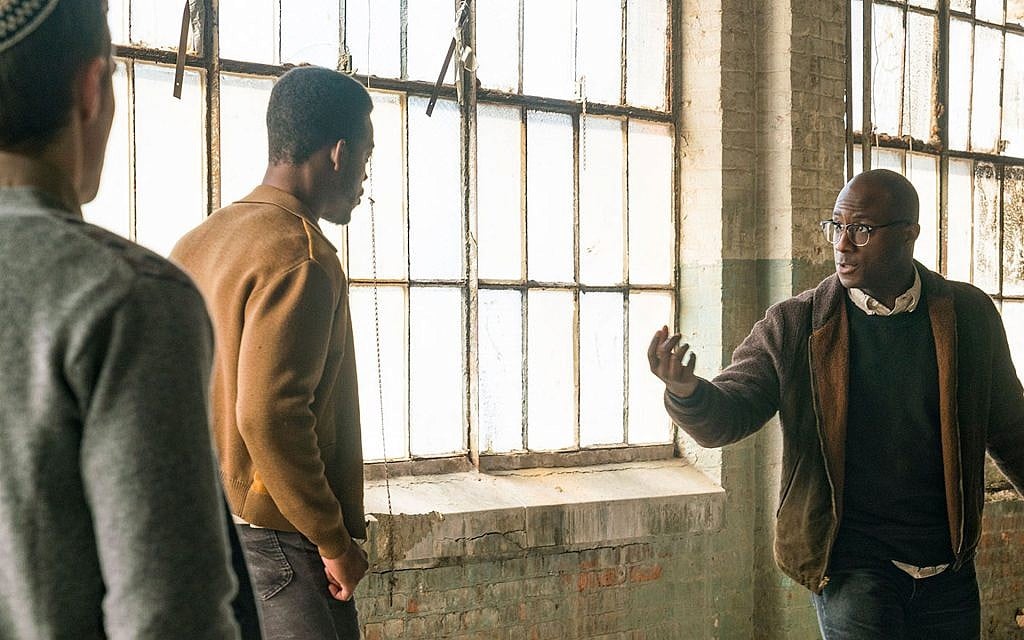
Levy responds with an impassioned speech about love.
“Look, man, with me it’s pretty simple — I dig people who love each other,” he says. “Black, white, green, purple, it doesn’t matter to me. Just spread the love.”
When Fonny asks if he’s a hippie, Levy replies, “I don’t know, I’m just my mother’s son. Sometimes that’s all that makes the difference between us and them.”
A version of the scene exists in Baldwin’s novel, although it’s a bit different. Levy is described on the page as an “an olive-skinned, curly-haired, merry-forced” 33-year-old from the Bronx. Franco (the younger brother of James) happens to be 33 and Jewish in real life, but the speech is an invention of the movie, and an older version of the screenplay floating around online did not include it.
The novel puts the “he dug people who loved each other” line in the mouth of narrator Tish rather than Levy himself.
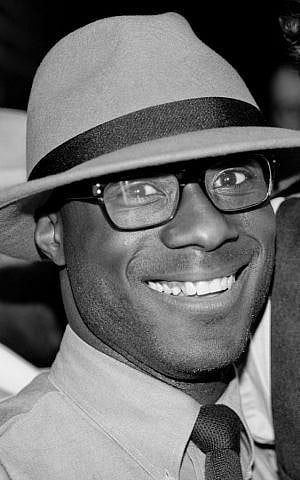
Jenkins — the film’s writer and director, whose debut “Moonlight” won three Oscars, including for best picture, in 2017 — has described the scene as one of the most pivotal in the movie.
“There’s this very simple scene where his character walks into the film and is appointed this very important task,” Jenkins said of Franco in an interview with Vulture at the Toronto Film Festival. “I was really careful about writing into the source material too much, but it just felt like there was something that this character needed to say to our main characters.
Jared eberhardt)
“You would assume black people are one of us and white people are one them. But it’s like no, there are us [sic], people raised right by our mothers, and there are them, who maybe haven’t been. We can’t even blame them for that because maybe their mothers didn’t have the capability to raise them the way that we were raised.”
Despite his good intentions, some on the festival circuit found the scene a little corny and even jarring — mostly, as Vulture also pointed out, because of the casting of Franco, who has come to be associated with the numerous wacky comedies in which he has starred in recent years, like “Neighbors” and “The Little Hours.”
“Is this scene a poignant moment underlining the necessity of human connection to cut through oppressive power structures, as Jenkins clearly intends?” Nate Jones wrote. “Or, as some viewers who found it pretty corny argued at the movie’s premiere party, is it a disruption of the movie’s carefully considered tone to hand one of the most pivotal emotional beats to the guy from ‘Neighbors’?”
The scene also paints a rosy portrait of the black-Jewish relationship at the time, when in reality it was far more complicated. In the 20th century, and especially in New York City, tensions between blacks and Jews often manifested through landlord-tenant relations — a topic addressed elsewhere by James Baldwin himself.
“When we were growing up in Harlem, our demoralizing series of landlords were Jewish, and we hated them,” Baldwin wrote in The New York Times in 1967 in an essay titled “Negroes Are Anti-Semitic Because They’re Anti-White.”
“We hated them because they were terrible landlords, and did not take care of the building. A coat of paint, a broken window, a stopped sink, a stopped toilet, a sagging floor, a broken ceiling, a dangerous stairwell, the question of garbage disposal, the question of heat and cold, of roaches and rats — all questions of life and death for the poor, and especially for those with children — we had to cope with all of these as best we could.”
But Baldwin goes on to note in the same essay that most of the white people who had treated him poorly probably weren’t Jewish and, after all, “it is not the Jew who controls the American drama. It is the Christian … The crisis taking place in the world, and in the minds and hearts of black men everywhere, is not produced by the star of David, but by the old, rugged Roman cross on which Christendom’s most celebrated Jew was murdered. And not by Jews.”
So in the end, the Franco scene is just a touching moment meant to remind us of the kindness of people of all races. And it adheres not only to Jenkins’s vision, but also to Baldwin’s.










The Times of Israel Community.