

Shoe security system may one day replace airport scanners
Magshoe makes life easier for airline passengers, eliminating the need to remove footwear. Could the technology be used to develop safer and more effective body scanners?
 Add ToI as a Preferred Source on Google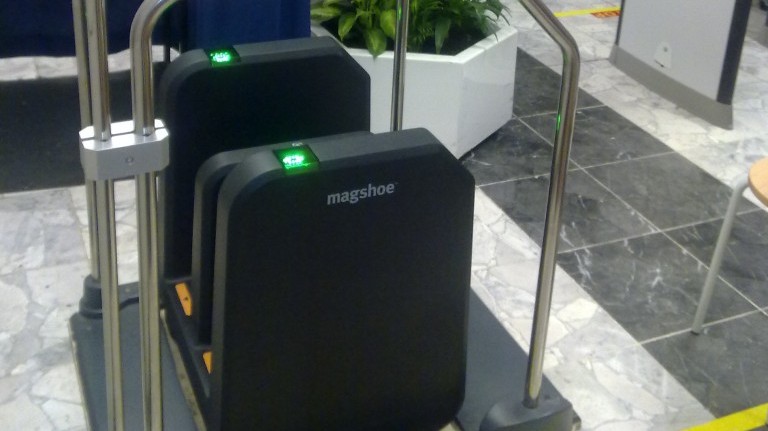
That the full-body scanners used by the Transport Safety Administration in the US can be fooled comes as no surprise fo Avishai Rothstein, marketing director of Israel’s IDO Security. “The problems full-body detection systems have been documented, and the latest controversy comes as no surprise.”
That “latest controversy” comes in the form of a video that has taken the blogosphere by storm. Jonathan Corbett, who runs a blog critical of the TSA, posted a video which showed him smuggling a metal object through the new full-body scanners being used at many airports in the US. The scanners are supposed to detect metal objects as passengers walk through them, but Corbett was able to outwit the scanners by effectively blending the metal object into the shadow created by a special side pocket he sewed into his shirt. Corbett wrote on this blog that he was able to get past the sophisticated detectors, which are controversial for a number of reasons, more than once.
In his post, Corbett quotes Israeli security expert Rafi Sela, a former security consultant for Ben Gurion Airport. Sela told officials in Canada who were considering the system that “he could ‘overcome the body scanners with enough explosives to take down a Boeing 747,’ and Ben Gurion therefore refused to buy scanners.”
“The US ignored this warning,” Corbett continued, “and Mr. Sela never publicly explained his statement. But it stuck with me.”
According to Rothstein, the older metal detectors, which had been in use for 40 some years, were much more effective than the new, expensive full-body scanners. And safer, too: The new scanners have been banned in many airports in Europe because they subject passengers to what the EU considers an unsafe level of radiation.
One thing that no system can do effectively, though, is examine the lower part of the body, including the legs at the ankles and below, and the shoes. “Because of the way metal detectors and full-body scanners work, they can’t tell if a person’s shoe contains a weapon, or just has some metal to reinforce the shoe,” said Rothstein. “That’s why you have to take your shoes off at the airport.
But Rothstein’s company has a solution to the shoe problem. MagShoe, in use in airports in Europe and the US, as well as at Ben Gurion Airport, allows security officials to check if a passenger is carrying a foreign object in his shoe, with a near-perfect record. Now in its third generation, the MagShoe system detects all metals in shoes and in the ankle/sock area (both ferrous and non-ferrous metals). And, it practically eliminates all false alarms due to the presence of prosthetics or metal normally found inside shoes. MagShoe does not use radiation to do its detecting, and enables passengers to pass through in seconds, eliminating the hassle, and perhaps embarrassment, of having to take their shoes off.
Could MagShoe be expanded for use as a full-body detection system? Not right now, Rothstein said. “The full-body scanners are quite dependent on radiation, and as we saw in the video, they can be fooled with some effort.” MagShoe uses Magnetic Fields Technology to detect metal, and the technology as MagShoe currently deploys it is not appropriate for full-body scanning. But IDO is working on other types of scanners, Rothstein said, and already has developed a number of variations of its technology, such as a scanner for use at banks and mints that ensures that no one walks away with valuable coins.
Could IDO products eventually do security checks in areas above the ankles, enabling passengers to avoid using full-body scanners altogether? The technology is certainly available, and perhaps the latest TSA controversy could be just the impetus IDO, or another enterprising Israeli company, needs to move forward with developing a full-body scanner alternative.










The Times of Israel Community.