

Shoppers face empty milk shelves as dairy farmers ramp up fight against proposed reform
Producers agree to resume raw milk supply to processing companies for the time being, though protest convoys to Jerusalem still planned for Wednesday
 Add ToI as a Preferred Source on Google
Sue Surkes is The Times of Israel's environment reporter
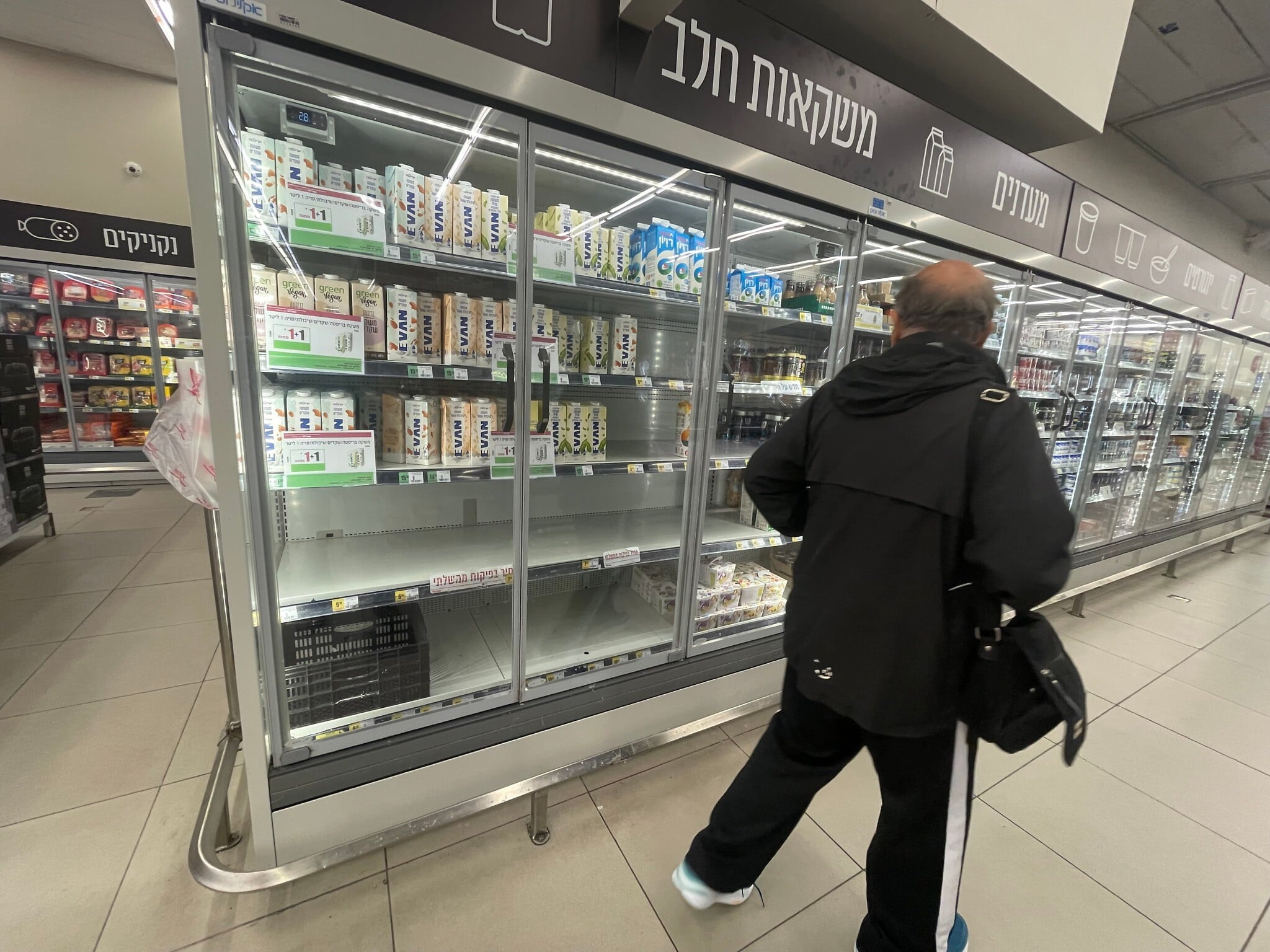
Customers and staff at a Shufersal supermarket in Haifa were bewildered on Tuesday by the empty shelves where government price-controlled milk cartons are usually arranged.
“A tiny pallet of cartons arrived this morning,” said the lady behind the cheese counter, motioning with her arms that it was less than a meter wide. “People were allowed to buy two cartons at a time.”
Of the few people who passed by the empty shelves, an immigrant from the former Soviet Union said he had no idea why there was no milk and had not heard about the Finance Ministry’s controversial dairy reform. A woman said she had heard of the reform, but did not know what it was about.
At the checkout counter, an elegantly dressed customer said she had “no idea” why the milk shelves were barren. “Someone told me it has something to do with the dairy farmers,” she added.
“Yes, there have been lots of complaints,” the checkout man confirmed. “But nobody knows why there’s no milk. Can you explain?”
“The dairy farmers are on strike over a reform that Bezalel Smotrich wants to pass,” a reporter from The Times of Israel responded, referring to the finance minister.
“I hate Smotrich,” chimed in another person at checkout. “He doesn’t think about ordinary folk.”
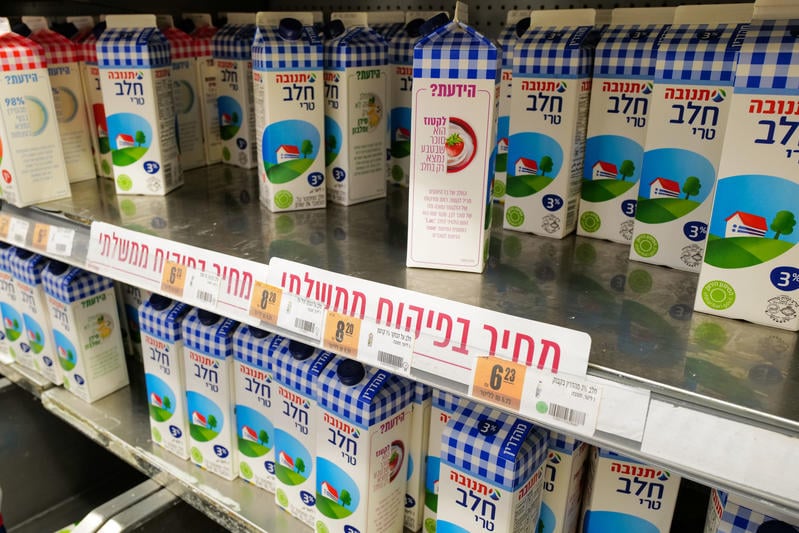
Similar scenes played out across the country on Tuesday after the Dairy Board — which regulates the industry and brings together representatives of the government, the farmers, and the dairy producers — decided to follow through on its threat to stop supplying raw milk.
A Shufersal spokesman said the shelves were empty across all its retail chains.
Spokespeople for the Tnuva and Strauss dairy processing companies declined to comment.
By Tuesday evening, the Dairy Board agreed to a request from Agriculture Minister Avi Dichter to resume supplying raw milk for the time being.
But plans for large protest convoys set to disrupt traffic and converge on the Knesset in Jerusalem on Wednesday were to go ahead as planned.
The main convoy will depart from Latrun, northwest of the capital, at 10 a.m., and travel along Route 1, arriving at the Knesset for a mass protest starting at 11:30 a.m. A tractor convoy will meanwhile leave the Masmiya Junction in southern Israel at 8:30 a.m., reaching Ein Karem on the western outskirts of Jerusalem at 11 a.m. and arriving at the Knesset at noon.
‘The real tragedy isn’t spilled milk’
During a day of spiraling claims and counterclaims between farmers’ representatives and Smotrich, the Finance Ministry announced that the latter intended to sign an order “in the coming days” to scrap tariffs on imported dairy products “for an extended period.”
The milk strike marked another stage in the farmers’ protest against Smotrich’s bid to reform the sector.
As part of a broader plan to lower the cost of living, Smotrich is seeking to disband the centralized coordination mechanism that has characterized the dairy industry since the state’s founding. He wants to slash milk production from the current 1.5 billion liters to 1 billion, cut the price per liter that dairy processors pay to farmers by 15 percent, and abolish tariffs of up to 40 percent to flood the Israeli market with imported dairy products. The plan was approved by government in December and now needs the Knesset’s authorization.

Farmers argue that the reform will cause widespread job losses and harm national food security, calling instead for Smotrich to tackle the monopolies that control the processing and retailing of dairy products. By Smotrich’s own admission in the Knesset on Monday, three companies control 85% of the dairy market — Tnuva, Tara, and Strauss.
Amit Yifrach, secretary-general of the Moshav Movement and chairman of the Israel Farmers Federation, said, “Smotrich can sell laws and make threats, but he cannot sell out food security or our farmers. Anyone who abandons Israeli milk endangers food security for the next war. This policy has pushed us to a boiling point. The real tragedy isn’t spilled milk; it’s the closure of farms and a total reliance on imports from countries like Turkey.”
Turkey, once a significant exporter of tomatoes to Israel, froze its contracts amid the Gaza war triggered by the Hamas-led October 7, 2023, invasion of southern Israel.

On Tuesday afternoon, Smotrich put out a statement on Facebook attacking the “monopolies and cartels” which, he said, tried for months to sell Israelis “the lie that my dairy reform will harm food security and milk on the shelves.” He warned that “nobody will threaten us,” while promising that his plan to break up cartels would ensure plentiful supplies of cheap milk.
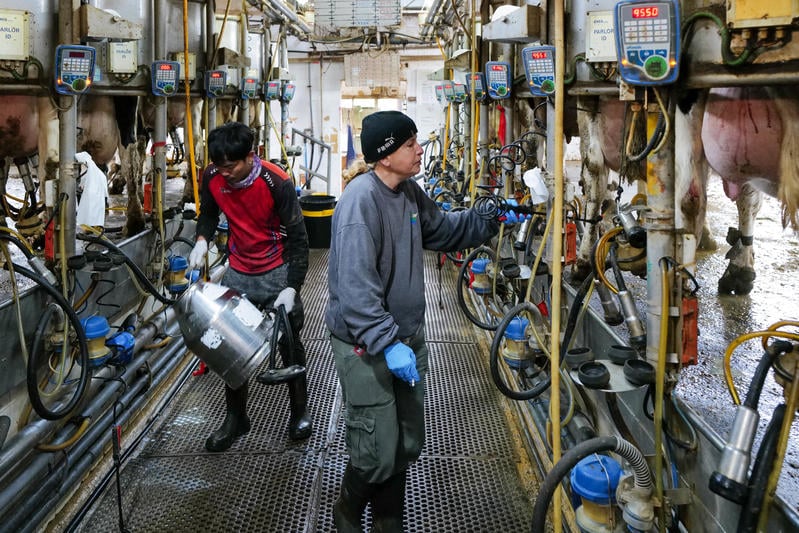
There are 660 dairies countrywide, according to the Dairy Board, each of which employs an average of seven workers. The farmers say around 400 of these are located along Israel’s borders.
Along with producing over 1.53 billion liters of milk annually, the dairy industry employs some 15,000 workers, including veterinarians, feed suppliers, and truck drivers.
The government sets the prices for the most basic items, such as 3% and 1% fat milk that comes in bags and cartons, 5% soft white cheese, 38% sweet cream, sour cream (Eshel and Gil) and standard yellow cheese, such as Emek.








The Times of Israel Community.