

IHRA calls for greater protection of Holocaust remembrance amid rising antisemitism
IHRA urges global action to defend Holocaust remembrance amid rising antisemitism, survivor threats, and historical distortion since October 7 attacks
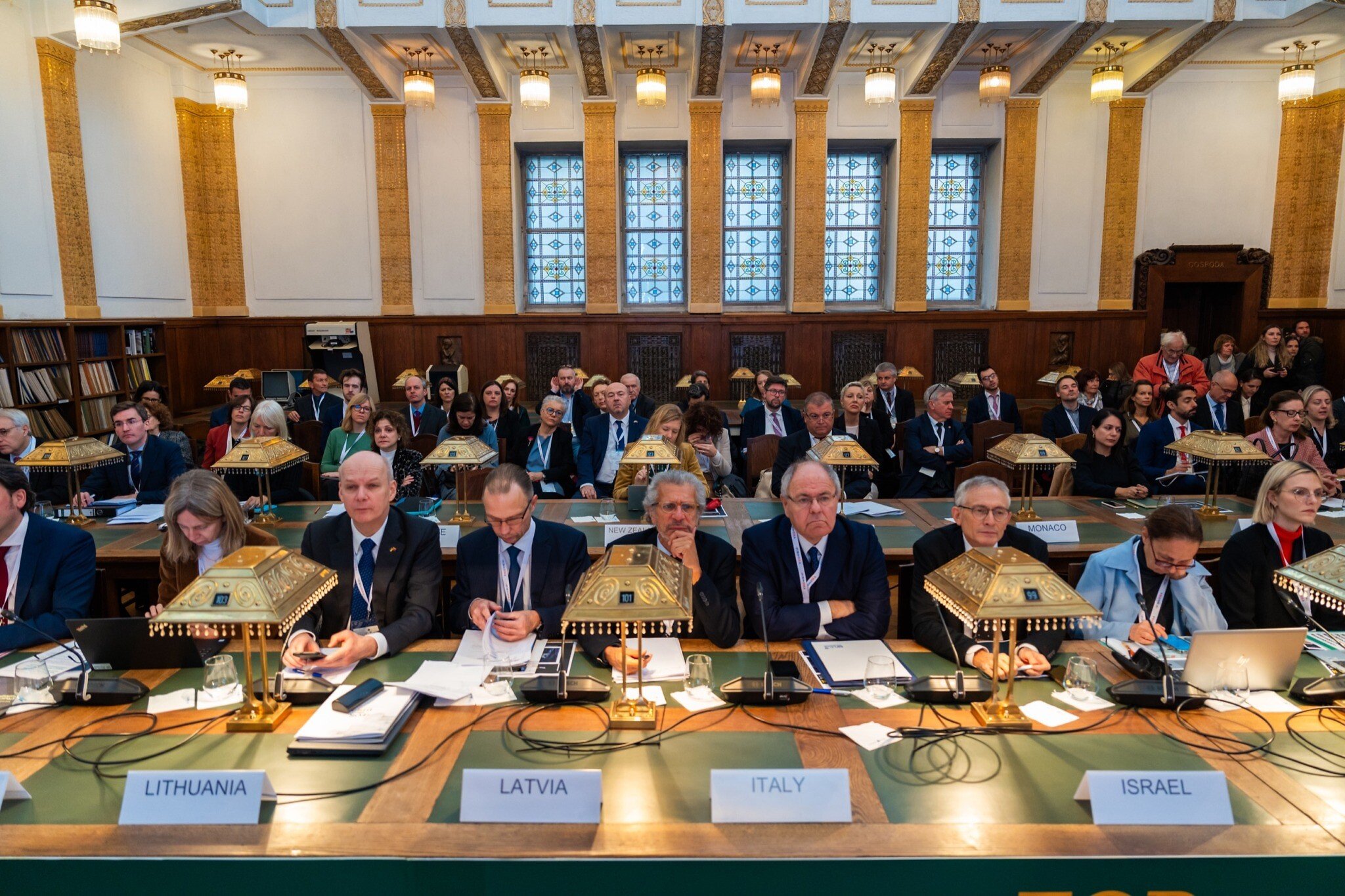
The International Holocaust Remembrance Alliance (IHRA) has issued a statement calling for greater protection for those safeguarding Holocaust memory, as practitioners face increasing threats from rising antisemitism and Holocaust distortion worldwide.
“IHRA is gravely concerned that Holocaust survivors and their families, researchers, educators, and memorial and museum professionals are experiencing increased insecurity, disruption, and delegitimization that derive from growing antisemitism in a number of countries inside and outside IHRA,” the statement said.
The organization decried that “accurate and meaningful Holocaust remembrance worldwide is being threatened by the long-standing, deeply-rooted scourges of antisemitism and Holocaust distortion, which have gained strength and audacity particularly since the October 7, 2023 Hamas terror attacks upon Israel.”
The statement, initiated by IHRA’s current Israeli Presidency, was adopted by its 35 member countries. It calls on local, regional, and national governmental agencies to protect Holocaust remembrance practitioners from antisemitic and distortionist threats and attacks.
Alliance addresses global rise in antisemitism
The statement was released during IHRA’s semi-annual plenary meeting, organized and led online by Israel with the support of the organization’s permanent office in Berlin. The meeting was held from June 23-26, 2025, bringing together 35 member countries, nine observer nations and ten affiliated international organizations to address the mounting challenges facing Holocaust remembrance. A recurring theme throughout the conference was the global surge in antisemitism and its impact on Holocaust remembrance, education, and research.
“The only solution is dialogue and a common resolve to understand and address antisemitism in all its forms,” said Advisor to IHRA, Robert Williams, during a session on antisemitism. “This is the task of IHRA, because only IHRA crosses the Atlantic and Pacific Oceans. Only IHRA allows experts to drive the agenda, not potentially well-intentioned but nevertheless restricted policymakers.”
One of the plenary sessions examined how antisemitism impacts Holocaust remembrance, education, and research, with experts presenting research on contemporary antisemitism and steps taken to counteract it.
First meeting under Israeli leadership
This was IHRA’s first meeting under Israel’s leadership. In March, Israel took on the presidency of the organization from the United Kingdom, with Yad Vashem Chairman Dani Dayan appointed as IHRA Chair. The plenary was originally scheduled to take place in Jerusalem but was moved online due to recent security restrictions.
“The eternal significance of the Holocaust for all of humanity is so decisive that it cannot and must not be diminished or weakened by contemporary geopolitical developments or military conflict, no matter how overwhelming those seem to be,” said Dayan in the plenary’s opening remarks. “Anyone who proclaims and practices truthful remembrance of the Shoah is essentially endangered by contemporary antisemitism. We must declare that and demand effective responses.”
Over 200 delegates participated in the conference’s proceedings, with Yad Vashem, the World Holocaust Remembrance Center, and Israel’s Foreign Ministry jointly leading the four-day event with lectures, discussions, learning sessions and working meetings.
The imperative of today
The concluding of the plenary included several key milestones that deepen international cooperation in safeguarding the historical record of the Holocaust. Albania became an observer country, Cyprus was invited to become a liaison country, and the European Holocaust Research Infrastructure (EHRI) was invited to become a permanent international partner of IHRA.
IHRA Chair Dayan took the opportunity to urge all countries to pledge their commitment to the Survivors’ Declaration, a foundational document first issued in 2002 at Yad Vashem. The Declaration expresses the enduring moral voice of survivors and implores the world to uphold human dignity, confront antisemitism, and safeguard Holocaust memory.
IHRA’s Secretary General, Michaela Küchler, called on delegates to rejuvenate and recommit to IHRA’s mission. “As the last survivors leave us, IHRA stands at a crossroads. We must remind ourselves that remembrance is not only an act of mourning. It is a moral imperative,” Küchler said.
She recalled a story of Holocaust victim Heinrich Michel, a shoemaker from Würzburg, whose memory was preserved through a single photograph and a handwritten testimony by his sister in the archives of Yad Vashem.
Education as a cornerstone
Central topics throughout the plenary included education and awareness. During one session, IHRA’s resource on Recommendations for Teaching and Learning about the Holocaust was updated to address emerging challenges such as the ethical use of AI and a need for age-appropriate materials.
The genocide of Roma during the Nazi era was also highlighted for increased awareness. Roma is an umbrella term used to describe a European minority of Indian origin with its own history, language, and culture. During the Holocaust, an estimated 500,000 Roma were murdered, while others were imprisoned, used as forced laborers, or subjected to forced sterilization and medical experimentation.
During the plenary, the Committee on the Genocide of the Roma focused on implementing IHRA’s teaching and learning recommendations. Delegates discussed challenges and solutions for increasing Roma representation in museums and memorials.
Crossroads of generations
The plenary proceedings reflected a consensus that IHRA’s mission is especially critical now, 80 years after the end of the Holocaust. This echoed the theme of Israel’s IHRA Presidency, “Crossroads of Generations” which underscores that Holocaust remembrance is at a crossroads worldwide, with the next generation required to preserve accurate Holocaust memory for future generations.
“The responsibility of preserving the memory and sharing the stories of the Holocaust will soon rest solely on our shoulders,” said Dayan upon Israel’s assumption of the presidency in March. “The voices of victims and survivors demand that we honor their legacy by standing firm against Holocaust denial, distortion, and hatred. In a world witnessing a dramatic rise in antisemitism and grappling with the challenges and opportunities of emerging technologies, our obligation to historical truth has never been more critical.”
About IHRA
IHRA is an intergovernmental organization comprising 35 member countries, nine observer countries, and ten partner organizations dedicated to promoting Holocaust education, researching and remembering, and combating antisemitism. One of the organization’s accomplishments includes establishing a working definition of antisemitism, which has been accepted in 40 countries, as well as by numerous local and regional authorities, and 1,200 cultural and academic institutions worldwide.
IHRA’s next plenary session is scheduled to take place in Jerusalem in December 2025.