

US-led coalition announces pause in fight against IS in Iraq after rockets
Baghdad summons US Ambassador Tueller to condemn American strikes that killed a top Iranian general, an Iraqi commander and other local fighters
 Add ToI as a Preferred Source on Google
The US-led coalition on Sunday announced it was “pausing” its fight against the Islamic State group in Iraq, where US troops training local forces have faced a spate of rocket attacks.
“This has limited our capacity to conduct training with partners and to support their operations against Daesh (IS) and we have therefore paused these activities, subject to continuous review,” the coalition said in a statement.
On Saturday, the coalition said its forces in Baghdad and in an airfield north of the capital had faced new attacks, bringing the total rocket strikes in the last two months to 13.
Iraqi foreign ministry on Sunday summoned US ambassador Matthew Tueller to condemn American strikes on Iraq that killed a top Iranian general, an Iraqi commander and other local fighters.
#Iraq parliament chanting "No, No America," and "Yes, Yes, Soleimani."
The U.S.'s debacle Iraq policy in one frame. https://t.co/vNtn14ttpi— Farnaz Fassihi (@farnazfassihi) January 5, 2020
“They were a blatant violation of Iraqi sovereignty,” the ministry said in a statement, and “contradict the agreed-upon missions of the international coalition.”
Iraq’s parliament was expected to vote Sunday on ousting thousands of US troops from military bases, which are threatened by pro-Tehran factions after an American strike killed top Iranian and Iraqi commanders.
Late Saturday, missiles slammed into the Baghdad enclave where the US embassy is located and an airbase north of the capital housing American troops, prompting US President Donald Trump to threaten strikes on 52 sites in Iran.
The near-simultaneous attacks seemed to be the first phase of promised retaliation for the US precision drone strike that killed Iran’s Major General Qasem Soleimani and Abu Mahdi al-Muhandis, deputy head of Iraq’s Hashed al-Shaabi.
While no one claimed Saturday’s attacks, a hardline pro-Iran faction in the Hashed, a network of Shiite-majority armed groups incorporated into the state, urged Iraqis to move away from US forces.
“We ask security forces in the country to get at least 1,000 meters (3280 feet) away from US bases starting on Sunday at 5:00 pm (1400 GMT),” said the Kataeb Hezbollah faction.
The deadline coincides with the planned conclusion of Sunday’s parliamentary session, which the Hashed has insisted should see a vote on the ouster of US troops.

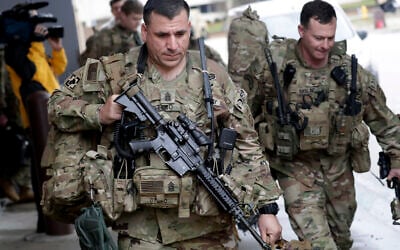
Some 5,200 US soldiers are stationed across Iraqi bases to support local troops preventing a resurgence of the Islamic State jihadist group.
They are deployed as part of the broader international coalition, invited by the Iraqi government in 2014 to help fight IS.
The Hashed, whose factions have close ties to Iran, has vehemently opposed their presence and called on parliament to revoke the invitation.
‘Posthumous victory’
The 329-member parliament was set to meet at 1:00 pm (1000 GMT) but two hours on, there was still no quorum and the session had not begun.
Several draft bills were being circulated calling for the Iraqi government to “work on ending the presence of all foreign forces and preventing them from using the Iraqi airspace for any reason”.
The drafts did not include a time frame for an ouster.
No Kurdish lawmakers attended the session and Sunni MPs also appeared to be dragging their feet as they were more supportive of a US troop presence, seen as a counterweight to Iran.
https://twitter.com/abdullahawez/status/1213806306412371968
“Any parliamentarian absent for the vote on the departure of the occupier will have betrayed his country,” said MP Ahmad al-Kinany from the Hashed’s political bloc, Fatah.
While praying over Muhandis’ remains in Baghdad on Saturday, Fatah head Hadi al-Ameri pledged to avenge him with “the departure of American troops from Iraq, forever.”
US defense officials in Iraq told AFP in the hours ahead of the session that they felt apprehensive and nervous.
Already, increased tensions prompted NATO to suspend its training activities in Iraq and a US defense official told AFP American-led coalition forces would “limit” operations.
Tom Warrick, a former US official and current fellow at the Atlantic Council, said Soleimani and pro-Iran factions had long sought the US’s ouster.
“If US forces do end up withdrawing, it could grant Soleimani a posthumous victory,” Warrick told AFP.
‘This is direct war’
The US strike on Baghdad international airport early Friday killed five Iranian Revolutionary Guards and five members of Iraq’s Hashed.
After a procession that made its way across various Iraqi cities on Saturday, the remains of the Iranians, plus those of Muhandis and another Hashed member, were flown to Iran.
DNA testing was required to separate the Iraqis’ remains so they could be properly buried, the Hashed said.
As head of the Quds Force, the Guards’ foreign operations arm, Soleimani oversaw Iran’s wide-ranging interventions in regional power struggles.
In Iraq, protesters taking to the streets since October had blamed him for propping up a government they see as corrupt and inept.
Demonstrations still rocked the capital and south on Sunday, with many protest chants shifting to condemn a possible regional conflict.
US President Donald Trump claimed Soleimani was planning an “imminent” attack on US personnel in the region and threatened Iran on Saturday with more strikes.
Iran’s supreme leader Ayatollah Ali Khamenei promised “severe revenge” for Soleimani’s death.
Saturday’s attacks appeared to be precisely what Iraqis had long feared: tit-for-tat strikes between the Hashed and the US on Iraqi soil.
“This is no longer a proxy war,” said Erica Gaston, a non-resident fellow at the New America Foundation.
“What you have is America attacking an Iranian general directly, and groups are now openly fighting for Iran to avenge him. This is a direct war,” she told AFP.








The Times of Israel Community.