

As chapter closes, Shimon Peres hailed by normally divided Knesset
After nearly six decades in Israeli politics, the Nobel laureate and elder statesman leaves public life having failed to achieve the peace he long sought
 Add ToI as a Preferred Source on Google
Ben Sales is a news editor at The Times of Israel
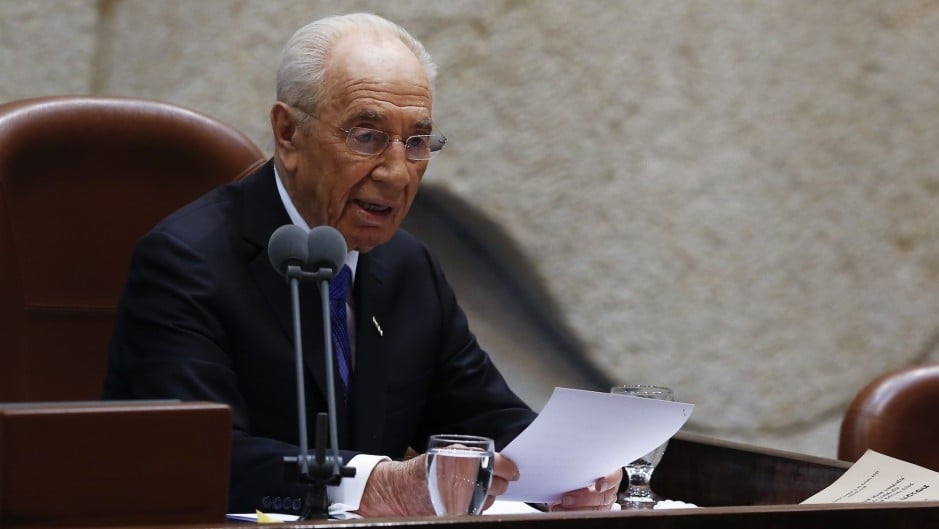
JTA — In the midst of a grinding war in Gaza, a sometimes near-empty Knesset gallery was packed last week for an uplifting moment: what probably was the final political act of Israel’s elder statesman.
Shimon Peres — former Israeli prime minister, defense minister, foreign minister and now former president — stood before the Knesset for the last time as a public servant on July 24, just prior to the inauguration of his successor, Reuven Rivlin.
Facing his professional home for almost all of the past six decades, Peres gave a farewell speech that traced the arc of his long career, recounting Israel’s past, defending it in its present predicament and offering hope for its future.
“We are a people that experienced unimaginable agony,” Peres said. “And we are a people that reached the lofty heights of human achievement. We made great efforts. We paid a heavy price.”
It was a toned-down ceremony due to the continuing conflict in Gaza and was an inauspicious time for Peres, 91, to be exiting the political scene.
For decades, the man who in 1994 was awarded the Nobel Peace Prize for helping engineer the Israeli-Palestinian Oslo Accords has repeated over and over that peace is within reach and could be achieved in his lifetime. Yet the final months of his presidency saw the acrimonious collapse of Israeli-Palestinian peace negotiations, the murder of four boys — three Israeli teenagers and a Palestinian teen — and Israel’s bloodiest military offensive in five years.
Peres is known today as a peacemaker, but he began his career in the Defense Ministry, helping to cement a close military alliance with France in the 1950s and developing Israel’s nuclear program in the 1960s.
Following the 1967 Six Day War, Peres advocated the settlement of the West Bank and Gaza.
Only in the 1980s, as Labor Party leader, did Peres become the peacenik he’s known as today. And it was only after he left party politics for the presidency, in 2007, that he rose above the parliamentary rivalries and failed leadership bids that had embroiled and foiled him over the previous few decades to become the unifying figure he is today.
Peres is the phoenix of Israeli politics. From hawk to dove, from faction leader to uniter, he has ridden the wave of Israeli history and somehow stayed afloat while others fell, faded away or died. It is that history that makes Peres one of the few Israeli leaders who could deliver the speech he did last week: at once vociferously defending Israel’s offensive in Gaza while als0 calling for an aggressive approach to Israeli-Palestinian peace.
“There is no place to doubt our victory,” Peres said, adding immediately: “We know that no military victory will be enough. There is no permanent security without permanent peace. Just as there is no real peace without real security.”
In a political career that spans 55 years, Peres has never prevailed in a popular election. He became prime minister in 1984 after his party, unable to form a government, entered into a unity coalition with the Likud. He also occupied the post briefly in 1977, after Yitzhak Rabin resigned, and in 1995, after Rabin’s assassination.
The peace treaty Peres yearns for has yet to be signed. But whether or not peace comes in his lifetime — though in his tenth decade he still appears energetic — his starring role in so much of Israeli history has earned him a respect that transcends political divisions.
At the Knesset session on July 24, Peres received thunderous applause from a generally divided house.
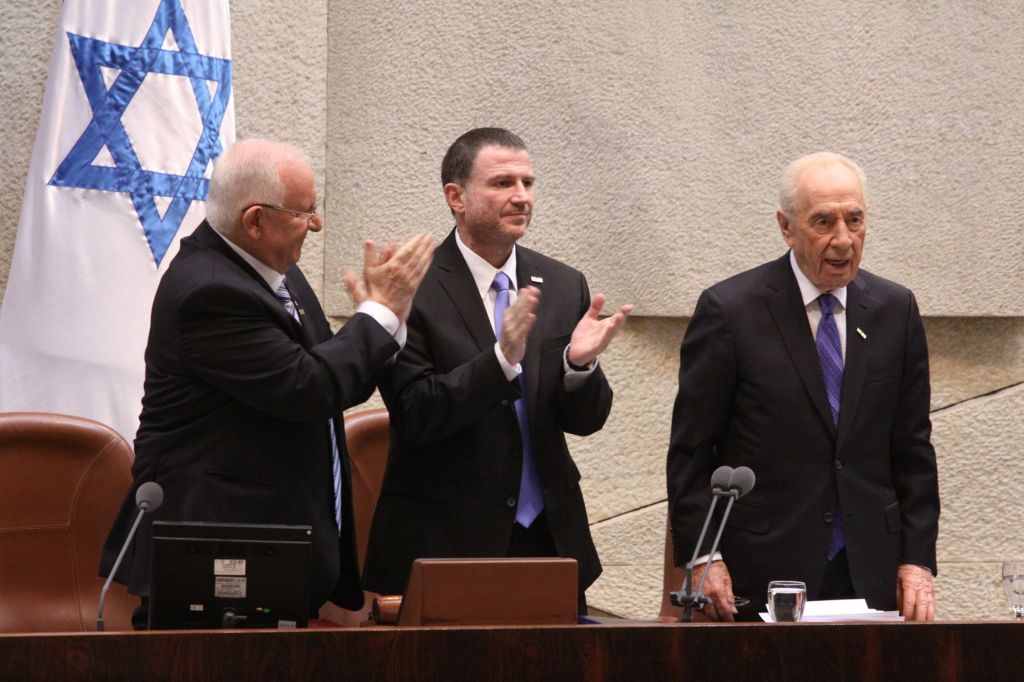
The man who succeeds him, Reuven Rivlin, is in many ways Peres’s opposite. Rivlin is a lifelong Likudnik; Peres has bounced between three parties. Rivlin wants to annex the West Bank; Peres prefers a two-state solution. Rivlin has pledged to focus his efforts on healing Israel’s internal divisions; Peres at times has acted like Israel’s second foreign minister.
Though he is no longer a government official, Peres is unlikely to disappear. He intends to continue working for regional reconciliation at his Peres Center for Peace and he still will be a presence in the media and at international conferences.
And Peres’s story remains woven into the history of Israel — its successes, its failures, its frustrations and its resilience.
“When I return and meet the beauty and strength of the State of Israel, I find myself shedding a tear,” he said near the end of his speech. “Maybe excited slightly more than my younger friends. Because throughout my years I witnessed the entire incredible journey, and the miracles of Israel.”






The Times of Israel Community.