

Coalition of the unwilling
With sourcing flimsier than a cardboard shack in the rain, the Hebrew press picks apart reports of Netanyahu and Herzog trying to form a unity government
 Add ToI as a Preferred Source on Google
Ilan Ben Zion is an AFP reporter and a former news editor at The Times of Israel.
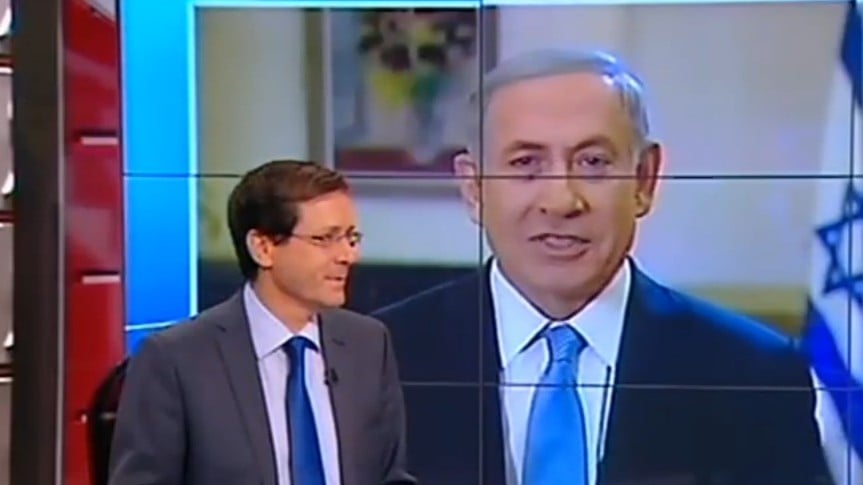
Rumors about talks between Prime Minister Benjamin Netanyahu and Zionist Union chief Isaac Herzog to form a unity government continue to make front page news. Does the Hebrew press ever tire of barely substantiated reports that negotiations are making no progress? Whether it’s Israel and the Palestinians, Iran and world powers, or political parties reportedly trying to hash out an agreement to work together, unsourced reports of talking going on behind closed doors never cease to grab headlines.
Everything hinges on a late-night meeting between the party leaders on Sunday in which the two were said to discuss the terms of the largest opposition party joining a Netanyahu-led government. An unnamed source in the coalition tells Haaretz that the disagreement not only stems from ideological differences between the left of center and right of center parties, but also what’s on offer to sweeten the pot for Labor. The paper says that Herzog’s demand is to take over the Communications, Culture or Justice ministry as part of the conditions to join.
“The ministers holding them at the moment are considered a red flag for the left, and the ouster of Ayelet Shaked [from the Justice Ministry], Miri Regev [from the Culture Ministry] or Netanyahu himself [as communications minister] from these portfolios would be considered a significant achievement,” the source is quoted saying. Netanyahu, however, is loath to concede them, and Herzog’s people flat-out denied those demands.
While Haaretz makes it out as if there’s still lots of negotiating to be done to reach an agreement, for Israel Hayom, the deal is nearly a fait accompli. Herzog plans to convene a meeting of the Labor Party to get approval for a deal to join the governing coalition, the paper reports.
If Haaretz’s sourcing is flimsier than wet cardboard, then Israel Hayom’s is as flaccid as the world’s first transplanted penis. The paper quotes “a source knowledgeable about the contacts” saying that Herzog made a series of demands to make joining Netanyahu appear like a Zionist Union coup, but the prime minister “isn’t prepared to to change the [coalition] base lines or freeze settlement construction in the West Bank as a consequence of it.”
“There’s a ruling government that can survive a lot longer, and therefore Herzog must understand that he’s forced to be flexible in his demands,” the source, who sounds an awful lot like someone across the table from Herzog, says. But if Netanyahu’s government were so secure, why is he trying to get Zionist Union to join?
Israel Hayom’s pundit Mati Tuchfeld pushes the paper’s line, saying that it’s a “shared interest” for both sides to reach an agreement for a broad government. The paper’s unabashed ridicule of Herzog since the run-up to the 2015 elections vanishes in his op-ed, in which he heaps the same praise on Herzog as he does Netanyahu, calling the two “experienced and seasoned politicians with no parallel.”
“It appears that only personages with their level of experience are capable of projecting the feeling that nothing happened, and that in another moment everything will go back to how it was,” he says, lavishing praise equally on the two politicians.
He says that if Netanyahu fails to bring Herzog in, it’ll be a minor setback, but for Herzog it would be “a mortal blow” that will lead to his ouster as head of the Zionist Union.
Yedioth Ahronoth lends so little credence to the talks about the Zionist Union joining Likud that it buries the story inside a piece about Tzachi Hanegbi turning down a minister without portfolio position. “As of yesterday,” the paper says, tiredly, halfway down the article, apparently channeling many party members’ disdain for a possible union with Likud, “it would appear that the meetings for forming a unity government reached a dead end.”
The gaps between the two sides “are still very great,” the paper reports, and Herzog didn’t manage to get his demands: involvement in the gas deal and peace talks with the Palestinians, icing controversial bills such as one to suspend unpopular MKs and to label foreign-funded NGOs, and halting settlement construction.
Unnamed senior members of Zionist Union tell Yedioth Ahronoth that even if Herzog manages to strike a deal with Netanyahu, it would cause a rift in the party and only 14 of its 24 members would join the coalition.
Nobody bothers mentioning the fact that the last time a centrist party joined a Netanyahu-led unity government, the whole business unraveled after less than two months. Is the Israeli press’s collective memory so short that they fail to recall the Kadima-Likud unity government of 2012 that dissolved because of disagreements over universal IDF draft? What tiny spark will break up this one?
Haaretz’s Amos Harel writes that the coalition talks are also responsible for widening the growing rift between Netanyahu and Defense Minister Moshe Ya’alon, who’ve butted heads over IDF generals’ comments of late. He posits that Ya’alon is worried that Netanyahu might sell him down the river as part of a deal with Herzog, and give his defense portfolio to someone Netanyahu can rely on should there be another flare-up in Gaza.
“The defense portfolio is likely to be part of the dowry for the new [coalition] partners” — Zionist Union and possible the ultra-nationalist Yisrael Beytenu, he says. “Netanyahu needs a stable defense minister whom he can trust… as demonstrated in the last campaign in the Gaza Strip.”
He says that for Netanyahu the question is: “Can Ya’alon continue to help him survive politically and continue to keep Israel’s security relatively calm, or can he part from [Ya’alon] without paying too high a price?”







The Times of Israel Community.