

Facing the presidential face-to-face
Trump and Clinton are at center stage in the run-up to the presidential debate, as is Netanyahu’s New York visit
 Add ToI as a Preferred Source on Google
Ilan Ben Zion is an AFP reporter and a former news editor at The Times of Israel.
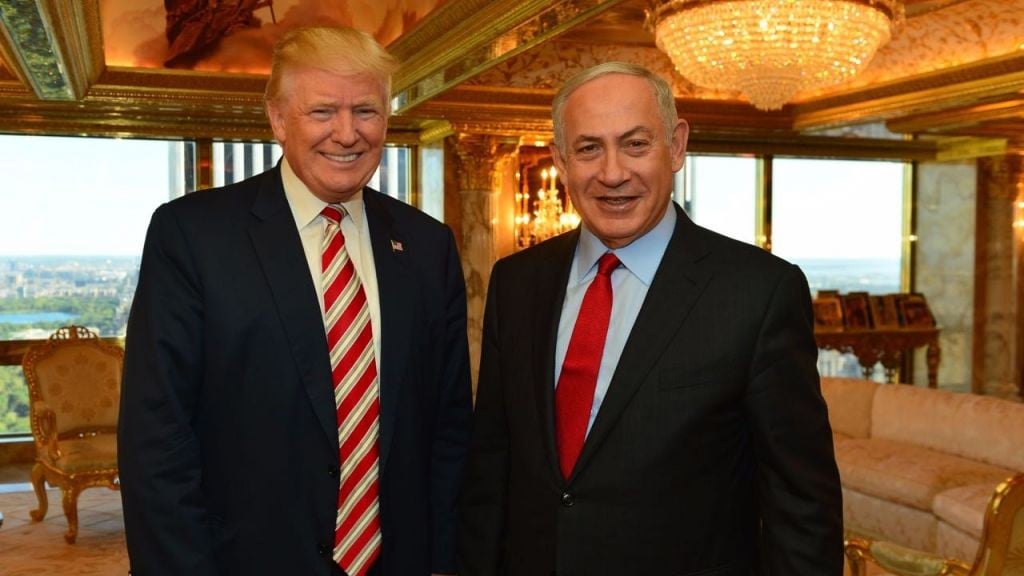
As the two US presidential candidates prepare to face off Monday night in their first head-to-head debate, the manner in which the Hebrew papers show their visages tells a lot about how they want their readers to perceive the Republican and Democratic nominees.
Israel Hayom’s surging support for Donald Trump ahead of the debate couldn’t be any more obvious: it shows a scowling Hillary Clinton and a beaming Trump on its front page. Yedioth Ahronoth, which has not hidden its antagonism for the Republican candidate, does the exact opposite, displaying Clinton with a smile and a hand over her heart, while Trump frowns and points aggressively.
But it is the photo of Trump with Prime Minister Benjamin Netanyahu during their Sunday meeting in New York City that runs across the board. Clinton’s meeting with Netanyahu gets no press because it took place after midnight Israel time, but because the presidential debate will only appear in Wednesday’s papers, it might get covered in tomorrow’s dailies.
Trump’s statement that he would recognize Jerusalem as the united capital of Israel makes the headline in Israel Hayom, where the upcoming debate plays second fiddle. Haaretz puts little stock in Trump’s comment, not bothering to put it in a headline and only mentioning a paragraph in that Trump’s campaign said it in a statement.
“It appears like the beginning of a wonderful friendship,” says Yedioth Ahronoth. “There are no walls of past tension between them,” it quips, “and they concur completely on how to deal with the evils of the world.” Trump’s promise to recognize a united Jerusalem, it notes, is more than any other presidential candidate has done. Others promised to move the embassy to Jerusalem, but never did.
Haaretz reporter Barak Ravid writes that Netanyahu spent 80 minutes with Trump, whereas he spent less than an hour with US President Barack Obama just a few days earlier. “This shows less about Netanyahu and more about what Trump and Obama feel toward him,” he says. Either that or the leader of the free world has a busier schedule than the Republican presidential candidate.
What bothers Ravid is that Trump said he wouldn’t cut Israel’s military aid, but then referred to it as “an excellent investment for America.” “Investment. Not shared interest of national security. Not part of the shared values of the only democracy in the Middle East. All in all business. What does that say about the future?”
Boaz Bismuth compares the upcoming presidential debate to the Super Bowl for his Israeli audience, many of whom have never watched a Super Bowl or know what it is. “In effect, Hillary’s campaign actually needs to explain to her that she should learn from Trump” so she can “pull a rabbit out of her hat” at the debate, Bismuth says. His suggestions are to admit she handled sensitive government material on her personal email servers, or “surprise Trump and tell him that she misses the days they were friends.” If she stays defensive, he says, Trump will continue to gain momentum. Trump, he advises, should project optimism, that’s how you win in America.
Yedioth Ahronoth’s Orly Azoulay describes Trump scarfing down a burger and a Coke and ignoring his aides’ counsel on how to manage the debate. “They prepared folders for him with briefings, but he doesn’t really take time to read,” she quotes a Trump adviser saying. “He trusts his intuition above anything else.” Clinton, on the other hand, asks deep questions “out of the knowledge that she must project her main advantage over Trump — political and international experience.” Between these two descriptions, it’s hard to tell who Azoulay is rooting for.
Elsewhere in the news, Haaretz highlights a new IDF directive allowing religious soldiers to ask for exemptions from events in which they’d have contact with women. Amos Harel says the new directive is an attempt to strike a compromise between the growing number of religious soldiers, particularly higher up the chain of command, and the increasing incorporation of women in the ranks. He says the new regulations tried to preserve the basic principles of the IDF’s character; to venture past them, soldiers would have to make a personal request.
The ongoing trial of Elor Azaria, an IDF soldier who’s charged with manslaughter for shooting a Palestinian terrorist in the head after he was already incapacitated, remains part of the national discussion after Netanyahu walks back comments that appeared to compare the soldier’s father to the parents of fallen soldiers. Israel Hayom appears to get behind Azaria, and its commentator Mati Tuchfeld calls the whole trial “unnecessary and damaging” to the IDF and Israel as a whole. He takes shots at Yedioth Ahronoth and Channel 2 for blowing Netanyahu’s remarks out of proportion.
Yedioth Ahronoth, meanwhile, speaks to Attorney General Avichai Mandelblit, who says that despite criticism for his handling of possible investigations into the prime minister, “if there’s reasonable suspicion, there will be a criminal investigation, I don’t care who it is.”







The Times of Israel Community.