

For Jewish community, midnight in Paris?
An attack on a kosher market leaves France’s community shocked and analysts wondering why Europe isn’t stirred to action
 Add ToI as a Preferred Source on Google
Joshua Davidovich is The Times of Israel's Deputy Editor
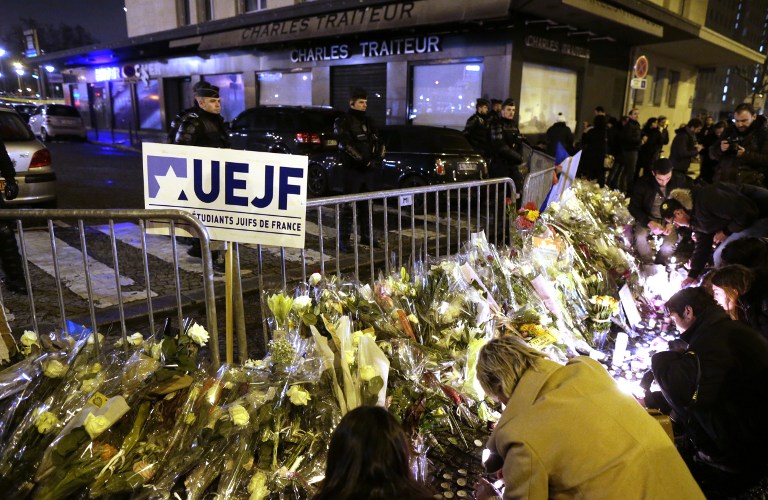
It’s been only two days since a horrific assault on a kosher market in Paris rocked France’s Jewish community, amid a spate of terror attacks, and the country and wider Jewish community are still very much reeling from the murders, as evidenced by the front pages of Israel’s major dailies Sunday morning.
“In Dad’s hands,” screams out the front page headline of Yedioth Ahronoth, accompanying a picture of a man holding a little boy and running out of the HyperCacher market. Israel Hayom also aims for the gut with its front page headline “The terrorist shot him and he died right in front of us,” against a stark black background.
Haaretz, meanwhile, takes the story forward, previewing Sunday’s massive rally in Paris with its main headline, though it ignores Israel’s high-level participation, instead highlighting “European leaders” who will be at the demonstration.
The broadsheet is chock-full of analyses on the situation in Paris, from philosopher Bernard Henri-Levy’s call for France to fight the jihadis without losing its soul (in a piece that pays considerable homage to the 12 Charlie Hebdo victims, but totally ignores the kosher market attack except to mention the attacker’s name) to Gideon Levy’s desperate plea that people shift attention from France to the death threat that he, Gideon Levy, received.
Sefi Hendler, meanwhile, wonders, as many others did, where the massive outpouring of support for the Jewish community was after the attack, from the same people who rushed to declare their identification with the Charlie Hebdo weekly.
“On Wednesday evening, all of France declared ‘Je suis Charlie,’ in what became the symbol of resistance to the barbarity – from Paris to New York. On Friday evening, there was no similar wave of pronouncements saying ‘I am a Jew,’ even though the citizens who happened to be in the supermarket were murdered just because they were in a place that symbolizes their Jewish lifestyle,” he writes. “There were, of course, quite a few French non-Jews who tweeted or wrote on their Facebook wall ‘Je suis Juif,’ but it was a drop in the sea compared to the tsunami of ‘I am Charlie’ posts that has led the public discourse. This gap is hard to explain.”
While Hendler looks forward and sees France putting itself at risk by ignoring threats to the Jews, Yedioth’s Alex Fishman looks backward and sees the same process, as Paris ignored Islamic extremism that focused its hatred on Jews — until it bit the republic in the derriere with the Hebdo attack.
“The security services of Europe – and France in particular – were not prepared in any way to face down Islamic extremist terror. Not professionally, not legally and certainly not mentally,” he writes. “Now France, and Europe as a whole, is shocked to the depth of its soul that French cops and journalists would be killed. Suddenly it becomes clear that all those red lights that should have lit up years ago, when Islamic terror killed Jews, didn’t blink on for even a second. French security services refused to touch Islamic terror in a professional and basic way.”
The paper also reports on the atmosphere of fear that has descended on the community in the wake of the attack. On Saturday morning, hours after the attack, only a few Jews trickled into prayers at two synagogues near the scene of the attack, the paper reports anecdotally. “Normally it’s full of worshipers here, today many are afraid to come,” one brave soul is quoted as saying.
It’s that same fear that characterizes Israel Hayom’s “exclusive” report interviewing hostages who were held at the market. One, who refuses to be identified by more than his first initial, tells the paper that he prayed terrorist Amedy Coulibany wouldn’t discover his Israel Navy shirt, or the IDF Paratroopers Brigade and Torah scroll necklaces he had on him. And he won’t let the paper show his face either.
“I got my life as a gift today,” he’s quoted as saying. Then, “Don’t photograph, I don’t want them to come to my house and kill me. There are a lot more jihadis in Paris. I don’t want them to recognize my face.”
The paper also speaks to Rabbi Batto Hattab, the chief rabbi of Tunisia, whose son Yoav Hattab was one of the four Jewish men killed in the HyperCacher attack.
“We accept the decree of God with love,” he tells the paper upon arriving somewhere (where, it doesn’t say) from Tunisia. “This is very difficult, what we are experiencing. My son came to France to finish his studies and at the end of the year planned to immigrate to Israel. On Tuesday morning I will bury him in the cemetery in Givat Shaul in Jerusalem. That’s the best place he can be.”
Yedioth Ahronoth, however, reports that Hattab, along with Yohan Cohen, Phillipe Barham and François-Michel Saada, will be buried on the Mount of Olives in a state ceremony, and that the four will be recognized by Israel as terror victims. The paper writes that the families decided on the move after Foreign Minister Avigdor Liberman convinced them to bury their loved ones in Israel, and that the funerals will take place under heavy security.
Cold and colder
Switching gears completely, Haaretz reports that despite the freezing weather experienced by the country over the last few days, Prison Service Authorities have refused to let African migrant detainees at the Holot holding facility in southern Israel use heaters, for fear of fires. The paper writes that after lawmakers got involved, the prison handed out heating pads, but only three of the weak devices per every 10 inmates.
“They gave us something small, a heating pad. It doesn’t help, it’s nothing. We told them it’s not right, we’re cold. They said they’ll bring us more heating pads by Sunday,” the paper quotes one African detainee as saying.
Meanwhile, Israel Hayom notes the cold shoulder the Palestinians’ statehood bid is receiving in Washington, writing that senators from both sides of the aisle are threatening to freeze Palestinian aid should they go ahead with their plans to join the International Criminal Court in The Hague.
“The Palestinian Authority’s (PA) decision to join the International Criminal Court (ICC) is deplorable, counterproductive, and will be met with a strong response by the United States Congress,” Senators Mark Kirk, Lindsey Graham, Robert Menendez, Chuck Schumer are quoted as saying in a statement. (The paper inexplicably forgets to mention Bob Corker, who also signed onto the statement.) “Existing US law makes clear that if the Palestinians initiate an ICC judicially authorized investigation, or actively support such an investigation, all economic assistance to the PA must end.”




The Times of Israel Community.