

Captivating image of Hasidic girl hangs in UK’s National Portrait Gallery
‘Chayla in Shul’ by young photographer Laura Pannack wins major prize in international competition
 Add ToI as a Preferred Source on Google
Renee Ghert-Zand is the health reporter and a feature writer for The Times of Israel.
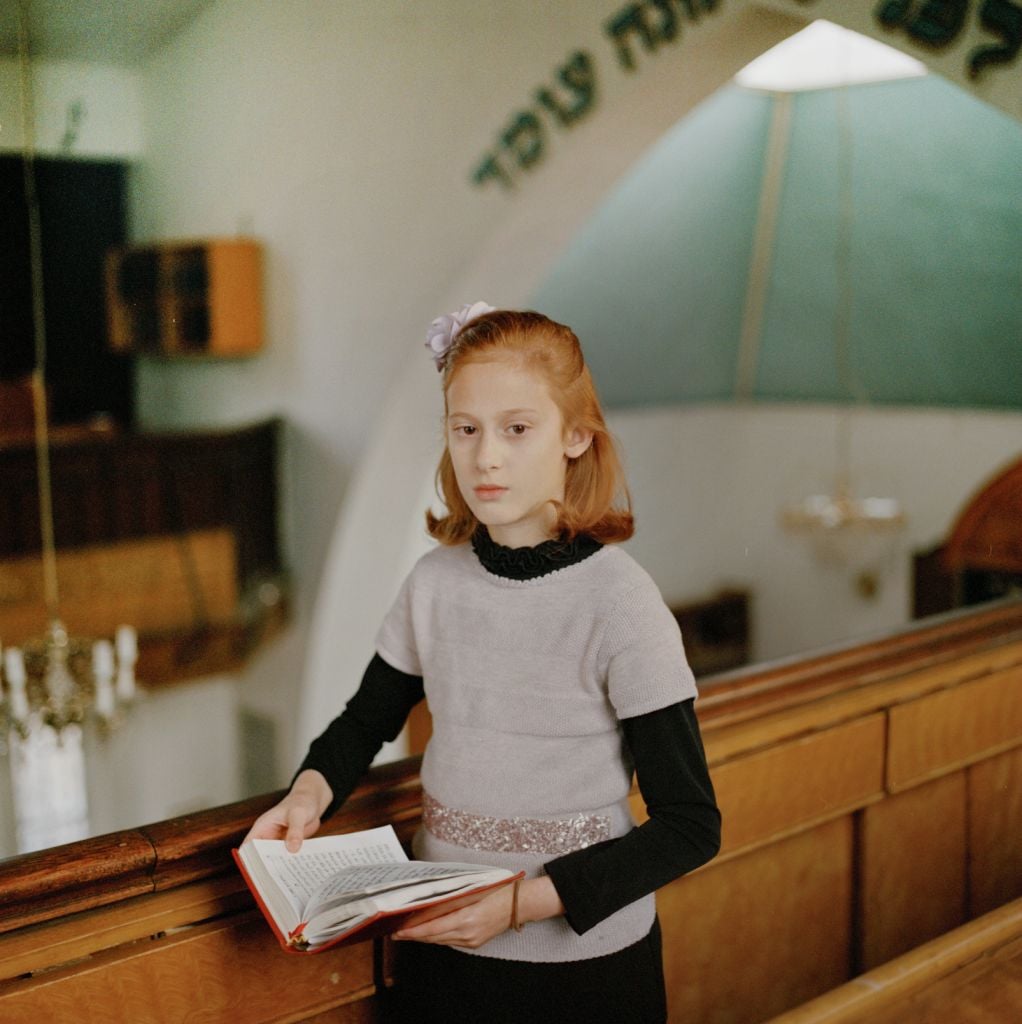
Visitors to the National Portrait Gallery in London between now and late February of next year will encounter a striking photograph of an 11-year-old, redheaded Hasidic Jewish girl in synagogue. The photograph is almost painterly in its composition, color and lighting, giving an impression of timelessness.
The portrait, “Chayla in Shul,” by photographer Laura Pannack, is the winner of the 2014 John Kobal New Work Award and part of the Taylor Wessing Photographic Portrait Prize exhibition of 60 new portraits by some of the world’s most exciting contemporary photographers. “Chayla” is part of an in-depth project Pannack is pursuing on the local Hasidic community in London’s Stamford Hill neighborhood for the past three years.
This is not the first time the London-based Pannack’s work has been included in the Taylor Wessing exhibition, nor her first major award. Pannack, 29, focuses on social documentary and portraiture, mostly though self-initiated projects, and has seen her photographs exhibited and published extensively in the UK and abroad.
The Times of Israel interviewed Pannack by email about the inception of her award-winning portrait of Chayla.
I understand that your approach to photography is to spend considerable time with your subjects in their habitual environments. How have you gotten to know the Hasidic community?
‘I am conscious I am meeting people who are very sensitive to having their picture taken’
The reason I spend time with people is to get a deeper understanding of who they are and to ensure that they are comfortable. It’s tricky, as perhaps I shot less than I would like, because I am conscious I am meeting people who are very sensitive to having their picture taken. I spend time with people by visiting their homes, having meals with them, playing with their children, volunteering my services, taking pictures for them rather than for me, and celebrating festivals with them. It is important to me that they get to know me.
Are you only photographing women in the community?
Yes, and their children and families. But the women are my main focus.
What has been the most surprising thing you have learned about the Hasidic community from spending time with its members?
I guess how strong the women have to be to look after so many children. They often have very large families and seem to cope so well.
Are you Jewish? If so, what was your religious upbringing, and what is your Jewish identity today?
I am. My mother is Jewish, but not practicing. I have been raised to acknowledge my Jewish roots and appreciate it as a part of my identity. I went to cheder [Hebrew school] and had a bat mitzvah, but my knowledge and understanding of Judaism is limited to say the least. I am not practicing but I am proud of my roots.
How did the photo of Chayla come about? What made you decide to photograph her in the synagogue, as opposed to at school or at home?
I love the look of the shul and I asked to shoot there, as access to her school would have been problematic. Her father is the rabbi.
What challenges faced you in photographing this portrait?
‘Chayla is intelligent, adult and extremely quiet. Photographing her was an honor’
Chayla is intelligent, adult and extremely quiet. Photographing her was an honor. I find it frustrating when I can’t get to know someone. I often use silence in my work to create tension, but with Chayla it was forced upon me as she didn’t really open up. Even now, after knowing her for years, she is incredibly shy around me and I am still trying to get to know her. It wasn’t challenging that she was silent. It just made me nervous. I think [silence] is a wonderful quality — I talk far too much!
Have you exhibited other photographs from this project, or is the one of Chayla the first you have shared with the public?
I haven’t exhibited others. Chayla is the first. Despite working on this project for many years, I have shot very little. My time has been spent getting to know different families and thinking about what I would like to capture.






The Times of Israel Community.