

Hezbollah claims elusive Hamas chief sent condolence letter
Mohammed Deif, targeted in Israeli assassination attempts, said to have written to Lebanese group following deadly strike in Syria
 Add ToI as a Preferred Source on Google
Adiv Sterman is a breaking news editor at The Times of Israel.
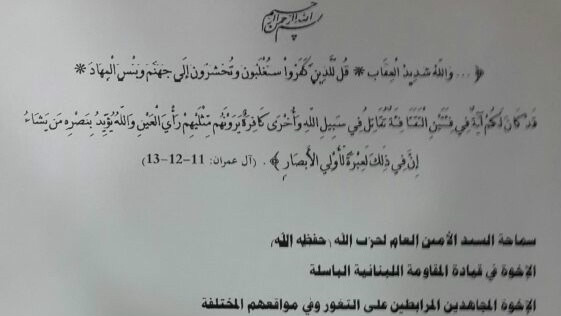
Lebanese group Hezbollah claimed Thursday to have received a condolence letter from Hamas’s chief military commander Mohammed Deif, the organization’s elusive terror mastermind who was targeted by an Israeli airstrike in Gaza during the summer’s 50-day Israel-Hamas war and had not been seen in public since.
According to the Lebanese Al-Manar TV station, which is widely considered to be affiliated with Hezbollah, the letter attributed to Deif discusses Sunday’s deadly airstrike in Syria that killed several of the Shiite group’s operatives as well as Iranian Revolutionary Guard Corps members.
The writer of the letter stresses that the killings must serve as a wake-up call to Muslims around the world, and criticizes “those who are cowards and who are submissive,” apparently a reference to Palestinian Authority President Mahmoud Abbas.
The letter, which was addressed to Hezbollah Secretary-General Hassan Nasrallah and the organization’s leadership, also called for immediate revenge on Israel for the attack.
Officially, Israel has neither confirmed nor denied taking any part in the fatal Syria strike, though unnamed security sources have indicated that the attack was, in fact, carried out by the IDF.
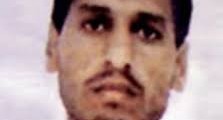
Last month, Hamas released a video which it claimed showed Deif, who headed Hamas’s Izz ad-Din al-Qassam Brigades, alive and well. Hamas has maintained that terror chief Deif survived an August 19 assassination attempt, in which his wife and child were killed.
Reports following the conclusion of the summer war suggested Deif could have escaped in the lull between the two missile strikes on his home, the second of which leveled the building.
Deif survived at least one earlier assassination attempt.
On Sunday, 12 Hezbollah and Iranian operatives were killed in a strike on a convoy near the Syrian border town of Quneitra. The dead included Iranian general Mohamed Allahdadi and a senior Hezbollah commander, Jihad Mughniyeh, son of Imad Mughniyeh, himself a former top commander with the group who was killed in 2008 in an operation widely thought to have been ordered by Israel.
Following Sunday’s incident, Israel ramped up alertness along the northern border, deploying Iron Dome anti-missile batteries and canceling leave for some soldiers in anticipation of a possible retaliatory strike by Hezbollah.
On Tuesday, a host of Iranian officials threatened harsh retaliation against Israel for the Sunday strike. Revolutionary Guards chief Mohammad Ali Jafari said that Israel should anticipate “devastating lightning,” according to the Iranian Tasnim news agency, and that Iran would widen its support for Muslim fighters in the Middle East “until the final collapse of the Zionist regime.”

Iranian Parliamentary Speaker Ali Larijani accused Israel of being behind “all acts of terror in the Middle East,” particularly in Syria, according to a Press TV report, and said that “necessary measures should be taken in these cases.”
Ayatollah Ali Khamenei also joined the chorus of Iranian officials blaming Israel for the airstrike.
According to a semi-official Iranian Fars news report, Soleimani and Mughniyeh had a relationship “deeper than that of a young man with his father’s friend, and those who didn’t know, imagined that he was indeed his son.”
Ilan Ben Zion and Stuart Winer contributed to this report.






The Times of Israel Community.