

In Rio, all that glitters need not be gold for Israel
All it took was a bronze medal by judoka Yarden Gerbi for papers to celebrate like it’s the second coming of the state, and begin to hope again of even more Olympic success
 Add ToI as a Preferred Source on Google
Joshua Davidovich is The Times of Israel's Deputy Editor
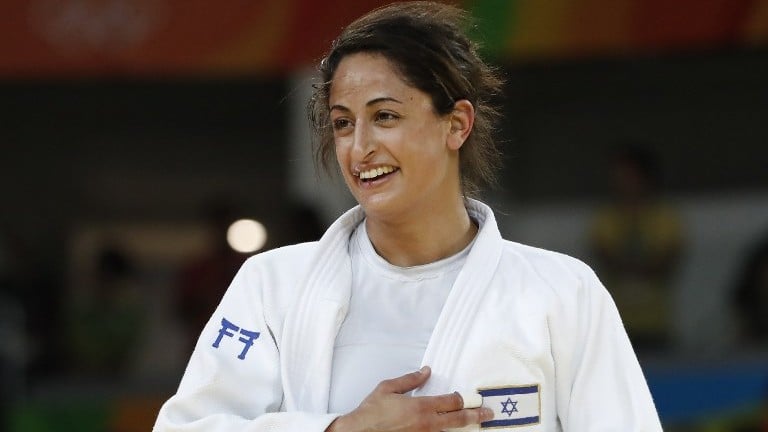
There are a few things that could tip a person off that they live in a small country. Your president might double as an assistant professor and TV commentator; your embassy in Washington might be the former home of an air conditioner contractors’ group. Or, as Israel finds out Wednesday morning, a single Olympic bronze medal may send the country into a massive frenzy, with celebratory front pages mirroring the A1s when the state was founded.
Yarden Gerbi’s judo almost-win in Rio might have constituted just a brief note for larger Olympics powerhouses, like Hungary, but in Israel, it’s major news of a type rarely seen.
Indeed, Gerbi’s medal win is also rarely seen, as the judoka became just the second Israeli woman ever to win a medal, and the first Israeli of any gender since 2008.
Gerbi may have only come in third, but to the papers she won the gold. Both tabloids Israel Hayom and Yedioth Ahronoth run massive congratulatory packages feting Gerbi’s win, starting with triumphant front pages covered with the same picture of Gerbi chowing down on her bronze and single-word headlines: (“Yes!” in Yedioth’s case, “Respect” in Israel Hayom’s).
Haaretz, meanwhile, apparently missing the magnitude of the event, makes do with a picture of Gerbi and the start of a story above the fold, but instead opts for so-called actual news above her, to wit: silly stuff like police beefing up their forces in East Jerusalem and large cuts to the education budget.
Making good use of the paper that used to be trees in Brazil’s rainforests, the papers are filled not only with festive pictures and color features about Gerbi and her fans and family, but reams upon reams of commentary of the decidedly unanalytical event, which seeps into the news coverage as well.
“Gerbi added her name to the golden letters of the annals of Israeli sports. Her achievement was historic not only because it was the eighth medal in Israel’s history … but mostly because she’s the first woman to stand on the podium since Yael Arad did it (twice) 24 years ago,” Miki Sagi writes in Israel Hayom’s news story.
Chilling with Gerbi’s family to watch the excitement go down, Yedioth’s Eitan Glickman describes a scene familiar to any sports fan.
“In the house, screaming can be heard, a mix of cheering and instruction for Yarden,” he writes. “And then the turning point in the match comes. Yarden pulls off an amazing maneuver and gets a serious advantage. … There’s just two or three minutes left in the match, but they are all nerve-wracking. And then it happens. Three seconds before the end the judge separates the two, Yarden takes a long breath, and at home they know that nothing can come between her and the medal. Relatives burst out in dancing in the wide living room, holding Israeli flags.”
Despite his paper playing down the event in comparison to the others, Haaretz’s Uzi Dan still rattles off a list of reasons why this medal is special, including the gap since the last medal, the fact that she’s a woman and the rest of the team had done so poorly thus far, and lastly, because of Gerbi’s own magic, which he says is so un-Israeli.
“She’s a fighter, she puts in time, she’s modest, and she’s also the only Israeli judoka to ever win a world championship. But most of all is her character. She doesn’t go off the wall when she wins and doesn’t get depressed when she loses,” he writes. “That’s exactly the opposite of the manic-depressive behavior of Israelis, of fans, and sometimes of athletes and pundits.”
The happy side of that manic depressive behavior is on display in commentaries in Israel Hayom, where Sagi, now as an analyst, writes that Gerbi’s win erases all the doomsaying of days past as Israeli athletes failed to win much.
“Thanks to Gerbi, color has returned to the Israeli delegation here in Rio and smiles have returned to the faces of Israelis, and rightly so,” he writes. “As is usually the case among us, the transition from euphoria to depression is a nonstop journey, and in the last two days we’ve done it again – the national mourning over the results of the first days has turned into euphoria, as if Hatikvah will soon be heard in Rio.”
In Yedioth, Nahum Barnea also writes that the hopes that the anthem will be heard are real, but reports sarcastically that the chances of that happening rest not with those who walk the judo mat we call earth, but with the Holy Judge above, beckoned by a politician who could use some lessons in how the Games work.
“Before the match, maybe before every match, [Culture and Sports Minister Miri] Regev sent a request to a rabbi. Somebody put it online and it was shown to me. ‘Dear Rabbi,’ she wrote. ‘[Pray] that we will win bronze and hear the anthem.’ Only someone who wins gold gets the anthem – this time it was Slovenia – but what does that matter,” he writes. “Everything is thanks to the rabbi.”






The Times of Israel Community.