

In Tel Aviv, English-speakers angle for Knesset representation
Community has unique needs best served by someone connected to the issues, says US-born MK Dov Lipman of Yesh Atid
 Add ToI as a Preferred Source on Google
Melanie Lidman is an AP reporter and former Times of Israel reporter
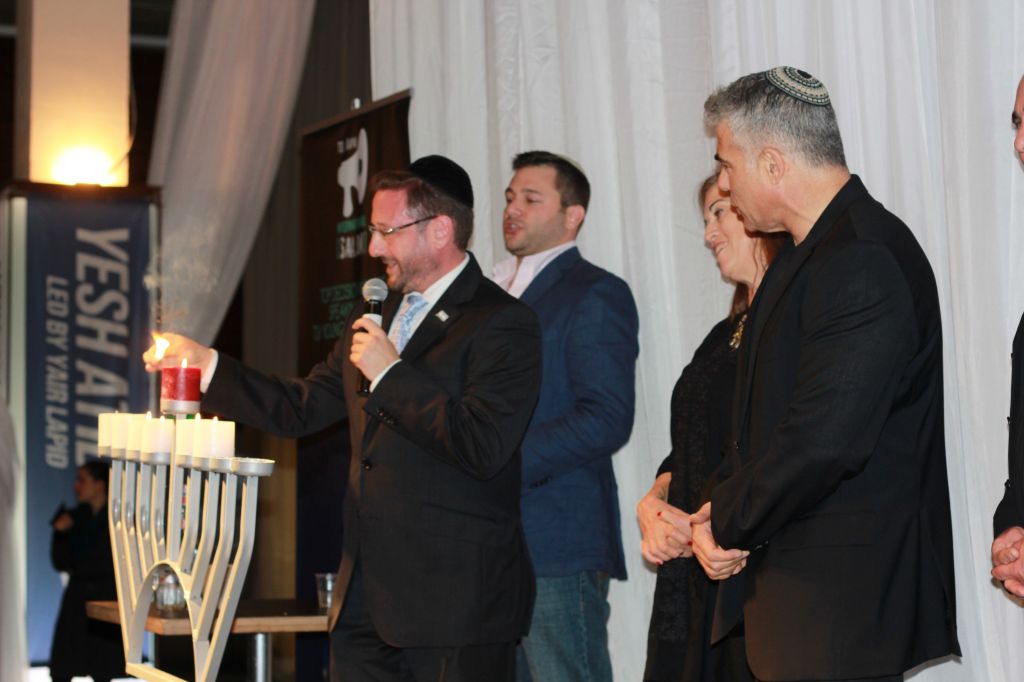
After Yair Lapid spent an hour and a half slathering on the praise for Zionist immigrants who choose to make aliyah to “give their life meaning,” one immigrant in the front row of the event for English speakers at the Trask Bar in Tel Aviv wanted a concrete answer.
Adam Bellos, a volunteer organizer with Tel Aviv Internationals Salon, which hosted a Q&A with Lapid for hundreds English speakers at a cavernous waterfront bar on Sunday night, asked the last question, and he was not pleased with the response.
I want to know that my voice will be represented in the Knesset, he told Lapid. That means having an MK who immigrated from an English-speaking country, Bellos continued. Is MK Dov Lipman, who was present at the event, going to make it to the next Knesset?
Lipman, originally from Baltimore, immediately turned bright red and insisted the question hadn’t been planted.
“We’re not even close to talking about the list,” Lapid answered. “Only after February 1 we’ll talk about the list. Right now we’re a family and we don’t want to be tangled up in a way that will pitch different members of this family against each other.”
While Bellos said he was disappointed with the non-answer, his question was a serious one for immigrants.
‘We are bombarded daily with requests from English olim. They have no one else to turn to’
“We were the largest minority without a voice in the Knesset [in the previous government],” said co-organizer Jay Shultz. “MKs think that Western olim have no challenges and no issues, but that’s not true.”
Lipman said that as the only Anglo-born MK in the last Knesset, his office became the de facto address for immigrants struggling with a variety of issues, many of which were not connected to his core issues of religious equality and the economy. “We are bombarded daily with requests from English olim,” he said. “They have no one else to turn to… education is usually their biggest concern when their kids are really struggling in school.”
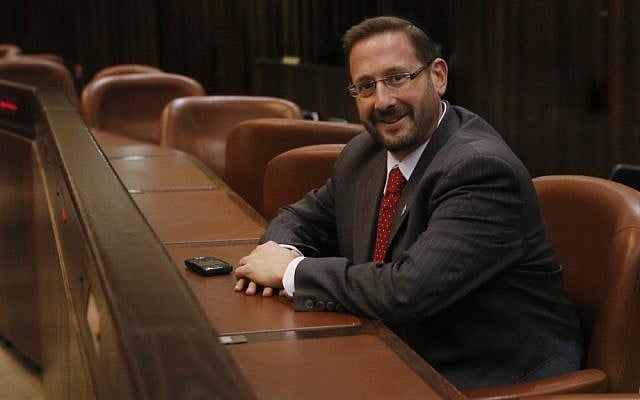
Lipman said he has won a number of small victories for immigrants, small bureaucratic steps that make acclimatizing to life in Israel a bit easier. For example, if immigrants who are converting their foreign driving license to an Israeli one fail their driving test twice, they used to have to take a complicated Hebrew theory test, which required studying the Hebrew driving manual.
“Olim used to call me in tears and say ‘I’ve been driving for 20 years and the instructor failed me because he was in a bad mood and now I have to take this impossible test,’” Lipman said. Lipman worked to cancel the theory test part so now immigrants who have been driving previously can retake the tests as many times as needed without the written theory test requirement.
He also worked with the Health Ministry to change requirements for foreign nurses, who were previously required to move to Israel and then wait to take the licensing exam, which made it financially difficult for nurses to immigrate because they could not start working right away. Now, nurses can take the test in select locations in the US if there is a group of over 50 people. Nurses can also come to Israel and take the test before moving here, meaning they can continue working at their jobs abroad while they wait to get certified.
These are the kinds of small but meaningful bureaucratic steps that require an MK who himself had immigrated to Israel working in the trenches who is aware of these difficulties and connected to the community, explained Lipman.
Lipman willingly admits he never expected to be in the current Knesset. He was the 17th slot in Yesh Atid’s list, and the party was only projected to win about 10-12 seats. When it eventually took 19 seats in the last election, Lipman, a Beit Shemesh resident who had lived in Israel for just seven years, became an MK.
In the current election, former US Ambassador Michael Oren, who is originally from New Jersey, is widely rumored to be running on the slate of Moshe Kahlon’s new party, Kulanu, so English speaking immigrants might have two chances to get a representative in the Knesset. The last such MK was Moshe Arens, who was born in Lithuania but moved to the United States as a child and came to Israel in 1948. Arens (Likud) was defense minister three times as well as minister of foreign affairs. He retired in 2003.
‘The government needs to see us as an asset, and without a Western immigrant representative in the government, they won’t hear our voice’
“This country has a massive treasure in their Western olim, the same way they had so many benefits from all of the educated Russians coming to Israel,” said Jonathan Javor, another organizer of the event who was also a candidate for Tel Aviv City Council with Ron Huldai’s Tel Aviv 1 party. “The government needs to see us as an asset, and without a Western olim representative in the government, they won’t hear our voice.”
“We don’t want a Western immigrant party…Western immigrants don’t vote as a bloc,” Javor continued. “What we want to do is put a Western immigrant in every party.”
That, he explained, is the purpose of Tel Aviv Internationals’ Salon events – giving immigrants a friendly opening into the complicated world of Israeli politics. Multi-party elections, primary lists, numbered seats, coalitions, dissolving the government after only 20 months of work – all that can be confusing to a new immigrant who didn’t grow up with this political system. “We need to be engaged, in order to get our voice out there,” Javor said.








The Times of Israel Community.