

Jerusalem Film Fest pays tribute to documentary pioneer
Albert Maysles, who died in March, was among the first to shoot handheld footage and record synchronous sound
 Add ToI as a Preferred Source on Google
This year’s Jerusalem Film Festival features a timely celebration of Jewish cinematic heritage with its tribute to Albert Maysles, the Jewish documentary filmmaker who, along with his brother David, were considered pioneers of non-fiction filmmaking.
Perhaps best known for his films “Salesman” (1968), “Gimme Shelter” (1970) and “Grey Gardens” (1975), Albert Maysles, who was once called “the best American cameraman” by Jean-Luc Godard, passed away in March, prompting the commemoration of his work. He was 88.
Daniella Tourgeman, international relations liaison and curator of the Jerusalem Film Festival, cited the Maysles brothers’ “canonical” status as a reason to pay homage in the wake of Albert’s death.
“The Maysles brothers were some of the most influential documentary filmmakers of all time,” she said. “Their influence extends beyond the subject matters of their films, but also in their approach to making them.”
The Jerusalem Film Festival always aims “to cherish artists and artistic visions,” added Tourgeman. “We also want to preserve the legacies of great filmmakers for younger generations. We all thought that Albert Maysles was very much worth a tribute for that purpose.”
Last July, Albert Maysles was awarded the National Medal of Arts from US President Barack Obama.
This year, the 10-day festival is screening six films of the late director: “Journey to Jerusalem” (1968), “Gimme Shelter” (1970), “Grey Gardens” (1975), “Islands” (1986), “LaLee’s Kin: The Legacy of Cotton” (2001) and “Iris” (2015), Albert’s second-to-last documentary about the eccentric fashion icon Iris Apfel.
Rebekah Maysles, Albert’s daughter, worked with Elad Samorzik, artistic director of the festival, to choose the selection of films shown.
They were unable to bring “In Transit”, his last film, posthumously released in May, due to a lack of international distribution rights. They do plan, however, to screen it at next year’s festival, said Tourgeman.
Both Maysles brothers were known for their cinéma vérité style. The two were among the first filmmakers to use the technological advance of the small camera, able to shoot handheld footage and record synchronous sound. Until David died of a stroke in 1987, the two consistently worked as a small crew, with David recording the audio and Albert shooting the film.
Martin Scorsese once described Albert’s camera work as “an inquisitive presence, but also a loving presence, an empathetic presence, turned to the most sensitive emotional vibrations.”
The brothers routinely collaborated with Susan Froemke, Ellen Hovde, Muffie Meyer and Charlotte Zwerin, who often shared the credits for key creative roles.
While the brothers had several achievements in the early 1960s, it was “Gimme Shelter” — about the Rolling Stones’ 1969 American tour — that brought them international attention. The grim documentary shows a fan being stabbed to death by the Hell’s Angels at the infamous Altamont Free Concert, outside San Francisco.
In addition to the film’s critical praise, it garnered criticism from those who thought it exploited the concert’s episodes of violence. Legendary New Yorker film critic Pauline Kael skewered the film as a “cinéma vérité sham” and having a “very disturbing pathos.”
Criticism of exploitation in the Maysles’ oeuvre didn’t end there. It was reignited with “Grey Gardens,” a film about Edith Bouvier and her daughter, Edith Bouvier Beale, the reclusive relatives of Jacqueline Kennedy Onassis, who lived in a crumbling old mansion in the East Hamptons. While some viewed the film as voyeuristic, it went on to gain cult status.
Film critic Roger Ebert hailed it as having a “fascinating, mysterious center.”
He went on to say: “It’s about two eccentrics, two people who refuse to live the way they’re supposed to, but by the film’s end we see that they live fully, in ways of their own choosing.”
In 2014, “Gimme Shelter” and “Grey Gardens” were listed as the 28th and 9th best documentaries of all time, respectively, by the British Film Institute. They are also often cited as landmarks of cinéma vérité.
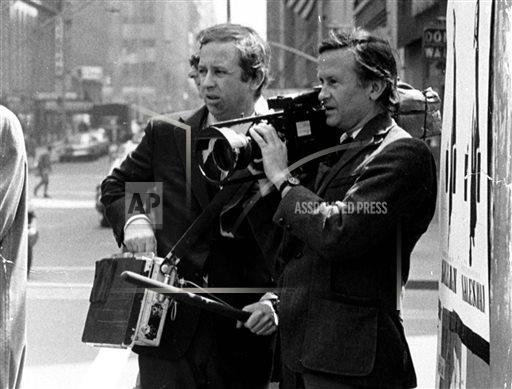
While the term “cinéma vérité”– meaning “cinema of truth” in French — was coined by anthropologist-filmmakers Jean Rouch and Edgar Morin, Albert acquired many of the movement’s techniques when he worked as a co-cinematographer on Robert Drew’s 1960 film “Primary.”
The documentary showed the Wisconsin Democratic primary election between John F. Kennedy and Hubert Humphrey.
Film scholars, however, point to “Primary” as more an example of direct cinema than vérité. While the two terms are often used interchangeably, critics identify certain distinctions.
Both styles are known for handheld camera work, raw footage edited into the structure of a novelistic story arc and an absence of interviews and voiceover narration.
Despite those similarities, direct cinema presents the film so that the subjects and the audience aren’t made aware of the camera’s presence while cinéma vérité, on the other hand, specifically shows the filmmakers’ interaction with the subjects.
Many of the Maysles’ earlier films, like “Salesman” (a study of four door-to-door bible salesmen), are considered works of direct cinema, whereas their later films shifted more to vérité methods:
In “Gimme Shelter”, for instance, there are scenes of the Rolling Stones watching previously shown footage with the Maysles brothers; in “Grey Gardens”, the main characters directly address the filmmakers.
With those films the Maysles brothers became innovators of the craft, suggesting the camera could be both an aesthetic tool and observational laboratory.
When asked by The New York Times in 1994 about his approach to documentary filmmaking, Albert said: “Making a film isn’t finding the answer to a question; it’s trying to capture life as it is.”
For more information on the Albert Maysles Tribute, screenings and ticket sales, go to the Jerusalem Film Festival website.







The Times of Israel Community.