

Jewish Home primaries end with over 43,000 voting
Some 60% of members of nationalist party choose Knesset slate after court nixes attempt to delay elections over procedural issues
 Add ToI as a Preferred Source on Google
Stuart Winer is a breaking news editor at The Times of Israel.
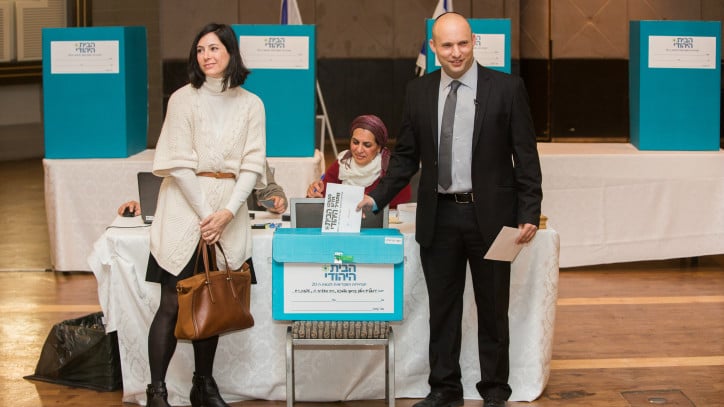
Roughly 60% of eligible Jewish Home party members, close to 44,000 people, cast their votes for the party’s Knesset slate Wednesday.
Eyal Bar Lev and Daniel Bashari, party members, obtained a court injunction Tuesday to halt the vote, but on Wednesday morning the Lod District Court rejected their claims and allowed the vote to go ahead as planned.
Some 77,000 party members were eligible to vote on the party list, which had 37 candidates competing for realistic places in the 20th Knesset. Results were expected Thursday.
Only a few seats in realistic spots were actually up for grabs, with the rest either reserved by the party leadership or slated for members of the Tekuma faction within the party, which held its primary earlier this week.
Polls show the party garnering seats some 15 seats in parliamentary elections scheduled for March 17.
A handful of the 262 voting stations at 126 locations across the country opened in the morning, with the bulk opening their doors at 3:00 p.m. Polling booths closed at 10:00 p.m. local time.
Turning to the court Tuesday, Bar Lev had demanded that invitations to participate in the primaries be sent to each of the party members and also that the voting slips be brought to a central location for counting under the eyes of observers, to ensure a fair democratic process.
On Tuesday the court ordered that the elections be put on hold until the concerns were resolved.

With barely two hours until polling stations opened, Economy Minister Naftali Bennett, the party’s leader, attempted to persuade Bar Lev and Bashari to waive their objections and allow voting to begin on time.
Party officials had downplayed the challenge as standard pre-election maneuvering.
“It is a standard spin before every primary, and that goes to show that we are maintaining the party traditions,” an unnamed party source told Israeli news site Ynet before the court decision. “The elections will be held as planned.”
According to Ynet, the largest segment of Jewish Home voters — some 41% — come from the central region of the country where most of Israel’s population live. Another 25% are from the periphery and 22% are from West Bank communities where the party has strong support.
Jewish Home had also increased its support among younger Israelis, with over half its eligible voters under the age of 34, and 22% above the age of 50. In 2012 only 34% of party members were under the age of 34 and about the same number were above the age of 50.
Adiv Sterman contributed to this report.










The Times of Israel Community.