

Kerry, Zarif discuss Syria peace, nuke deal at UN
US top diplomat, Iran FM hold first meet since sealing landmark agreement in Vienna 2 months ago
 Add ToI as a Preferred Source on Google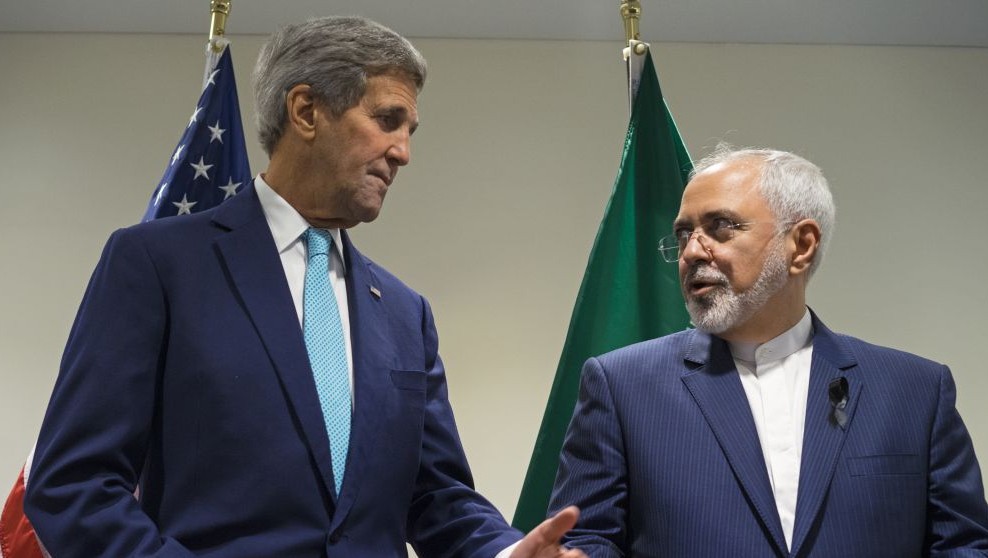
US Secretary of State John Kerry met on Saturday at United Nations headquarters in New York with Iranian Foreign Minister Mohammad Javad Zarif to discuss the ongoing civil war in Syria, the developing crisis in Yemen and the nuclear deal the world powers signed with Tehran in July.
“I view this week as a major opportunity for any number of countries to play an important role in trying to resolve some of the very difficult issues (of) the Middle East,” Kerry told reporters, according to Reuters.
“We need to achieve peace and a way forward in Syria, in Yemen… in the region,” he added. “I think there are opportunities this week, through these discussions, to make some progress.”
Kerry and Zarif were holding their first face-to-face meeting since they sealed a landmark nuclear agreement in Vienna in July.
Zarif said his primary focus in the talks with Kerry would be implementation of a deal that curbs Iran’s nuclear program in exchange for relief from economic sanctions. He also said Iran was willing to discuss regional issues, including the deadly stampede at the Hajj pilgrimage in Saudi Arabia, in the appropriate forum.
“The situation in the region, the unfortunate developments in Saudi Arabia over the last week, have been disastrous and we need to address them. We will address them in the proper international forum,” Zarif said.
On Friday, the Obama administration’s top Iran negotiator, Undersecretary of State for Political Affairs Wendy Sherman, said discussing Syria with Iranian officials would “make sense” in the context of current developments.
But she noted resistance to the idea within Iran, which, along with Russia, is a main supporter of Syrian President Bashar Assad. She said the subject of Syria had been raised informally on the sidelines of the nuclear negotiations that ended in July, though never in a structured way.
The US has called, without success, for Iran and Russia to stop backing Assad. In recent weeks, Russia has built up its military presence in Syria. That issue was to be a central topic of discussion in Kerry’s meeting with Russian Foreign Minister Sergei Lavrov on Sunday in New York, a day before President Barack Obama’s talks with Russian President Vladimir Putin.
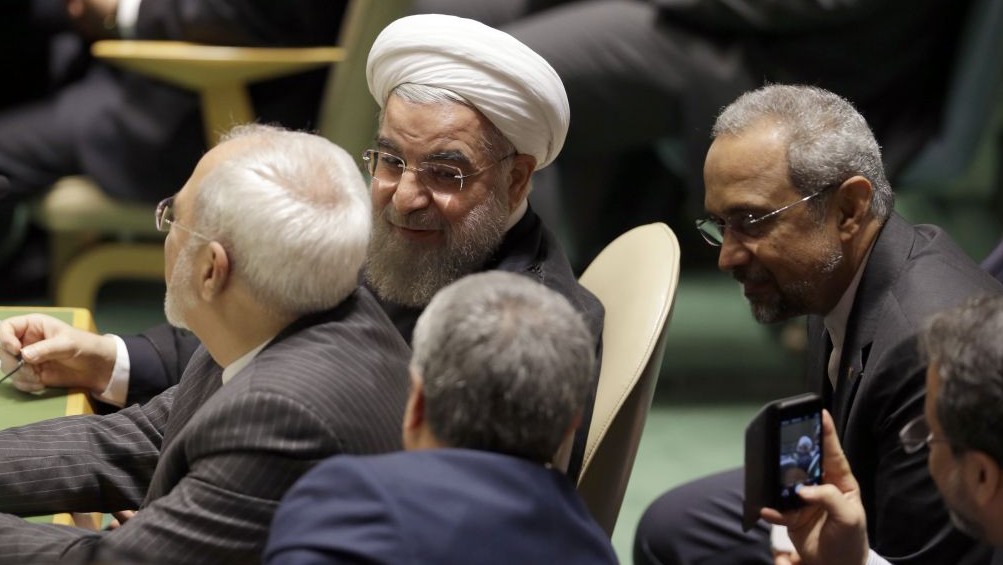
Also on Friday, Iranian President Hassan Rouhani said that Iran-US ties had improved in recent years but that there was “still a long road to travel” until the two countries established normal relations.
Speaking to a group of editors after arriving for the annual UN General Assembly, the Iranian president said the opposition expressed by some US lawmakers on the Iranian nuclear deal reflected “extremely bitter extremist judgments,” and was not well-received in Iran.
“It was as if they were on another planet,” he said, according to Reuters. “They did not seem to know where Iran was.”
“The nuclear issue is a big test within the framework of issues between the United States and Iran,” Rouhani told the group. “If we can see that we can reach success…and both sides have contributed to that success in good faith, then perhaps we can build on that.”
Rouhani said implementation of the nuclear deal would improve the atmosphere to allow progress to be made.
He also said that Iran can play a constructive role in addressing the threat of the Islamic State group, which has seized control of large swaths of Syria and Iraq, and that world powers were wrong to try to keep Iran out of the discussions on how to deal with the threat.
Iran is “a powerful and effective country in the region, this is undeniable,” Rouhani said. Without Iranian intervention on the side of the Baghdad government at a crucial juncture last year, he said, the Islamic State might already have taken over all of Iraq.
“Had it not been for Iran’s help, Baghdad would have fallen and certainly Daesh would have been ruling in Baghdad,” he said.
Rouhani defended the government of Assad from charges of brutality in dealing with its opponents. He denied any knowledge of the use of “barrel bombs” against civilians in Syria’s civil war, but suggested that Damascus was entitled to use whatever it has at its disposal to counter terrorists. Citing the beheadings of women and children and other atrocities by Islamic State extremists, he said, “With such a savage, inhuman, subhuman group, how should we fight them?”








The Times of Israel Community.