

Key reasons why opponents hate the Iran nuclear deal
Even though US lawmakers critical of the accord can’t win in Congress, they vow to continue fighting agreement
 Add ToI as a Preferred Source on Google
WASHINGTON (AP) — Even though opponents of the Iran nuclear deal can’t win in Congress, they aren’t going to go quietly.
Conservative Republicans are vowing to take President Barack Obama to court, claiming he has broken the law by not providing Congress with all relevant documents pertinent to the deal.
“This debate is far from over, and frankly, it’s just beginning,” House Speaker John Boehner, R-Ohio, said Thursday. “This is a bad deal. … We’ll use every tool at our disposal to stop, slow, and delay this agreement.”
Here are the key reasons why critics oppose the deal.
They haven’t seen two side deals
Republicans in the House claim that the Obama administration has not provided Congress with the text of two so-called “side agreements” that the International Atomic Energy Agency negotiated with Tehran. The law that gave Congress a chance to review the agreement for 60 days required the president to give lawmakers all relevant documents.
The conservative Republicans claim the 60-day clock never started and that they can’t cast votes on the deal because they are still waiting for all the documents.
The administration says it doesn’t have the separate agreements, and the nuclear inspection agency says confidentiality agreements prevent it from releasing them.
Rep. Mike Pompeo, R-Kan., is undeterred.
“We have members of Congress stand up and demand that they see the text of bills that rename post offices and yet this is a historic agreement and many of my colleagues are saying they are going to vote for it without even knowing what the details are about important components about how we’re going to verify whether the Iranian regime has complied with this agreement,” he said.
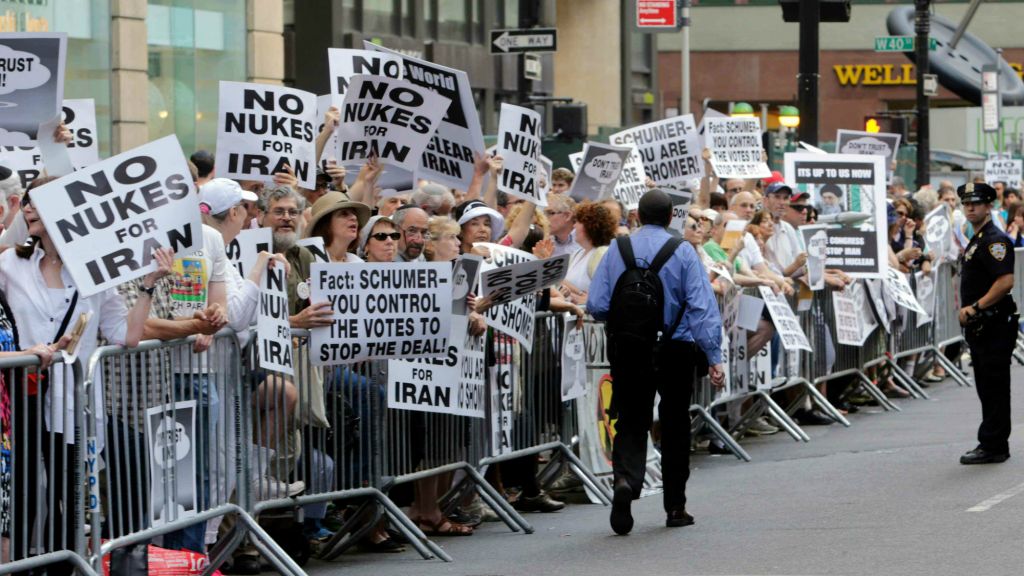
Iran gets over $100b. in sanctions relief
Opponents are outraged that Iran, a country that the State Department has labeled a state sponsor of terrorism, will be getting at least $100 billion in relief from economic sanctions that have choked Iran’s economy for years. They worry that Iran will use the money to ramp up its weapons programs and expand military assistance to forces in Syria, Yemen, Lebanon and elsewhere that oppose the US and its allies.
‘This is a bad deal… We’ll use every tool at our disposal to stop, slow, and delay this agreement’
Treasury Secretary Jacob Lew says that after sanctions are eased, Iran will be able to freely access about half of some $100 billion in foreign reserves. He said more than $20 billion is inaccessible because it is committed to projects with China and tens of billions of other restricted funds are in non-performing loans to Iran’s energy and banking sector.
Moreover, as the deal progresses, world powers say they’ll eliminate oil, trade and financial restrictions that have severely damaged Iran’s economy. Such action could create hundreds of billions of dollars in economic growth.
Opponents remain skeptical. “What do you think they’re going to do with the $100 billion? Do you think they’re going to build roads and bridges?” asked Sen. Lindsey Graham, R-S.C.
Inspections not strong enough
Critics of the deal have said repeatedly said that the inspection regime outlined in the plan will not be rigorous enough to prevent Iran from cheating.
“Rather than anytime/anywhere inspections, the deal creates a process within which Iran can delay inspections for at least 24 days,” said Senate Majority Leader Mitch McConnell, R-Ky.

The Obama administration rebuts that claim, saying Iran will give UN inspectors more access to its nuclear program. If inspectors identify a suspicious site, an arbitration panel with a Western majority will decide whether Iran has to give the agency access within 24 days. The administration says all sites, including military ones, may be inspected if the agency has solid evidence of undeclared nuclear activity.
Deal doesn’t end Iran’s nuclear weapon prospects
The White House says Iran has reaffirmed as part of the deal that “under no circumstances will Iran ever seek, develop or acquire any nuclear weapons.” Opponents say that Iran will still be able to develop nuclear weapons in the future.
Sen. Bob Menendez, D-N.J., who was one of just four Democrats in the Senate to oppose the deal, said the deal only manages or works to contain Iran’s nuclear ambitions.
“My overarching concern is that it requires no dismantling of Iran’s nuclear infrastructure and only mothballs that infrastructure for 10 years,” Menendez said.
UN arms embargo
Secretary of State John Kerry said that during the negotiations, Iran wanted the arms embargo lifted immediately and that the US and its partners won a victory by being able to continue the arms embargo for five years and the missile one for eight.
‘My overarching concern is that it requires no dismantling of Iran’s nuclear infrastructure and only mothballs that infrastructure for 10 years’
“The hardliners can use the freed-up funds to build an ICBM (intercontinental ballistic missile) on their own as soon as sanctions are lifted and then augment their ICBM capabilities in eight years after the ban on importing ballistic weaponry is lifted, threatening the United States,” said Sen. Chuck Schumer, D-N.Y., who also opposed the deal.
As negotiators neared a deal, Iran insisted that UN restrictions be lifted immediately to allow Tehran to import or export conventional weapons and buy ballistic missile technology. In the end, Iran accepted the arms embargo for up to five more years. For ballistic missile technology, the ban expires after no more than eight years.
Copyright 2015 The Associated Press.





The Times of Israel Community.