

Kicking butt or kicking the can down the road?
With the country reeling from a spate of attacks, the leadership appears to take action, though many in the press question whether it shouldn’t be taking other tacks
 Add ToI as a Preferred Source on Google
Joshua Davidovich is The Times of Israel's Deputy Editor
If Swiss psychiatrist Elisabeth Kubler-Ross lived in Israel, her five stages of grief — at least when it comes to terror attacks — might have been boiled down to two: Anger and cracking down.
At least that’s the impression one gets from press reports Thursday, as simple Newtonian physics takes hold and a spate of Palestinian attacks lead to an Israeli reaction.
Newtonian, that is, except for whole equal and opposite thing. Israel’s reaction, which many in the press think is wrongheaded, includes clamping down on Palestinians in Israel illegally, finishing up a section of the West Bank security fence near Jerusalem and upping security yet higher near the capital’s Old City, with each paper focusing on a different measure.
The front page of Israel Hayom, the only paper to lead with the Israeli reprisal, leaves little room for doubt about where it stands on blue-and-white jingoism, with the Tom Clancy-esque headline “Target: Illegals.”
Yet despite the flashy headline, the paper contains nary a word on police plans to round up undocumented Palestinian workers in its 15-page terror package (though a story with the same headline and actual reported content appears online, raising questions as to whether editors simply forgot to place their top story in the paper).
Even a commentary by Nadav Shragai ignores the hunt for Palestinian laborers, with him writing that the most obvious solution is to pour more forces into the West Bank with the aim of busting up makeshift arms manufacturers, though he admits not everyone is aboard.
“The IDF and Shin Bet security service are refraining from taking this action. This was a political-military cost-benefit decision. The assessment is that door-to-door searches, as was done for instance during Operation Brother’s Keeper [to locate three kidnapped teens and crack down on Hamas in 2014] could lead to a larger fight and possibly even slide southward [toward Gaza], to speak nothing about the amount of forces needed for an operation like this,” he writes. “Even if the decision to stop a baseline ‘clean-up’ operation has a certain logic, as long as there is a delay in exposing the guns leaking into the area, the number of rifle barrels only grows.”
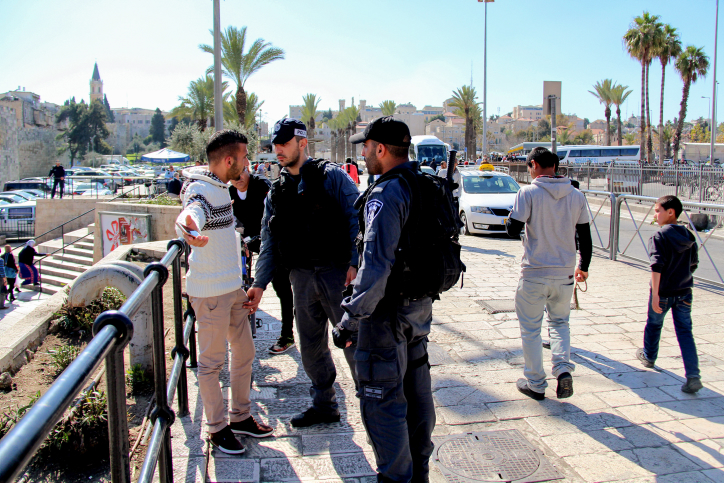
It’s not like the IDF, police and Shin Bet are sitting around playing pocket pool, though. Yedioth Ahronoth’s Yifat Ehrlich spends a day with the cops charged with patrolling East Jerusalem near the Old City, lately a hotbed of violence, and comes out with a glowing dispatch.
“At every corner stand male and female fighters, alert, bleary-eyed. They are grinding through the hours on an emergency footing. That means instead of 9.5 hour shifts, they are pulling 12 hours, and sometimes even 16 hours. In a row. On their feet,” she writes. “‘The watchers on the walls,’ as in all of them working in East Jerusalem, recently got a yearly bonus of NIS 10,000. But they aren’t here for the money, and don’t want to complain. ‘This is our work’ they say. ‘Our families and ourselves are proud of what we are doing.”
The cops are alert, but the tabloid’s Sima Kadmon says the one man who matters, Prime Minister Benjamin Netanyahu, is not, accusing him of doing little to assuage the violence.
“Instead of holding security assessments and discussions and making decisions, Netanyahu looks as if he has contained this intifada. As if he’s finished with it – or so assume political sources. The anger, urgency and determination seen at the beginning of the lone-wolves intifada, leading to heated discussions on subjects like rules for opening fire and bolstering security forces, all that has disappeared,” she writes. “Netanyahu, at least, has gotten used to it. He’s gone back to dealing with survival, with small-ball politics.”
As if to answer Kadmon, Haaretz reports that Netanyahu in fact ordered a series of measures following a security assessment summit late Tuesday night after the evening’s three terror attacks.
“The Prime Minister’s Office later announced several measures to keep unauthorized Palestinians out of Israel proper, including closing gaps in the separation barrier around Jerusalem, completing the barrier in the Tarqumiya area and sponsoring bills to punish anyone who provides shelter or transportation to Palestinians without Israeli permits,” the paper reports. “It was also decided to close down Palestinian media outlets that engage in incitement, with professionals in the security establishment to decide which outlets would be shut down. Relatives of terrorists will also have a harder time getting permits to work or do business in Israel.”
Still Haaretz’s lead editorial strikes much the same tone as Kadmon, though in contrast, the broadsheet blames Netanyahu for taking the wrong actions to try and fight the groundswell of terror.
“These attacks do not pose an existential threat to the state. People die in them, but we can live with them without the State of Israel being destroyed. Still, these attacks are intolerable. We cannot reconcile ourselves to this deadly phenomenon. They are the work of human beings, and they can be ended – or at least reduced – by human beings, particularly those currently in government,” the editorial reads. “The attacks remind us daily that the assumption by Netanyahu, the settlers and their supporters that the newer troubles (Iran, Islamic State, Syria and its refugees) will make people forget the Israeli-Palestinian conflict is groundless. The small bill is being presented to Israelis every day and all over the country, while the big bill, being written in Washington, the United Nations and other international forums, will be submitted at a time more likely to be determined by [Palestinian Authority President] Abbas’s despair than Netanyahu’s bluster.”
Not among the package of reactions, but possibly in the offing, is a controversial proposal to deport families of terrorists who knew about attacks to Gaza, as a deterrent. The measure, which has received more and more support from politicians despite the attorney general indicating it is a non-starter, is talked up in Israel Hayom by Finance Minister Moshe Kahlon, who seems undeterred himself by silly things like international law.
“In the past we deported them to Lebanon, to Syria, to Gaza. We need to do this today,” he tells the paper. “Not to wait for anything. To be insistent upon it. If there are legal issues – we need to look at how to overcome them, but we need to do it. This is a deterrent and can help us a lot in the current fight against terror.”
But even as Israel is looking to send more people to Gaza, it also seems interested in letting people currently in Gaza out. Haaretz’s Amira Hass reports that Israel is beginning to let Gazans leave the country via the West Bank’s Allenby Crossing with Jordan, but only if they agree to not come back for at least a year.
“This appears to mark a change in a policy of almost 20 years: Since 1997, Israel has not permitted Gazans to travel abroad and return via the Allenby border crossing, i.e., through Israeli territory and the West Bank, with very few exceptions,” Hass writes. “Thus, the Rafah border crossing became the only departure gate for Gazans to go abroad. Theoretically, Israel is now increasing the number of Gazans who will be able to travel abroad. On the other hand, the condition that one must remain outside the country for at least a year is a strong deterrent, since there is hardly any possibility of returning via Egypt.”






The Times of Israel Community.