

Hajj ‘will go on’ after deadly Mecca crane collapse
107 die, hundreds are injured when heavy storm sends metal boom crashing through roof of Grand Mosque
 Add ToI as a Preferred Source on Google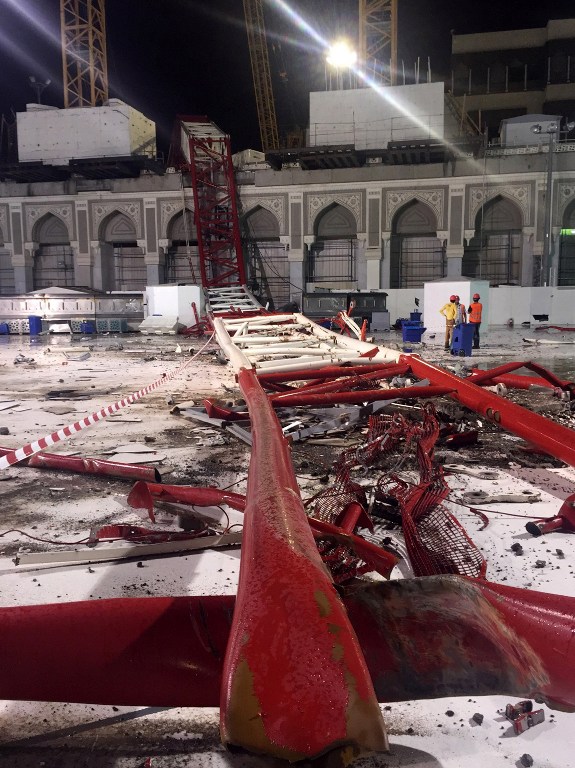
This year’s hajj pilgrimage will go ahead despite a crane collapse which killed at least 107 people at Mecca‘s Grand Mosque, a Saudi official said on Saturday.
“It definitely will not affect the hajj this season and the affected part will probably be fixed in a few days,” said the official, who declined to be named. “Hajj will go on, for sure.”
The hajj is one of the five pillars of Islam, and every capable Muslim is expected perform it at least once in their life.
The towering construction crane toppled over Friday during a violent rainstorm in Mecca, Islam’s holiest site, crashing into the Grand Mosque. Hundreds of thousands of faithful from around the world had already arrived in the city for the hajj, which is expected to start on September 21.
Images posted by social media users showed a grisly scene, with police and onlookers attending to numerous bodies lying amid pools of blood on the polished mosque floors.
Saudi Arabia’s civil defense authority provided a series of rising casualty numbers on its official Twitter account as ambulances whisked the wounded to area hospitals. As of early Saturday, it said those injured in the disaster numbered 238.
A photo released by the authority showed police and workers in hardhats inspecting a pile of collapsed concrete slabs inside a part of the sprawling, ornately decorated mosque. Another showed the base of the toppled red-and-white crane tilted upward at a sharp angle.
Images aired on Saudi state television showed the crane’s metal boom smashed through what appeared to be the roof of the mosque.
Ahmed bin Mohammed al-Mansouri, the spokesman for the presidency of the Mecca and Medina mosque affairs, said in a statement carried by the official Saudi Press Agency that the accident happened late Friday afternoon during a severe storm carrying strong winds and heavy rain.
Authorities did not provide details on the victims’ nationalities, but it was likely that the tragedy will touch several countries.
U.S. Secretary of State John Kerry expressed his condolences and said the U.S. stands with Saudi Arabia and “all Muslims around the world in the aftermath of this dreadful incident at one of Islam’s holiest sites.”
The Grand Mosque and the cube-shaped Kaaba within it draw Muslims of all types from around the world throughout the year, though numbers increase significantly in the run-up to the hajj. The mosque is Islam’s holiest site to which Muslims face in daily prayers and a central site among the hajj rituals.
Al-Mansouri said the crane, which was being used in construction work at the mosque, struck a circular area around the Kaaba and a nearby walkway.
The governor of the Mecca region, Prince Khalid al-Faisal, quickly called for the formation of a committee to investigate the cause of the accident. He directed all appropriate authorities to provide support for all of those injured, according to a statement from Mecca principality public affairs head Sultan al-Dosari that was carried on SPA.
Several cranes surround the mosque to support an ongoing expansion and other construction work that has transformed the area around the sanctuary.
Steep hills and low-rise traditional buildings that once surrounded the mosque have in recent years given way to shopping malls and luxury hotels — among them the world’s third-tallest building, a giant clock tower that is the centerpiece of the Abraj al-Bait complex.
The construction giant Saudi Binladin Group is leading the mosque expansion and also built the Abraj al-Bait project.
The Binladin family has been close to the ruling Al Saud family for decades and oversees major building projects around the country. The Binladen family disowned one of its many members, late al-Qaeda leader Osama bin Laden, in the 1990s.
It was not immediately clear who owned the crane that collapsed.
During the week of the hajj, Muslims converge on Mecca to perform a series of rituals, including the circling of the cube-shaped Kaaba, praying and holding vigil at Mount Arafat and perform the symbolic stoning of the devil by throwing pebbles at the three pillars in Mina.
It was on Mount Arafat, marked by a white pillar, where Islam’s Prophet Muhammad is believed to have delivered his last sermon to tens of thousands of followers some 1,400 years ago, calling on Muslims to unite.
While following a route that the prophet once walked, the rites are believed to ultimately trace the footsteps of the prophets Ibrahim and Ismail, or Abraham and Ishmael as they are named in the Bible.
The millions of pilgrims who visit the country’s holy sites each year pose a considerable security and logistical challenge for the Saudi government, and large-scale deadly accidents have occurred on a number of occasions in years past.
In 2006, more than 360 pilgrims died in a stampede at the desert plain of Mina, near Mecca. A crush of pilgrims two years earlier left 244 dead.
The worst hajj-related tragedy was in 1990, when 1,426 pilgrims died in a stampede in an overcrowded pedestrian tunnel leading to holy sites in Mecca.





The Times of Israel Community.