

Obama ‘concerned’ over Kobani, as airstrikes push Islamists back
President says US-led coalition will continue bombing runs on Syrian border town fending off Islamic State advance
 Add ToI as a Preferred Source on Google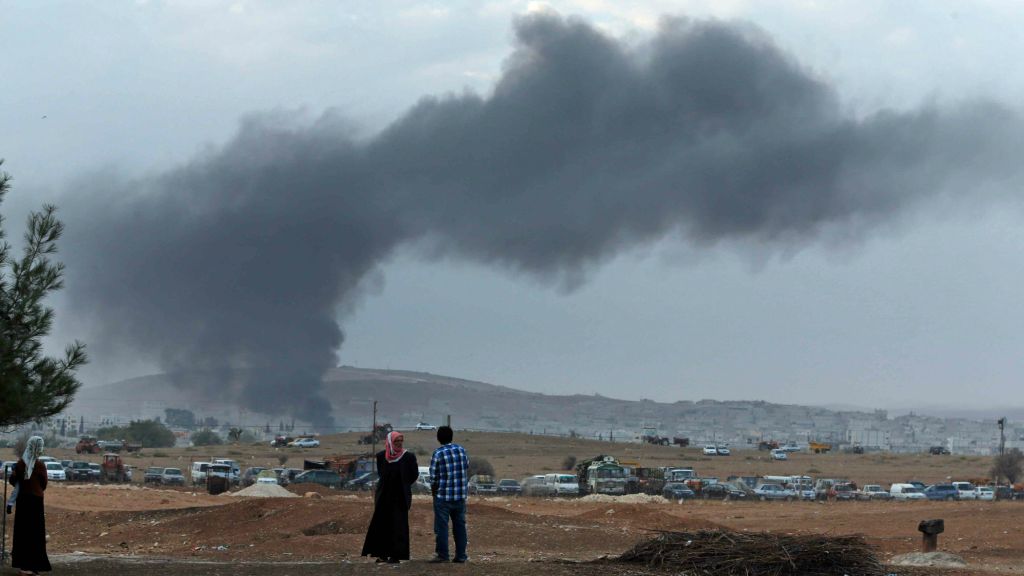
MURSITPINAR, Turkey — The White House said Tuesday a multinational air war against Islamic State jihadists in Iraq and Syria is succeeding, as top brass from 22 countries met to discuss a strategy for combatting them.
That optimism was underscored by the Syrian Observatory for Human Rights, which said US-led air strikes had stopped in its tracks IS’s bid to seize Kobani, a strategic Syrian town on the border with Turkey.
Speaking as President Barack Obama prepared to meet with the generals of the US-led coalition, White House spokesman Josh Earnest said “we’re in the early days of the execution of that strategy, but certainly the early evidence indicates that this strategy is succeeding.”
Obama on Tuesday expressed grave concern over the plight of the Syrian town of Kobani under attack by Islamic State jihadists, and said a US-led coalition would keep up bombing raids there and in western Iraq.
“We’re deeply concerned about the situation in and around the Syrian town of Kobani,” Obama said after meeting commanders from a coalition of more than 20 countries fighting the IS group.
The US president, sitting next to his national security adviser Susan Rice and the US military’s top officer, General Martin Dempsey, said the US government was “also focused on the fighting that is taking place in Iraq’s Anbar province.”
The battles in Anbar province and Kobani illustrated the threat posed by the IS group in both Iraq and Syria and “coalition air strikes will continue in both these areas,” he said.
Obama said there had been some “important successes” in the campaign against IS militants, citing the successful bid to retake and hold Mosul dam in Iraq.
The coalition chiefs agreed that “this is going to be a long term campaign,” he said.
“There are going to be periods of progress and setbacks,” he said.
But Obama added: “We are united in our goal.”
The effort to defeat IS was not merely a military operation and the campaign would require tackling the group’s extremist ideology and its funding sources, Obama said.
The coalition would need to communicate an “alternative vision to those attracted” to the IS group, he said.
The meeting, at an air force base outside Washington, came as American-led warplanes hammered IS militants with 21 raids near Kobani on Monday and Tuesday, the US military said.
IS militants recently captured nearly half of Kobani, but Observatory director Rami Abdel Rahman said the latest strikes had “succeeded in saving it from falling entirely into the jihadists’ hands”.
Central Command, which oversees US forces in the Middle East, said there were indications air raids had “slowed ISIL (IS) advances,” but that the situation remained fluid.
The battles were expected to dominate the talks at Andrews Air Force base among the military chiefs, including from all five of the Arab states taking part in the air campaign in Syria.
The meeting “provides an opportunity to take stock of coalition progress to date and continue to align and fully integrate the unique capabilities of coalition partners,” said Alistair Baskey, spokesman for the US National Security Council.
Obama was also due to meet the commanders and looked forward to discussing “additional measures that the coalition can take to degrade and ultimately destroy” IS, Baskey said.
It was the first time such high-ranking officials from so many nations have come together since the coalition was formed in September and which now, on paper, includes about 60 countries.
Turkey’s call for the establishment of a protective buffer zone along its border with Syria, where the jihadists have pushed into the heart of predominantly Kurdish Kobani, was also expected to be on the agenda.
Ankara, which has faced a three-decade Kurdish insurgency, has tightened security of its porous Syrian border after the fighting in Kobani sparked the exodus of 200,000 refugees.
Earnest called the stepped-up strikes a “continuation of our broader strategy, not a change in it,” when asked if they represented a shift.
The fight would not be quick or easy, he acknowledged, adding that “we’ve been pretty candid about the fact that this is a longer-term proposition”.
The White House spokesman also insisted US ground troops would not be involved in the battle.
‘A martyred town’
French President Francois Hollande urged Turkey to open its frontier with Syria to help Kobani’s defenders, warning the town could fall to IS “at any moment”.
“I think about what is happening today in Kobani, a martyred town, a symbolic town. If we have to intervene, as we decided for France in Iraq, we also have to give the moderate Syrian opposition… all the support, all the help necessary,” he said.
Fighting is reported to have spread to less than a kilometre (half a mile) from the barbed wire fence of the Turkish border, the Observatory said.
Kurdish fighters were trying to push into the eastern sector, under IS control, said the Observatory, which has a wide network of sources inside Syria.
On Monday, Kurdish militia captured the strategic hilltop of Tel Shair west of Kobani, according to the Observatory, which said the site had changed hands several times.
The black IS flag could no longer be seen flying on the hill from across the border.
Anbar teeters
Concern has also been growing over Iraq, where IS fighters have been threatening to seize more territory.
Iraqi forces are reported to be under intensifying pressure in Anbar province, a vast region stretching from near Baghdad to the Syrian border.
On Monday, security sources said Iraqi troops stationed on the edge of Heet, in Anbar, had withdrawn to another base, leaving it under full jihadist control.
Pro-government forces have also been in trouble south of IS-held Mosul around the Baiji oil refinery, where US aircraft Sunday dropped supplies including food, water and ammunition to Iraqi troops for the first time.
In Baghdad, an Iraqi MP and prominent militia leader, Ahmed al-Khafaji, was one of at least 21 people killed by a suicide car bomb in the Shiite neighbourhood of Kadhimiyah.
The third bombing in Kadhimiyah in four days, it was immediately claimed by IS in a statement posted online that also said Khafaji was the intended target.



The Times of Israel Community.