

Parties’ demands presage coalition woes for Netanyahu
Jewish Home member predicts his party will quit coalition over settlement demolition; Shas insists on senior positions
 Add ToI as a Preferred Source on Google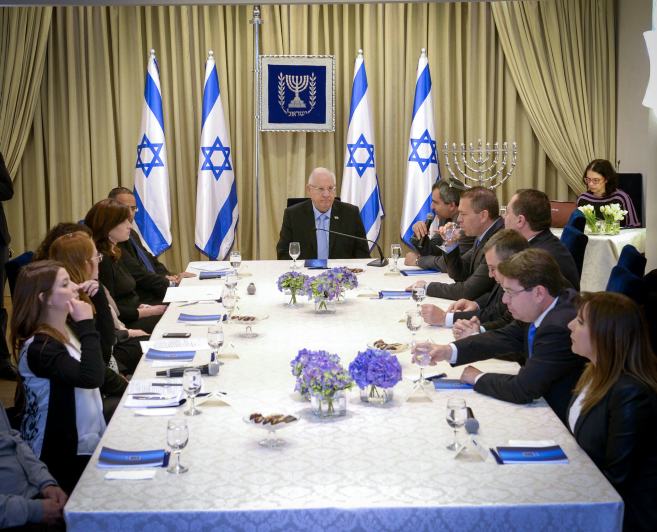
Less than a week after Israel’s general elections, Prime Minister Benjamin Netanyahu has received recommendations from a requisite majority of 67 MKs to form the next coalition, and party representatives are out in full force to position themselves and their factions.
Netanyahu must now move to assign cabinet positions, including some senior ministerships, to other factions whose support he needs to form a Knesset majority, but also to lawmakers within his own Likud party, which with 30 seats is by far the largest body expected to sit in a coalition government.
The tentative game of give-and-take may prove difficult for Netanyahu because of opposing inter-party interests and ideologies.
Number 8 on the hawkish Jewish Home party list, Bezalel Smotrich, preemptively threatened to “explode” away and break apart the coalition within a year-and-a-half if the government moves ahead with a Supreme Court resolution to demolish a number of Israeli structures built on private Palestinian land in the West Bank.
“The evacuation of the Amona [outpost] and the demolition of houses in Ofra will be the landmine that if stepped on, will lead to our explosion out of the coalition,” Smotrich told Galey Israel radio on Monday, referring to a Jewish settlement and a nearby outpost 20 kilometers north of Jerusalem.

“I don’t see the Jewish Home party sitting in [government] and partaking in the destruction… of an entire community and the expulsion of its residents,” he said.
Analysts believe the incoming government will be formed by right-wing and religious parties, some of which oppose the creation of a Palestinian state, and that if Netanyahu bows to international pressure to disengage or evacuate settlements in the West Bank, he could risk a coalition break-up leading to new elections.
In Israel, prime ministers are given a mandate to govern for 4 years, but terms rarely last that long due to coalition infighting and eventual government breakdowns.
Meanwhile, members of the ultra-Orthodox Shas party told reporters that faction chief Aryeh Deri will predicate his entry into a Netanyahu government on two senior cabinet positions. While cabinet seats remain formally undecided, sources close to Deri said that he would demand the Interior Ministry and the Ministry of Religious Services.
Although Netanyahu may already enjoy majority support from Knesset lawmakers, some factions indicated that they would refuse to sit in government with other factions. For example, Shas and United Torah Judaism members said they would not join a government that includes Yair Lapid’s Yesh Atid, a party that is staunchly opposed to ultra-Orthodox influence within government.
In any case, Yesh Atid party officials signified they would not recommend anyone for the premiership and that the centrist faction would join the opposition.
Likud party officials announced that they would move to ensure that no. 3 on the party’s list, Yuli Edelstein, will be reelected as Knesset speaker. Senior Likud representatives are expected to demand a large number of top cabinet positions from Netanyahu, owing to the large size of the party.
President Reuven Rivlin is expected to task Netanyahu with forming a coalition in the coming days. Formal coalition negotiations between various parties are expected to begin in earnest Wednesday, and Netanyahu will have four weeks to form his government, with an option to extend talks for another two.
Meretz, Yesh Atid, Zionist Union and the Joint (Arab) List, are expected to sit in the opposition.
Times of Israel staff contributed to this report








The Times of Israel Community.