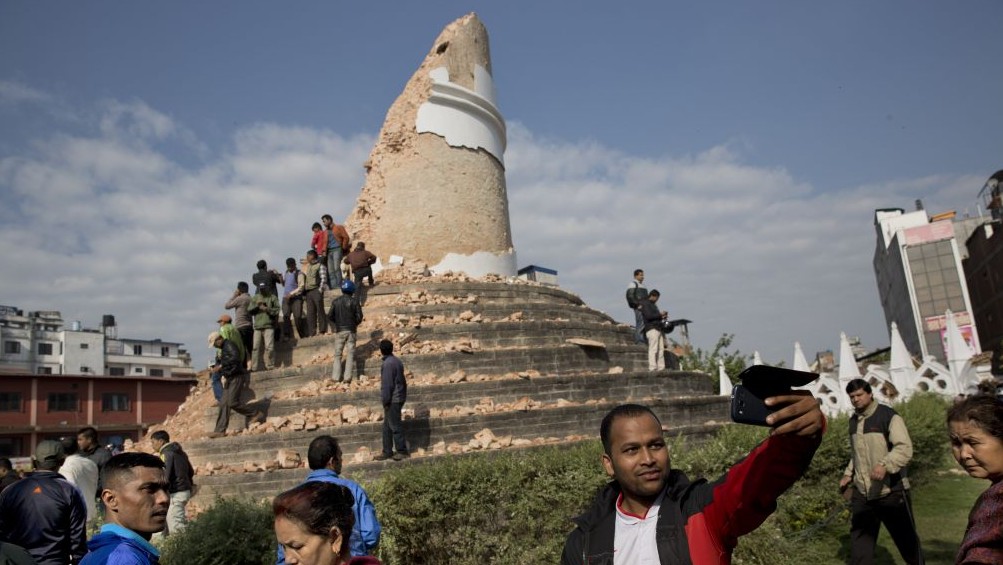
A man takes a selfie at the historic Dharahara Tower, a city landmark, that was damaged in Saturday’s earthquake in Kathmandu, Nepal, Monday, April 27, 2015. (photo credit: AP/Bernat Armangue)
KATHMANDU, Nepal — Social media is a chronicle of life, and sometimes death. So it should be no surprise that a site of great human and cultural loss in Nepal’s devastating earthquake is now barraged with the clicking of smartphones.
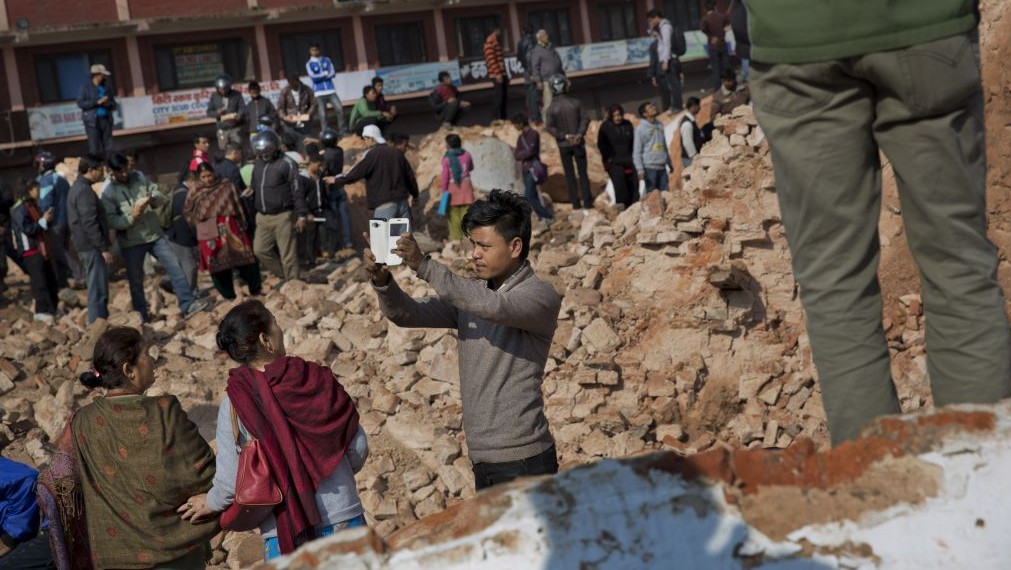
Near Kathmandu’s famed Dharahara Tower, a historic nine-story structure reduced to an enormous pile of red brick dust, dozens of people clambered around the debris clicking selfies and photos of their friends posing in front of the wreckage. The tower built by Nepal’s royal rulers in the 1800s was one of the country’s most treasured monuments, and was photographed far more than other buildings destroyed by Saturday’s quake.
It is unclear how many people were killed in the tower, but it was believed to have been filled with tourists.
Pawan Thapa, a 21-year-old business student who arrived from the suburbs to try to help with the recovery effort, was dismayed by the scene. Some of those taking pictures were smiling for the camera.
A man takes a selfie at the historic Dharahara Tower, a city landmark, that was damaged in Saturday’s earthquake in Kathmandu, Nepal, Monday, April 27, 2015. (photo credit: AP/Bernat Armangue)
“This is earthquake tourism. This is not right,” he said. “They are more interested in clicking their selfies than understanding that it is a tragedy.”
Get The Times of Israel's Daily Editionby email and never miss our top stories
Most of those taking pictures, however, did not appear to be tourists but locals capturing the devastation of their community, and the loss of a landmark that had helped define it.
Copyright 2015 The Associated Press.
Advertisement
Help us report truthfully on social media
As a multimedia journalist, my job is to take the quality, fact-based journalism produced by The Times of Israel newsroom and make it accessible across every platform — from Instagram posts to podcasts to short-form videos.
This is how many, especially young people, consume news these days. But misinformation is rampant on social media. Our team at ToI produces accurate, responsible short-form reporting on Israel and the Jewish world.
If you believe in the importance of factual social media journalism, please consider joining our reader support group, The Times of Israel Community. Your financial support is essential to sustain responsible multimedia reporting.
We’re really pleased that you’ve read X Times of Israel articles in the past month.
That’s why we started the Times of Israel - to provide discerning readers like you with must-read coverage of Israel and the Jewish world.
So now we have a request. Unlike other news outlets, we haven’t put up a paywall. But as the journalism we do is costly, we invite readers for whom The Times of Israel has become important to help support our work by joining The Times of Israel Community.
For as little as $6 a month you can help support our quality journalism while enjoying The Times of Israel AD-FREE, as well as accessing exclusive content available only to Times of Israel Community members.
Thank you, David Horovitz, Founding Editor of The Times of Israel


 Add ToI as a Preferred Source on Google