

Rubio: Obama didn’t make a deal with Iran, he just gave concessions
GOP hopeful also castigates president for demonizing domestic critics of accord as warmongers and lobbyists with money
 Add ToI as a Preferred Source on Google
Rebecca Shimoni Stoil is the Times of Israel's Washington correspondent.
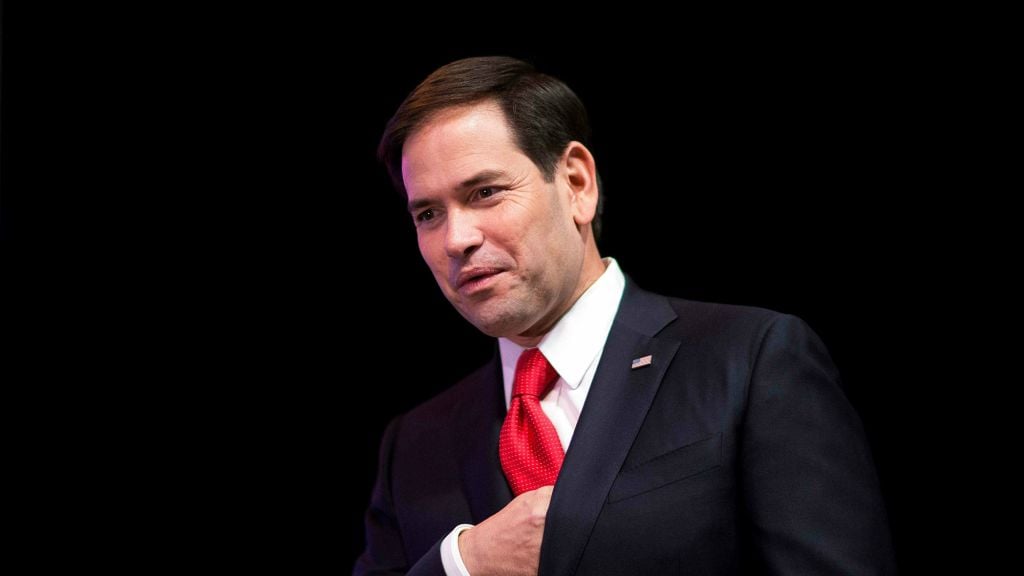
WASHINGTON — Characterizing President Barack Obama’s foreign policy as one of “weakness and concession,” top-tier Republican presidential candidate Senator Marco Rubio attacked the administration’s approach to Cuba and Iran as “the convergence of nearly every flawed strategic, moral and economic notion that has driven President Obama’s foreign policy.”
He lambasted Obama for making a string of concessions to Iran, and for demonizing domestic critics of the controversial P5+1 powers’ nuclear accord.
Speaking on Friday morning before the conservative-leaning Foreign Policy Initiative, Rubio promised that on his first day in office, he will establish a three-part plan to “roll back President Obama’s deal with Iran and repair the damage done to America’s standing in the Middle East.”
His plan, Rubio said, will first reimpose sanctions on Iran, including “crushing new measures that target human rights abusers and Iran’s leaders involved in financing and overseeing Iran’s sponsorship of terrorism.”
He would then terminate defense sequestration – the limitation of the US defense budget as part of across-the-board federal budgetary cuts – and “ensure our forces in the Middle East are positioned to signal readiness and restore a credible military option.”
With these two conditions in place, Rubio said that he would link any future talks with the regime in Tehran “to Iran’s broader conduct, from human rights abuses to support for terrorism and threats against Israel,” as well as insisting that a deal “must terminate Iran’s nuclear program.”
“Some will say there would also be no room for negotiations,” Rubio said, referring to the administration’s claim that if the current deal fails in Congress, Iran will not return to the negotiating table. “But history proves otherwise. Iran may not return to the table immediately, but it will return when its national interests require it to do so.”
Rubio’s foreign policy address was delivered on the same day that Secretary of State John Kerry flew to Cuba to participate in a ceremony raising the US flag at the embassy in Havana – an embassy that had been closed for half a century following the Cuban Revolution. “The world has missed having an American president who speaks honestly about the world in which we live,” Rubio asserted.
Rubio complained that the move to normalize relations with Cuba and the Joint Comprehensive Plan of Action regarding Iran’s nuclear program “demonstrate with jarring clarity how this administration has failed to anticipate impending crises, ignored the realities of the globalized economy, and sought to make America liked rather than respected; the way it has placed politics before policy, adversaries before allies, and legacy before leadership; the way it has confused weakness for restraint, concession for compromise, and — most simply of all — wrong for right.”
He complained that Iran is still led by “radical Shia clerics who wish to one day unite the world under Islam and believe this will only happen after a cataclysmic showdown with the West; leaders who have been directly responsible for the deaths of hundreds of Americans in the last decade, who continue to lead chants of “Death to America” each week, and who refuse to stop financing terrorists that seek to kill Americans and wipe Israel off the map.”
Rubio, the son of Cuban immigrants, said that in Cuba, the US faces “proudly anti-American leaders who continue to work with nations like Russia and China to spy on our people and government; who harbor fugitives from American justice; and who stand in opposition to nearly every value our nation holds dear by violating the basic human rights of their own people, preventing democratic elections, and depriving their nation’s economy of freedom and opportunity.”
Rubio vowed that if elected, “as a symbol of solidarity between my administration and those who strive for freedom around the world, [he] will invite Cuban dissidents, Iranian dissidents, Chinese dissidents, and freedom fighters from around the world to be honored guests at my inauguration.”
In contrast, Rubio said, Obama “has been quick to deal with the oppressors, but slow to deal with the oppressed. And his excuses are paper-thin.”
Rubio did not just lash out against Obama’s foreign policy, but also against Obama’s approach toward his domestic critics. “Instead of focusing his criticism on these illegitimate governments, the President has attacked opponents of his policy here at home — going so far as to demonize critics of his Iran policy as “lobbyists with money” and “warmongers,” and those opposed to his Cuba policy as “practitioners of ethnic politics,” he said, alluding to recent complaints about language described by the influential periodical Tablet’s editorial board as “dog whistles” to anti-Semitic tropes. “This shameful, derogatory rhetoric should have no place in our democracy, especially from our President.”
According to Rubio, among the many flaws in the nuclear agreement reached last month with Iran, Obama “has endorsed the construction of a full-scale, industrial-size nuclear program within 15 years;” “failed to secure anytime/anywhere inspections;” and “has virtually guaranteed Iran becomes a regional power with the ability to build long-range missiles capable of hitting the U.S. homeland.”
“He has given all of this away without any commitment that Iran will end its support for terrorism, accept Israel’s right to exist, or return a single American hostage,” Rubio continued.
“In short, the deal with Iran isn’t a deal at all. It is a string of concessions to a sworn adversary of the United States.”
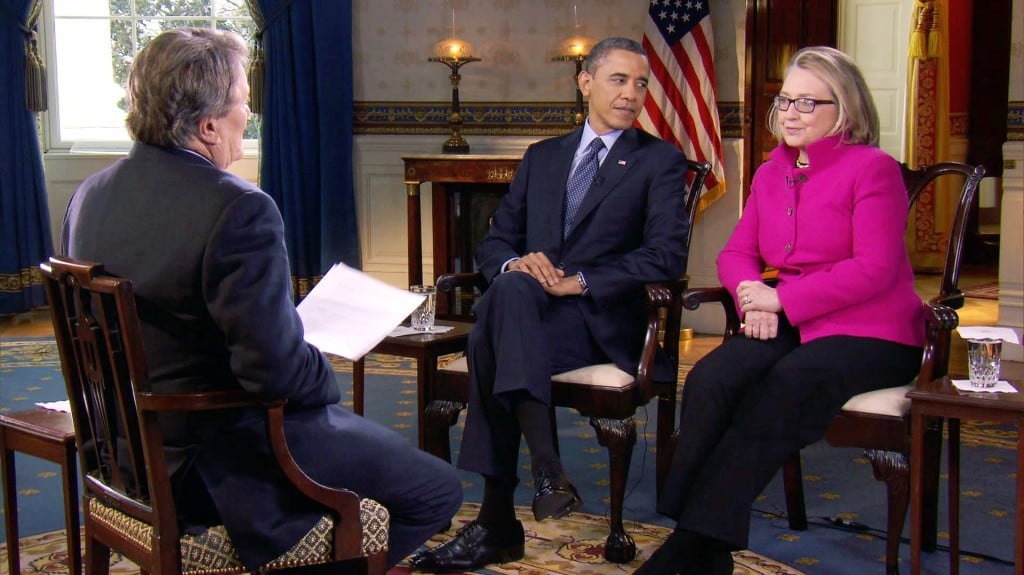
Rubio said Democratic presidential candidate Hillary Rodham Clinton was a partner in Obama’s failed policies in Iran and Cuba. “She not only supports these two deals, she now brags about her instrumental role in bringing them to fruition,” he said in a speech that mentioned Clinton by name three times and Obama 13.
“Hillary Clinton will not overturn these deals as president,” he said. “I will.”
While Rubio lags behind GOP front-runner real estate mogul Donald Trump, he has enjoyed a surge in at least one key demographic following his performance in last week’s candidates’ debate.
Rubio’s performance was widely acknowledged by pundits as among the most successful during the televised event. A recent poll conducted by Suffolk University places Rubio in third place in the bellwether state of Iowa, only seven points behind Trump, who is leading the Midwestern state.






The Times of Israel Community.