

The day France walked together
It was the moment when a fragmented, apathetic society finally understood what was at stake
 Add ToI as a Preferred Source on Google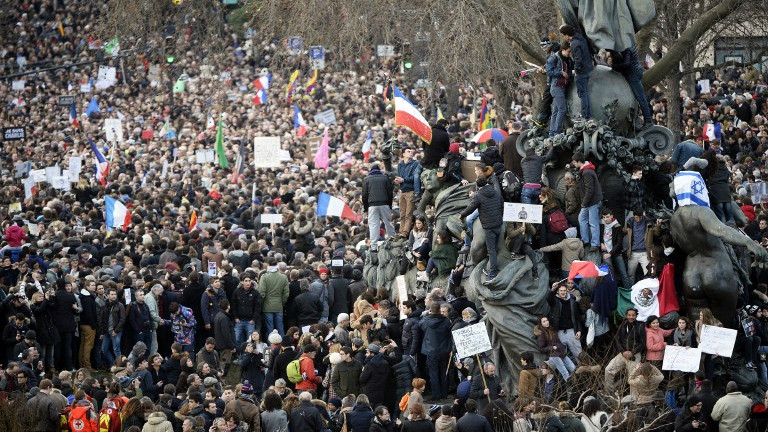
The day we heard the news of the massacre at Charlie Hebdo, the shockwaves were felt across the country.
Unlike many countries, the French satirical press has a long and strong tradition. Freedom of the press is cardinal in France. Mandated by law since the late nineteenth century, the free expression of journalists is strongly protected, often more than elsewhere. French journalists and cartoonists have long used this freedom, employing biting irony and especially cartoons and caricatures to freely criticize the government, police, taxes, religions and …“Les cons,” the morons. No authority is spared. The French don’t always appreciate it but often have laugh about it over their coffee.
In the case of Charlie Hebdo, designers, journalists, editors, and staff come from all the monotheistic branches (Christianity, Islam and Judaism) and atheism. The magazine never spared any religion. Their anticlerical and libertarian attacks put them equidistant from all. But none of those criticized would have ever killed to silence their humor.
Two of the Charlie Hebdo cartoonists who were murdered were over 75 years old and had been working since the 1960s. They had caricatured and drawn with exceptional talent, comparable to the greatest literature authors, daily life, the political news of the day, the evolution of society. And as they had always worked for several newspapers at the same time, they accompanied two or three generations of readers, that is to say, hundreds of thousands of French, from all backgrounds, from all walks of life, of all political or religious opinions.
Whatever the specific views were on the issue of the “Mohammed cartoons,” when the barbarians assassinated the Editorial Board meeting, two generations felt the injury, directly and violently.
That same evening, thousands who belong to those two generations, joined by many more young people, gathered in Paris’s Republic Square and all the public squares of France’s major cities. They gathered spontaneously, without any partisan appeal, without any desire to impose a particular political line. Their massive presence gave pause to one and all.
As you may know, communal divisions (religious or not) have grown significantly in recent years in France. France is home to the two biggest Muslim and Jewish communities in Europe. The tension took root gradually, fueled by social context but also by the international context and backlashes against terrorism. These political divisions have not softened in the past ten years. Meanwhile, a great distaste for politics and “politicians” has set in. Trust in parties has largely eroded. But that night, Wednesday night, tens of thousands of people showed the way. They said “We’re not afraid,” “remain united,” “I’m Charlie.”
This multifaceted declaration, “I’m Charlie,” allowed everyone, everywhere, to feel connected and to get involved. It went viral.
Everyone, even in small towns and villages, understood. Newspapers and radios all adopted “I’m Charlie” and put aside their divisions to focus on the real issue. On social networks, at an incredible speed, the topic was clearly the freedom of thought and freedom of expression that had been targeted by assassins. Within a few short hours, “I’m Charlie” was everywhere, in the streets, in emails, in cafes, in Paris, in offices, on buildings in the rest of the country, in Europe and the world. The challenge was clear to all.
With the death of the 12 people (Christians, Jews, Muslims and atheist alike) slain in the offices of Charlie Hebdo, with the hunting down of the killers and the steps taken by the government, French citizens of all stripes came to newly appreciate the value of the rule of law. A segment of the population also understood that many amongst the moderate Muslim community might feel weakened, earmarked and rejected.
Protesters in Republic Square, along with government and religious leaders immediately made efforts to avoid the confusion that Arab = terrorist. And, for the first time on such a scale, a large number of moderate Muslims declared themselves to be French and protested the hijacking of their religion. They signed petitions, they spoke on the radio, they bought space in “Le Monde.” Thursday evening and Friday in the mosques there were numerous sermons along those lines.
Over the next two days, with the death of a young woman police officer in Montrouge and the hostage taking in the Hyper Casher supermarket, a new challenge arose. The clearly anti-Semitic goal of the murderers became obvious. It was not just a newspaper expressing its anticlericalism and caricaturing the Prophet. Jews were killed because they were Jews. And once again, after Brussels, after Toulouse, after…
And the French Jews felt directly affected and highly threatened. It was clearly reason for concern. Security measures were immediately deployed throughout the country.
Sunday, with 17 people dead, in Paris and in all regions of France, demonstrations were held on a scale never before seen. Regardless of social or national origins, regardless of political or religious views, four million people took to the streets to reject division and exclusion, and voice their common commitment to a state that guarantees democratic values and rejects racism and anti-Semitism.
Four million. This has not been seen since 1945. Four million. This means that there were moments when nearly half the population of a city was in the street. The walkers of Paris and other cities, Catholic or Protestant, Muslims and Buddhists, atheists and Jews, declared their unity as citizens. They walked as the people of France, applauded their police and welcomed 50 heads of state from Europe, Africa and the Middle East who had thought to share this sad day and this international moment of democracy.
For a distant descendant of Cerf Beer Turique, the trustee of the Jews of Alsace, who negotiated the decree of emancipation of the Jews of France with the Abbot Grégoire and the aristocrat Clermont Tonnerre, Sunday was an important day.
—
The writer, who graduated from the Institut d’études politiques de Paris(IEP), is a sculptor who works and lives in Normandy.




The Times of Israel Community.