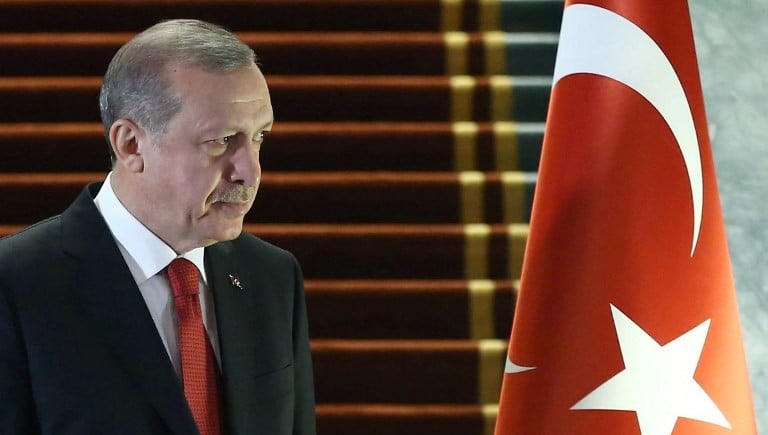
Turkish President Recep Tayyip Erdogan at an official ceremony in the Presidential Complex in Ankara, on December 24, 2015. (AFP/Adem Altan)
Turkey said on Thursday it had summoned Iran’s ambassador to protest attacks on Turkish President Recep Tayyip Erdogan in the Iranian press in the wake of a diplomatic crisis between Tehran and Riyadh.
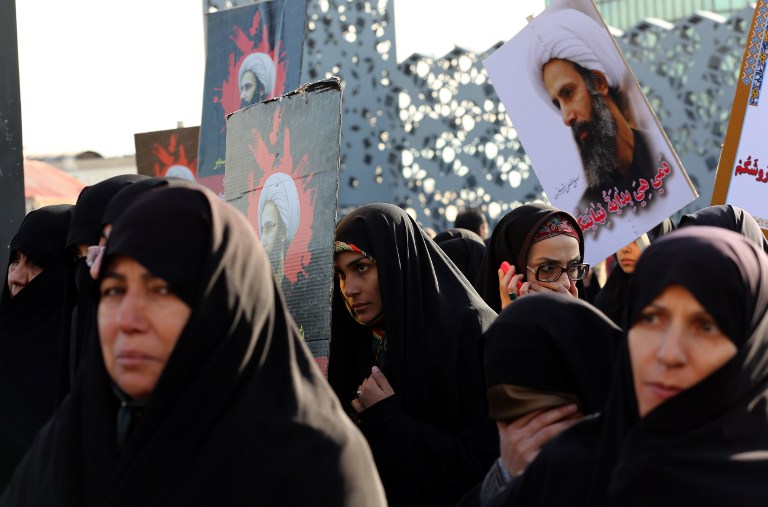
Erdogan has refused to condemn Saudi Arabia’s execution of prominent Shiite cleric and activist Sheikh Nimr al-Nimr this month. The execution sparked outrage in Shiite-majority areas of the Middle East, and protesters in Iran attacked two Saudi diplomatic missions, prompting Riyadh to sever diplomatic ties.
“We strongly condemn our president being directly targeted in certain articles in Iranian outlets controlled by the Iranian authorities… and demand that these articles cease immediately,” the Turkish foreign ministry said in a statement.
It added that attacks on the Saudi embassy in Tehran and the kingdom’s consulate in Iran’s second city Mashhad were “unacceptable and deplorable.”
Iranian women gather during a demonstration against the execution of prominent Shiite Muslim cleric Nimr al-Nimr by Saudi authorities, at Imam Hossein Square in the capital Tehran, January 4, 2016. (AFP/ATTA KENARE)
Turkey formally abolished the death penalty in 2004 as part of its bid to join the EU.
Get The Times of Israel's Daily Editionby email and never miss our top stories
Erdogan on Wednesday said that Nimr’s execution was an “internal legal matter” for Saudi Arabia, and ties between Ankara and Riyadh have improved in recent months. The Turkish leader visited Riyadh last month in a new sign of warming bilateral ties.
Turkey and Saudi Arabia, both overwhelmingly Sunni Muslim powers, share the same vision over the conflict in Syria where they believe only the ousting of President Bashar Assad can bring an end to almost five years of civil war.
Meanwhile, tensions have increased between Turkey and overwhelmingly Shiite Iran, which along with Russia is the key remaining ally of Assad.
Advertisement
Help us report truthfully on social media
As a multimedia journalist, my job is to take the quality, fact-based journalism produced by The Times of Israel newsroom and make it accessible across every platform — from Instagram posts to podcasts to short-form videos.
This is how many, especially young people, consume news these days. But misinformation is rampant on social media. Our team at ToI produces accurate, responsible short-form reporting on Israel and the Jewish world.
If you believe in the importance of factual social media journalism, please consider joining our reader support group, The Times of Israel Community. Your financial support is essential to sustain responsible multimedia reporting.
We’re really pleased that you’ve read X Times of Israel articles in the past month.
That’s why we started the Times of Israel - to provide discerning readers like you with must-read coverage of Israel and the Jewish world.
So now we have a request. Unlike other news outlets, we haven’t put up a paywall. But as the journalism we do is costly, we invite readers for whom The Times of Israel has become important to help support our work by joining The Times of Israel Community.
For as little as $6 a month you can help support our quality journalism while enjoying The Times of Israel AD-FREE, as well as accessing exclusive content available only to Times of Israel Community members.
Thank you, David Horovitz, Founding Editor of The Times of Israel


 Add ToI as a Preferred Source on Google