

US, Russia still at odds over Syria, officials say
American, Russian foreign ministers meet on sidelines of General Assembly, but no agreement on resolution to disarm Damascus
 Add ToI as a Preferred Source on Google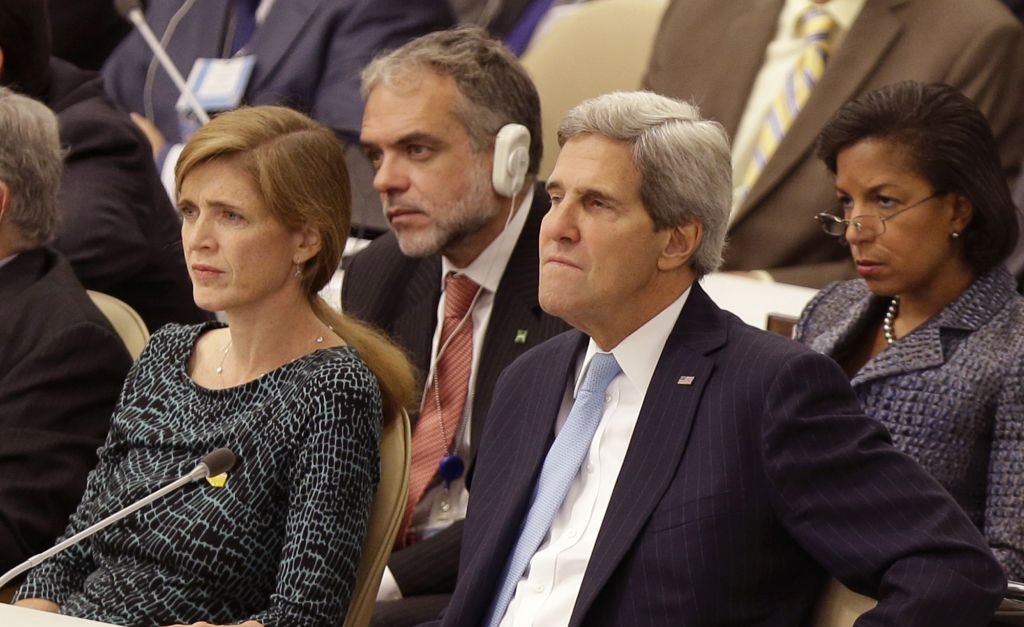
UNITED NATIONS (AP) — US and Russian negotiators remain at odds on a UN Security Council resolution that would hold Syria accountable if it fails to live up to pledges to dismantle its chemical weapons stockpiles, American officials said Tuesday, as President Barack Obama warned the world body that it risks its credibility and reputation if it does not act.
Secretary of State John Kerry and Russian Foreign Minister Sergey Lavrov met for nearly 90 minutes at the United Nations and though progress was made in some areas, they were unable to reach agreement on the text of a resolution that would meet Obama’s standard, the officials said. The officials spoke on condition of anonymity because they were not authorized to discuss publicly the closed-door meeting.
Kerry told reporters after the meeting that the session had been “very constructive.”
Three senior officials familiar with the effort say negotiations remain a work in progress as the US pushes for a binding, enforceable, verifiable arms-control regime that strips Syria of its entire chemical weapons stocks and facilities. The US also is demanding that the resolution not contain ambiguities or loopholes, they said.
The officials said several “key conceptual hurdles” are points of contention with the Russians as both sides seek agreement on the language of the resolution. The US and Russian ambassadors to the United Nations have been tasked with working out the language.
UN diplomats say differences between the US and Russia on how a resolution should be enforced have held up action in the Security Council. Russia is opposed to any mention of Chapter 7 of the UN Charter, which includes military and nonmilitary actions to promote peace and security.
Russia and China have vetoed three Western-backed resolutions that would have pressured Syrian President Bashar Assad to end the 2½-year war that, according to the UN, has killed more than 100,000 people.
Work on the resolution is going on at the same time as the Organization for the Prohibition of Chemical Weapons, the body that will be in charge of securing and destroying the arms, is working on its own document to lay out its exact duties.
The two resolutions must be completed and agreed in tandem if the US-Russian agreement is to succeed, the US officials said.
The US-Russia agreement came as Obama was pushing Congress to approve a military strike against Syria for a chemical weapons attack last month on civilians outside Damascus, which the Obama administration contends was carried out by Assad’s regime. With Congress appearing all but certain to withhold its approval, Obama did an abrupt turnaround and asked Kerry to try a last-ditch diplomatic approach with Lavrov.
In his address to the Security Council on Tuesday, Obama said the council had to act.
“If we cannot agree even on this,” Obama said, “then it will show that the United Nations is incapable of enforcing the most basic of international laws.”
Despite the framework chemical weapons deal, the Russians have challenged the Assad’s culpability. Assad has blamed rebel forces for the attack.
Obama aggressively pushed back against those claims in his UN speech.
“It’s an insult to human reason and to the legitimacy of this institution to suggest that anyone other than the regime carried out this attack,” the president said.
Obama also said that while the international community has recognized the stakes involved in the civil war, “our response has not matched the scale of the challenge.”
He announced that the US will provide $339 million in additional humanitarian aid to refugees and countries affected by the Syrian civil war, bringing the total American aid devoted to that crisis to nearly $1.4 billion. The White House said the aid will include $161 million spent inside Syria for medical care, shelter and sanitation projects, with the remainder going to help Syrian refugees in Lebanon, Jordan, Iraq, Turkey and Egypt.
And, he called on Assad allies to stop supporting his regime.
“The notion that Syria can somehow return to a pre-war status quo is a fantasy,” he said. “It’s time for Russia and Iran to realize that insisting on Assad’s role will lead directly to the outcome that they fear: an increasingly violent space for extremists to operate.”
At the same time, Obama signaled that the US might drop its opposition to Iran participating in the international conference on Syria that UN Secretary General Ban Ki-moon and others are hoping to schedule for next month in Geneva. The US opposed Iran’s attendance at the first Geneva conference on Syria last year because of its support for Assad and the Lebanese militant group Hezbollah, which has been fighting alongside Assad’s forces against the opposition.
“I welcome the influence of all nations that can help bring about a peaceful resolution of Syria’s civil war,” Obama said.
Ban urged world leaders to stop fueling the bloodshed in Syria with weapons and get both sides to the negotiating table to end the “biggest challenge to peace and security in the world.”
He said the international response to last month’s “heinous use of chemical weapons” in Syria “has created diplomatic momentum — the first signs of unity in far too long.” And he urged the Security Council to adopt an “enforceable” resolution on the chemical weapons deal and bring the perpetrators of the Aug. 21 chemical weapons attack outside Damascus to justice.
Copyright 2013 The Associated Press


The Times of Israel Community.