

US to ‘fine tune’ Iraq strategy in light of Ramadi debacle
Pentagon considers arming Sunni tribes against Islamic State after disappointing failures of Iraqi army
 Add ToI as a Preferred Source on Google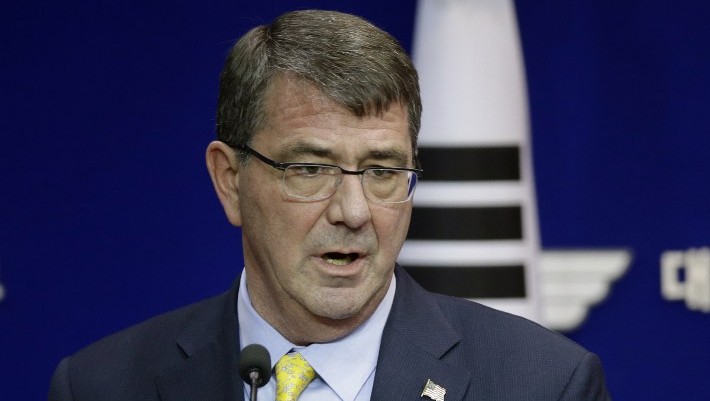
WASHINGTON (AP) — Pentagon leaders are trying to “fine tune” US strategy for ousting the Islamic State group from Iraq, focusing on faster and better training and arming of Sunni tribes whose combat role is central to reversing the extremists’ advances, senior US officials said Thursday.
Defense Secretary Ash Carter, speaking to reporters while traveling to Asia, said he told senior military officers at the Pentagon this week to come up with ideas to improve training and equipping, particularly of the Sunni tribes who complain that the Shiite-dominated government in Baghdad is dragging its heels on helping them.
“I can’t describe to you what the possibilities are because folks are looking at them right now,” Carter said.
The scramble for answers comes after Islamic State forces, though outnumbered, captured the Anbar province capital of Ramadi as Iraqi forces fled on May 16. Although the White House says those Iraqi forces were not US-trained, the defeat prompted Carter to make the startlingly frank public assessment last weekend that the Iraqis lacked “the will to fight.”
A Pentagon spokesman, Col. Steve Warren, said later that the focus is on fine-tuning the strategy, not rewriting it.
The US military strategy in Iraq is built on airstrikes to degrade the Islamic State forces while rebuilding Iraqi security forces to eventually regain the vast swaths of territory in the north and west that were lost over the past 18 months. The current focus is on retaking Ramadi and other parts of predominantly Sunni Anbar province.
The Obama administration insists it will assist the Sunnis only through the Shiite-dominated central government in Baghdad because it wants to foster a multi-sectarian government, rather than directly arm and organize the ethnic tribes for combat. It was unclear whether Carter might recommend scrapping the indirect approach or adjust it in some way in the days ahead, but the tenor of his remarks and comments by other officials suggested that dramatic changes were unlikely.
Gen. Ray Odierno, the Army chief of staff who was a top commander in Iraq during the 2003-11 war, said there may be merit in enlarging the US military role by embedding US advisers with Iraqi forces in the field. But he made clear that this also has drawbacks, and that it would be a judgment call if recommended by the Pentagon.
Odierno, who served in command three times in Iraq, said the failure of Iraqi security forces to hold their ground was “incredibly disappointing to me personally.” But he also said he sees no wisdom in sending substantial US ground combat forces to do the fighting.
“I’m adamant about that,” he said. Expending American lives to defeat the extremists without fixing Iraq’s internal political divisions would be a waste and an unsustainable solution.
“It always comes back to the government of Iraq,” Odierno said, referring to its inability to unify its Sunni, Shiite and Kurdish populations in a way that would give the country’s security forces confidence and motivation to fight.
Washington already has pledged to accelerate the shipment of certain weapons to Baghdad, including AT-4 weapons that could be used to stop armored vehicles that Islamic State fighters have used effectively as suicide bombs. The US also has said it will try to speed up the delivery of airstrikes requested by the Iraqi government.
Speaking to reporters on Thursday, Carter focused on arming and equipping Sunni tribes.
“One particular way that’s extremely important is to involve the Sunni tribes in the fight — that means training and equipping them,” Carter said. “Those are the kinds of things the team back home is looking at.”
But a senior defense official said Carter still wants to work through the Iraqi government, an approach that has been ineffective so far. The official was not authorized to describe the defense secretary’s thinking publicly and spoke on condition of anonymity.
Copyright 2015 The Associated Press.










The Times of Israel Community.