

A-G proposes absentee land compromise in Amona demolition dispute
As December 25 deadline for removing illegal settlement nears, officials seek a way out of the political deadlock that does not contravene Israeli and international law
 Add ToI as a Preferred Source on Google
Sue Surkes is The Times of Israel's environment reporter

Attorney General Avichai Mandelblit on Monday proposed an apparent compromise to the standoff in the cabinet over the looming December deadline to demolish an illegal West Bank outpost.
According to Mandelblit’s suggestion, the evacuees of Amona, ordered removed by the High Court of Justice by December 25, would be housed temporarily on three plots of land administered by Israel’s Custodian for Absentees’ Property.
The move would mean evacuees would have a place to stay near the original settlement, which the courts and other government bodies have repeatedly ruled was built illegally on private Palestinian land, while their new homes are completed in another settlement in the northern West Bank.
The move appears to be an attempt to forestall the passage of a so-called “regulation bill” sought by pro-settlement ministers and lawmakers that would allow the Amona settlement to remain in place by allowing the state to expropriate private Palestinian property without the requirement of a compelling and urgent public need.
Critics, including ministers within the current right-wing coalition, as well as much of the Israeli left, international organizations and governments in Washington and Europe, contend that this breach of private property protections would amount to de facto claims of annexation of West Bank land.
Nearly all foreign governments do not recognize Israeli claims to the West Bank, while Israel itself has kept the area’s status in limbo, extending the protections of occupation under the Geneva Accords to Palestinians living there while denying that the legal status of occupation exists in the “disputed” territory, a status that Israel contends allows for the building of Israeli settlements in the territory. Beyond the legal dispute, Israel’s settlements are seen by many on the center and left of Israeli politics, and by much of the international community, as an obstacle to the establishment of a Palestinian state in much of the West Bank.
Mandelblit’s suggestion to temporarily move Amona’s residents to “absentee” land — property belonging to Palestinians who were expelled, fled, or who left the country after 29 November 1947, mainly due to war — allows for a stopgap measure for Amona’s 40 families without requiring the Regulation Bill.
Use of absentee landowners’ land, which is held in a custodianship by the state, does not require a legal takeover of the property, and therefore avoids the dramatic precedent the Regulation Bill regarding the status of West Bank land.
The absentee land in question is divided into three plots, and would require roads to be built between the plots to connect community members.
The proposal would be invalidated, Mandelblit said Monday, if the Regulation Bill was passed, as the intermediate status would be superseded by the state’s new power to expropriate.
The proposal is based on a legal opinion issued in 1998 by then-Chief Military Prosecutor Ori Shaham that argued that absentee properties could be used in cases of urgent public need.
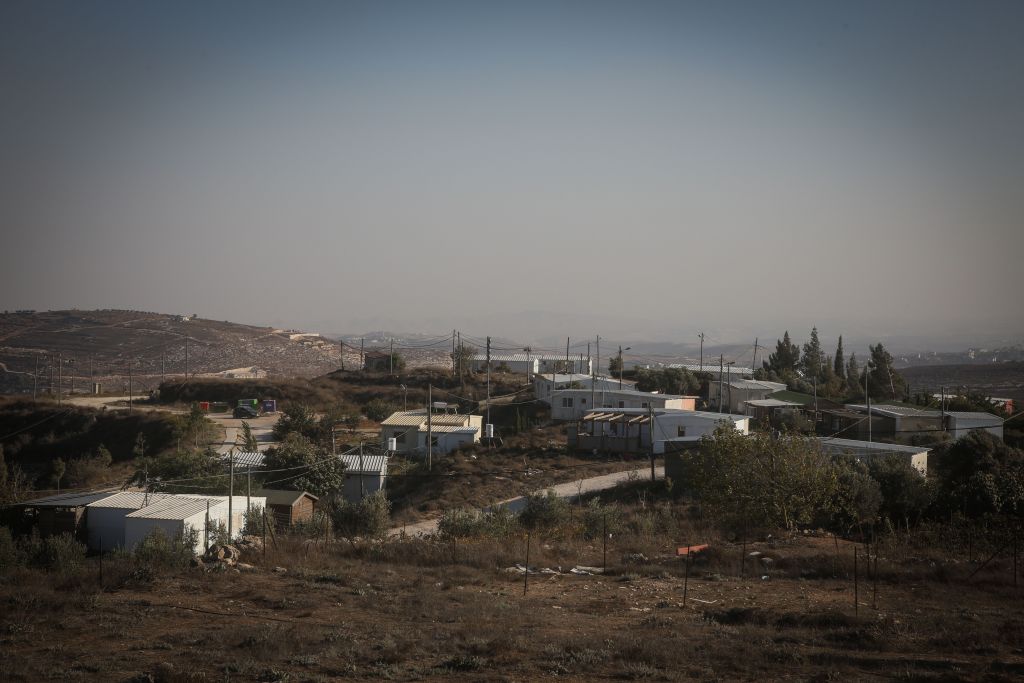
After over a decade of legal wrangling, the High Court of Justice ruled in 2014 that the Amona outpost, near Ramallah, which was founded in 1996 and is home to some 40 families, was built on privately-owned Palestinian land and has be razed by December 25.
In recent months, the right-wing coalition has sought a legal loophole to stave off the demolition, including floating various versions of the contested Regulation Bill, which passed a preliminary reading in the Knesset on November 16 but which the attorney general has deemed unconstitutional.
The idea of relocating the outpost to nearby land where the identities of the owners — the “absentee” landlords — are unknown was raised at Sunday’s meeting of the security cabinet, during which ministers asked Mandelblit to draw up the legal brief he provided Monday.
At Sunday’s meeting, Education Minister Naftali Bennett, leader of the right-wing Jewish Home party and the chief proponent of the Regulation Bill, was reportedly urged to abandon the effort to grant the state the power to expropriate private Palestinian land, Hebrew media reported based on anonymous leaks from the closed-door meeting.

Among those urging him to change his mind were Netanyahu, Defense Minister Avigdor Liberman, who has said in recent weeks that the demolition of Amona could not be avoided, and officials from the justice and foreign ministries.
He reportedly refused to back down at the meeting, demanding first to see a caravan on the ground in the new territory before he would abandon efforts to save Amona at its current site.
Sources within Jewish Home said that the absentee property idea was a step in the right direction but that the party was still intending to bring the Regulation Bill to a vote in the Knesset plenum on Wednesday after its first reading. The bill will only become law if it passes a third reading in the Knesset.
The Jewish Home sources echoed Bennett, saying the legislation would only be halted once the first caravan had been stationed in the temporary location.
Opposition figures meanwhile pressed Knesset Speaker Yuli Edelstein in a letter Monday to postpone a vote on the Regulation Bill because there had been no debate in the plenum on the legislation’s political and security implications.
The anti-settlement Yesh Din organization, which represents owners of the land on which Amona currently stands, accused Mandelblit of caving in to political pressure by agreeing to a solution that still involved a curtailing of the property rights of Palestinians, and which the group said would also contravene international law and the Justice Ministry’s own longstanding policy.
Yesh Din has petitioned the High Court of Justice to allow the Palestinians who claim ownership of Amona’s land to be allowed to return to the site.
Marissa Newman contributed to this report.









The Times of Israel Community.