

Disabled Palestinian war photographer turns camera on culture
After being crippled by stray bullet fired by Palestinian gunman, Osama Silwadi found new calling in documenting his people’s heritage
 Add ToI as a Preferred Source on Google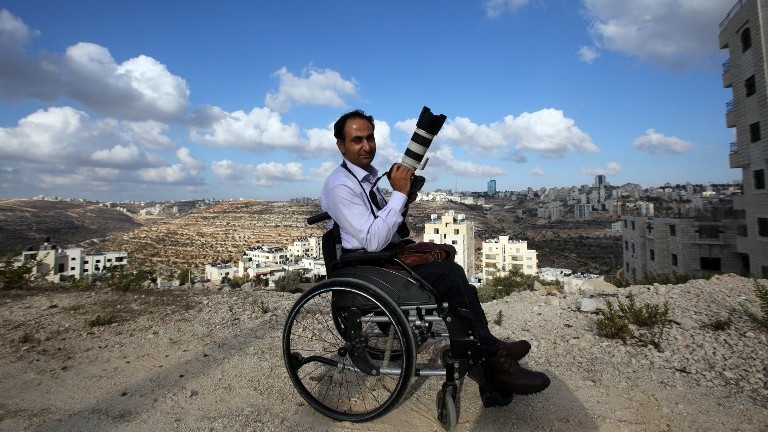
RAMALLAH (AFP) — When Palestinian Osama Silwadi was crippled by gunfire, his injuries ended his career as a war correspondent.
But the now wheelchair-bound photographer has found a new calling — documenting his people’s heritage.
After nearly 15 years covering the violence of the First and Second intifadas (in 1987-1994 and 2000-2005), Silwadi’s life took a dramatic turn in 2006 when he was hit by a stray bullet fired by Palestinian gunmen.
Silwadi, 33 at the time, was in his office in the West Bank city of Ramallah when he heard gunmen outside firing during a funeral procession.
“I heard shooting in the street and I ran to the window to take pictures,” he recalls, describing how a group of gunmen were firing into the air as a show of mourning.
Two bullets tore through his stomach, one passing through while the second ruptured his spleen and shattered his spine.
He spent 40 days in a coma and when he woke up, a doctor told him he would never walk again.
Eight years on, Silwadi, now 40 and a father of three girls, is still in a wheelchair.
He remains hopeful that one day he will walk again, but he has not let his disability get in the way of his passion for photography.
“I’m working even better than before my accident,” he says.
“Being so close to dying and then hovering between life and death for such a long period of time left me far more spiritual and has helped me see life differently, to see that it is beautiful,” Silwadi says.
At the time of his injury, Silwadi had been working as a photographer for 14 years for several international press agencies, including AFP, for which he had won awards.
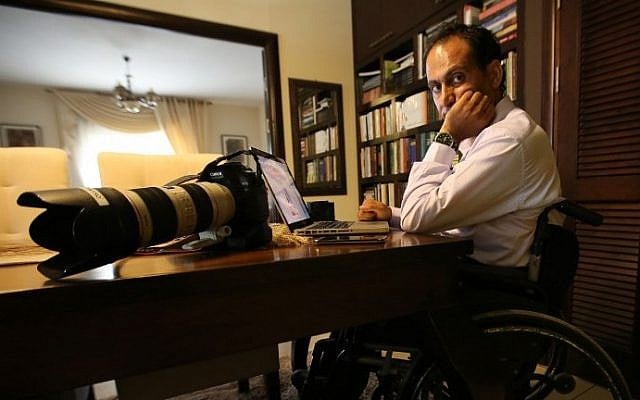
After his convalescence, he immediately began working on the painstaking task of setting up the Palestinians’ first-ever digital archive, collecting pictures and video clips of the life and work of Yasser Arafat, the iconic Palestinian leader who died in 2004.
His meticulous work earned him a job with the UN cultural agency, UNESCO, as an expert consultant on digital archiving.
He then turned his attention to his own photo archive, publishing a collection of images called “Palestine, How Are You?” featuring pictures of daily life as seen through the eyes of a child.
Before he was paralyzed, Silwadi had already published two other books of images: “Constant Giving and Creativity” (1997), a book on Palestinian women, and “Here We Are” (2005), a collection of images of daily life.
Protecting the Palestinian heritage
For Silwadi, safeguarding Palestinian cultural heritage goes hand-in-hand with the question of Palestinian identity and the future of the Palestinian people.
“I see the way in which the Palestinian people have had everything stolen for the profit of the Israelis,” he told AFP.
“I thought it was important that the Palestinians protect their heritage by taking pictures of their cultural heritage and speaking about it.”
A tireless documenter of Palestinian history, Silwadi has since his injury published several books on the walls of Jerusalem’s Old City, on traditional costumes, on jewellery and on cuisine.
His latest work, a book on traditional Palestinian architecture that was published in September, is titled “The Whisper of Stones”.
The book is filled with images of traditional domed ceilings, beautifully crafted doors and crumbling walls overrun with vegetation around grand old houses that were abandoned during the violence of the two uprisings.
His work has won praise from many corners, including from Sharif Kanaana, a specialist in Palestinian cultural heritage and former professor at Birzeit University near Ramallah.
“His pictures are magnificent, they teach you about the country,” Kanaana told AFP. “Of course, this is not an academic work but that doesn’t take anything away from its value as an archive.”
But Silwadi remains modest about his achievements.
“All I’m doing is carrying out my national duty with respect to our heritage,” he says.







The Times of Israel Community.