

EU, Russia, China to discuss offer of new terms to Iran — report
Powers may try to entice Tehran with financial aid in return for curbing missile program and Mideast meddling, according to German newspaper
 Add ToI as a Preferred Source on Google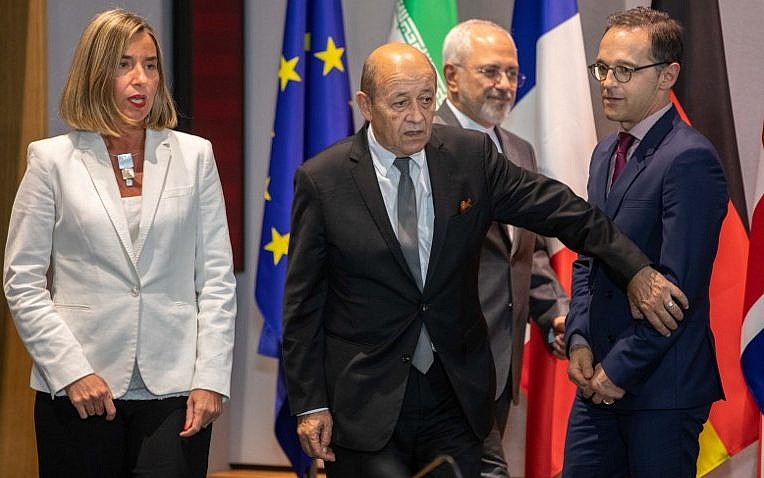
Representatives of European powers will meet with Russian and Chinese officials in Vienna this week to discuss a new accord with Iran, in an effort to preserve the 2015 nuclear deal, Reuters reported Sunday, quoting German newspaper Welt Am Sonntag.
World powers reportedly plan to offer Tehran financial incentives in return for the Islamic Republic limiting its ballistic missiles program and expansionism in the Middle East — thus placating the US and avoiding the resumption of American sanctions.
On May 8 US President Donald Trump announced he was withdrawing from the 2015 deal and would reinstate tough economic sanctions on Iran.
Iran said Saturday it would wait to see whether Europe produces tangible results in overcoming US sanctions before it decides whether to stay in the nuclear deal, as a top EU official visited Tehran to present plans for maintaining trade ties.
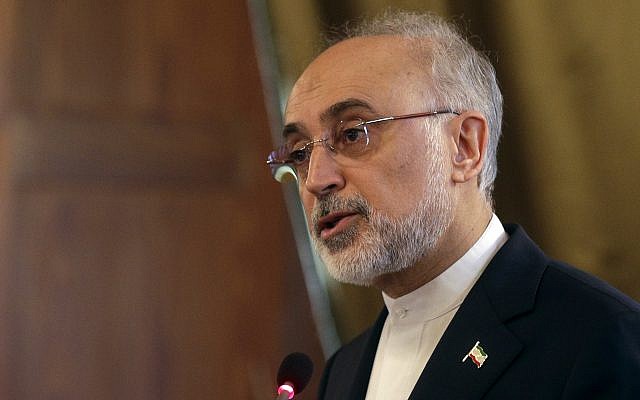
“The ball is in the court of the EU. They have presented different proposals, we will see if they materialize,” said the head of Iran’s Atomic Energy Organisation, Ali Akbar Salehi.
Iran has threatened to resume industrial uranium enrichment “without limit” unless its interests are preserved by the remaining parties to the deal, which also include China and Russia.
Salehi said the Iranian people had lost trust in the nuclear agreement and that if trade benefits were not protected “they will lose more confidence… and we will be forced to leave.”
After leaving the nuclear deal, Washington wants to move forward by offering to build a “coalition” to counter the multiple “threats” posed by the Tehran regime — but Europeans intent on saving the 2015 accord may thwart that effort.
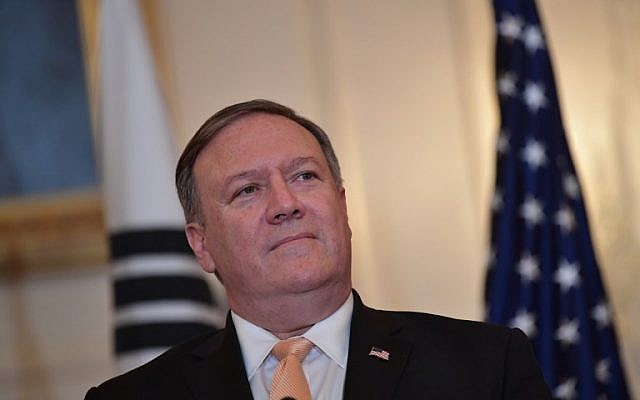
US Secretary of State Mike Pompeo on Monday will unveil a new “diplomatic roadmap” for Iran — how America plans to “address the totality of Iran’s threats,” according to the State Department’s director of policy planning, Brian Hook.
Washington is looking to draft a “new security architecture and a better security framework, a better deal,” Hook told reporters ahead of the speech, the first major policy address by Pompeo since he became America’s top diplomat.
“The US will be working hard to put together a coalition,” State Department spokeswoman Heather Nauert said, flagging Washington’s bid for a multilateral approach after its unilateral withdrawal from the accord.
President Donald Trump has long trashed the deal with Iran — concluded under his predecessor Barack Obama, together with Britain, China, France, Germany, and Russia — saying it did not do enough to curtail Tehran’s nuclear ambitions.
The Republican leader also said it did not go far enough in restricting Iran’s ballistic missile program, or its intervention in regional conflicts from Yemen to Iraq and Syria.
“We need a new — a framework that’s going to address the totality of Iran’s threats,” Hook said.
So far, the guidelines of this new strategy are unclear.
The big unknown is whether European leaders, who were bitterly disappointed by Trump’s decision to ditch the deal, would be willing to return to talks with his administration any time soon.
The re-establishment of the US sanctions that were lifted after the Iran nuclear deal was signed will force European companies to choose between investing in Iran or trading with the United States.
In reality, there is no choice — European companies cannot afford to forsake the US market.
And with investment from Europe — which had been the main carrot dangled before the Iranians to right their struggling economy — now stymied, Tehran may have little incentive to hold up its end of the bargain.
The Europeans have tried to squeeze a little flexibility out of Washington to help out their firms, but to no avail.
“They tell us, ‘We want the sanctions to hurt, there won’t be any exemptions,'” said one European official.
Some in the US administration are calling for a “North Korea scenario,” meaning the imposition of sanctions so severe that they force Iran back to the negotiating table.
By reimposing the sanctions, Washington aims to “bring economic pressure to bear on Iran,” Hook said.
“It was economic pressure that brought the Iranians to the table a few years ago.”




The Times of Israel Community.