

‘Fear takes hold of Egypt’
With the army deploying across the country, one columnist predicts violence as the public tries to rid itself of Morsi
 Add ToI as a Preferred Source on Google
Elhanan Miller is the former Arab affairs reporter for The Times of Israel
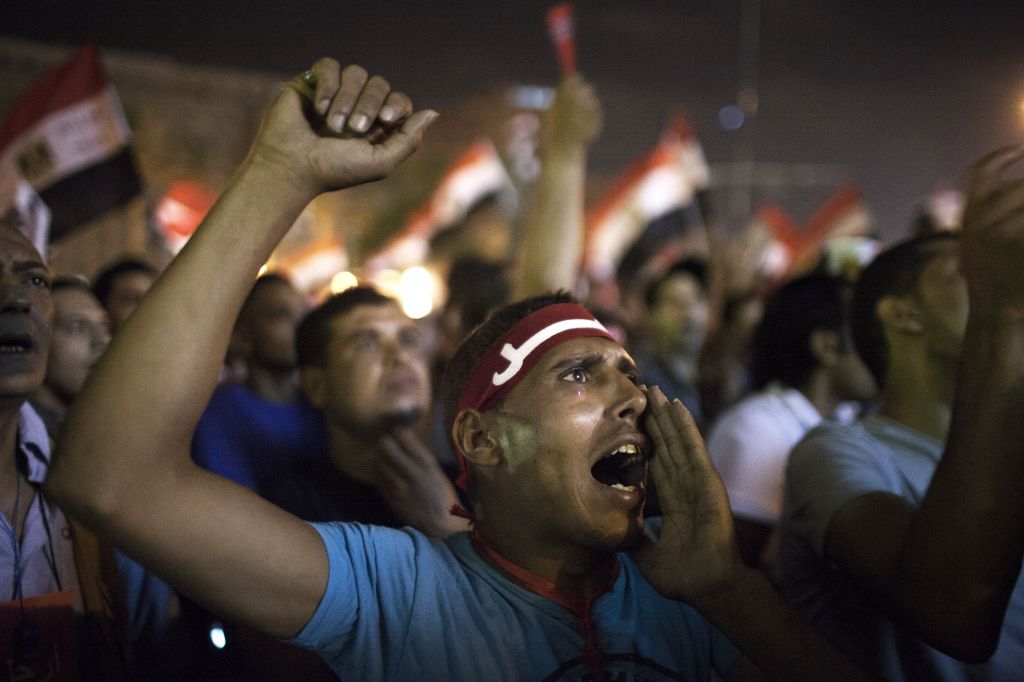
Egypt tops the headlines of Arab dailies on Sunday, with widespread demonstrations expected to determine the fate of Mohammed Morsi’s one-year-old regime.
“Egypt heats up ahead of June 30,” reads the headline of Saudi-owned daily A-Sharq Al-Awsat, which reports “unprecedented” mobilization in the country Saturday. According to security sources, President Morsi and his family have been evacuated from the presidential residence and moved to the fortified republican guard house northeast of the capital Cairo.
The daily then goes on to report that 200 US marines stationed in southern Europe were put on alert for immediate deployment to Egypt in case of emergency.
“Egypt braces itself, and the scope of demonstrations will determine the fate of the ‘Brotherhood regime,'” reads London-based Al-Hayat‘s rather long headline, featuring a photo of bearded supporters of Morsi waving sticks during a rally in Cairo Saturday.
“It is believed that the scope of the demonstrations and the way they are dealt with will determine, to a great extent, the fate of the Muslim Brotherhood regime,” writes reporter Mohammed Salah.
“If things slip out of control and confrontation erupts between Morsi supporters and opponents, eyes will no doubt turn to military establishment, which says it will defend the right of protesters to peacefully express their views while being subordinate to the elected president. However, the occurrence of bloody clashes may lead the military establishment to adopt a different position.”
London-based Al-Quds Al-Arabi, typically more alarmist than the rest, speaks about “the specter of civil war in Egypt,” featuring a photo of demonstrators around a big fire.
Qatari news channel Al-Jazeera describes Sunday’s demonstrations as another link in an unending chain of demonstrations. “In reality, Egyptians never left the streets for two and a half years,” claims the reporter in a video news piece.
The station reports “intense security tension,” noting that the military has increased its presence around sensitive installations.
“Whatever repercussions today’s events in Egypt have, just as history showed that deposed president Mubarak could not rescue Egypt, himself and his party, so too will history write that current president Mohammed Morsi will not be able to rescue Egypt, himself or the Muslim Brotherhood,” writes Homayed.
Al-Quds Al-Arabi editor-in-chief Abdel Bari Atwan bemoans the fragmentation of the demonstrators, and their high levels of violence.
“In the past there was one address for the demonstrations and one goal uniting participants: toppling a corrupt regime and bringing its leaders to justice. Now the titles are many and co-demonstrators have turned to enemies. We would not be exaggerating if we said that they hate each other more than they hate president Hosni Mubarak or even Netanyahu himself.”
“Taking to the streets in the manner we see today has nothing to do with legitimacy. The call for disobedience in the same way has nothing to do with democracy. This mobilization on both sides strives to destroy the other and not live with him. This constitutes a return to the first era of barbarism.”
The headlines of Egypt’s press are even more dramatic on Sunday.
“Fear takes hold of Egypt,” reads the headline of establishment daily Al-Ahram, reporting that the country’s top Muslim and Christian institutions have pleaded with believers to keep the protests peaceful and not shed any blood.
“The squares to Morsi: One year is enough,” reads the headline of independent daily Al-Masry Al-Youm, which has become an outspoken critic of Morsi over the past months.
“Egypt expects mass demonstrations today in all of its squares to complete the goals of the January 25 revolution by toppling the regime of President Mohammed Morsi and conducting early presidential elections,” reads the article’s lead paragraph.
The daily’s editorials express a feeling of tense anticipation. “A pivotal day in Egypt’s history,” reads Hassan Nafi’ah’s op-ed. “The sanctity of blood,” read’s Amr Shobaki’s.
“President Morsi believes … that his place in Ittihadiya Palace was given to him by God, whereas it was war and deceit which got him there,” writes Ahmad Al-Darini in an op-ed titled “The final moments of the nightmare of tribal rule.”
“He took power through war and deceit and he will leave through war and deceit. Those are the rules of the game, far from any metaphysical aspects this tribal man tries to cling to.”
—







The Times of Israel Community.