

Global health workers sign pro-ceasefire letter; clause to free Gaza hostages was cut
A missive signed by 2,700 set to be published in The Lancet had text about kidnapped civilians removed after signatories complained
 Add ToI as a Preferred Source on Google
JTA — Like many American Jews, Matt Greenberg has been bombarded with requests to sign open letters about the state of affairs in Israel and Gaza.
One that he received this week in a WhatsApp group particularly incensed Greenberg, who helms a Jewish social services nonprofit in Stamford, Connecticut. Saying that it would be published in the prestigious medical journal The Lancet, the letter called for a ceasefire in Gaza as the top priority of global health workers.
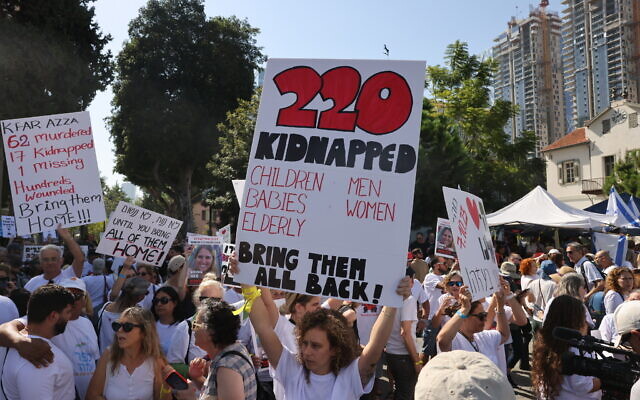
The letter, which had not been published by The Lancet at time of writing, also included little condemnation of Hamas, the terror group that killed more than 1,400 Israelis and took more than 220 hostages. And a clause calling for the immediate release of all hostages was removed after signatories complained.
Greenberg was incensed by what he saw and decided to sign a competing pro-Israel letter also circulating in the medical community. So he clicked the link and added his name to “Call to Action: An Open Letter from Global Health Professionals.”
Only later did Greenberg realize he had signed the wrong letter. This passionate Israel supporter and head of his regional Jewish social services organization had mistakenly added his name to a petition that included a health advisor to the anti-Zionist group Jewish Voice for Peace, and couldn’t figure out how to remove it.
“I originally thought it was a pro-Israel, anti-Palestinian letter,” Greenberg told the Jewish Telegraphic Agency. “Obviously it was the reverse.”
He added, “I unfortunately didn’t read the letter well enough and properly to understand what it meant and what it was saying.”
Greenberg’s experience is a window into the dizzying stream of petitions and open letters that have been circulating in the weeks since Hamas’s October 7 onslaught on Israel and the start of Israel’s war to destroy Hamas in Gaza. Open letters and social media posts have become a major currency of protest, with statements from Hollywood celebrities, students at elite universities, and titans of arts and culture weighing in. So many letters are flying that even people who want to sign ones that align with their values can’t track them all.
Greenberg’s experience also points to the fact that deep division over what to say and do about the Israel-Hamas war extends into the global medical community, where there was apparently a dispute over whether to call for the release of the hundreds of hostages taken by Hamas.
The most immediate priority listed in the Lancet letter is a ceasefire in Gaza, followed by establishing humanitarian corridors and “the recognition of human rights of all people in the region.” Hamas broke a 2021 ceasefire when it attacked Israel. Israel and its allies reject the idea of a ceasefire because it would leave Hamas in control of Gaza, which poses a direct threat to the safety of Israeli residents.
The Lancet letter also pushes for organizations to be allowed access to investigate “alleged war crimes,” singling out the bombing of a hospital in Gaza that Hamas blamed on Israel but which multiple news organizations and countries, including the United States, have attributed to a failed Palestinian rocket. The letter says it ultimately hopes to address “antisemitism and Islamophobia worldwide.”
A note attached to the open letter explains that one addendum, “The immediate and unconditional release of all hostages,” was added during the drafting process only to be removed 24 hours later “based on debate and feedback.” No further explanation was given. Hamas is currently holding at least 220 Israeli hostages.
“I can’t for the life of me imagine why any rational person would want to have that removed,” said Greenberg, who is CEO of the Schoke Jewish Family Service of Fairfield County. “There’s so much talk of humanitarian aid and all that kind of stuff, you’d think that would be a given.”
The open letter had not been published by Thursday afternoon. It had been submitted for publication to The Lancet, which has published an array of pieces on the conflict, including a call for humanitarian aid to Gaza and a separate letter, signed by 1,500 Israeli health care professionals, calling for “the immediate release of Israeli hostages.”
The letter was still continuing to amass signatures, crossing the 2,700-signature threshold before pausing. Matt Greenberg was still listed at 1,743.







The Times of Israel Community.