

 From the Liveblog of
Monday, June 22, 2026
From the Liveblog of
Monday, June 22, 2026
Sa’ar and visiting EU official discuss Gaza, PA reforms and settlements amid tensions with Brussels
 Add ToI as a Preferred Source on Google
Nava Freiberg is The Times of Israel's deputy diplomatic correspondent.
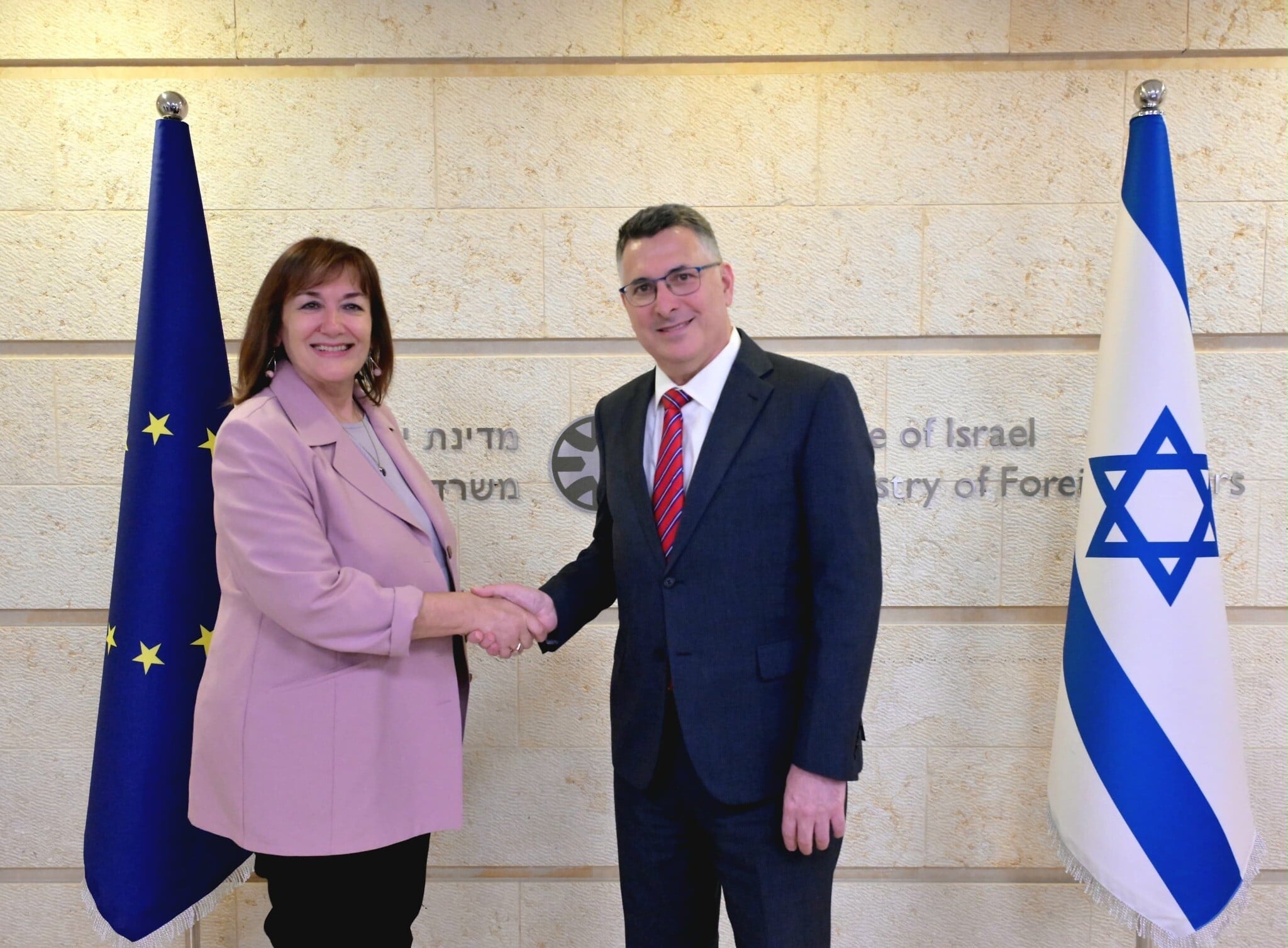
Foreign Minister Gideon Sa’ar and visiting European Union Commissioner for the Mediterranean Dubravka Suica offer contrasting views on Gaza, the Palestinian Authority and West Bank settlements during a meeting in Jerusalem today.
The visit comes at a tense moment in Israel-EU ties, after Sa’ar announced on Thursday that he was halting all contact with European Union foreign policy chief Kaja Kallas for reportedly comparing Israel to South Africa’s apartheid regime — an allegation Kallas has not publicly denied — and accused her of “acting obsessively and with blatant unfairness toward Israel.”
“We believe in the importance of comprehensive, honest and open dialogue with the EU. But ‘dialogue’ cannot just be one side dictating its political positions to the other side,” Sa’ar says in joint remarks delivered ahead of the meeting with Suica at the Foreign Ministry.
Turning to address key foreign policy issues, Sa’ar reiterates Israel’s position that any postwar arrangement in Gaza must include the disarmament of Hamas and accuses the terror group of “delaying” that process.
In her own remarks, Suica agrees that “Hamas must have no role in the future governance of Gaza and must disarm,” while adding that the humanitarian situation in Gaza “remains very problematic” and that aid must reach those in need “at a bigger scale,” alongside conditions for early economic recovery.
She also says a “viable and financially sustainable Palestinian Authority is important for regional stability and security,” adding that “lasting peace requires a political horizon, not economic isolation through withholding tax revenues,” referring to Israel’s continued withholding of tax revenues that it collected on behalf of the PA since the Oslo Accords, and which the body says amounts to $5 billion after a year without transfers.
Israel defends withholding the funds by arguing that Ramallah allocates some of that money for terrorists and their families.
Sa’ar dismisses claims by the PA that it is implementing reforms on that issue, accusing it of continuing a controversial policy of providing payments to terrorists and their families through newly established channels, as well as “poison[ing] the minds of Palestinian society with endless incitement in its schools, textbooks, mosques and media.”
“There is, unfortunately, none of the change necessary to build a reliable and different relationship [with the PA],” he says.
Suica further says the EU has “deep concerns about deteriorating situation regarding the illegal settlements” in the West Bank and reiterates that Brussels sees a negotiated two-state solution as “the only sustainable path forward.”
Sa’ar rejects the widespread international view that Israeli settlements in the West Bank are illegal, saying that “no government in the past has accepted an approach that denies our basic right to live in our homeland,” adding that the settlements are “necessary for our security.”
During her two-day visit, Suica is scheduled to meet with President Isaac Herzog and with PA Vice President Hussein al-Sheikh and PA Prime Minister Mohammad Mustafa, with discussions expected to focus on Gaza’s recovery, PA reforms and regional cooperation, according to a statement from an EU spokesperson.






The Times of Israel Community.