

Netanyahu turns to key ultra-Orthodox community to get out the vote
Opposition leader stumps in Bnei Brak, courts a controversial rabbi, and sits down with Haredi journalists in effort to counter what he claims is voter apathy in the community
 Add ToI as a Preferred Source on Google
Jeremy Sharon is The Times of Israel’s legal affairs and settlements reporter
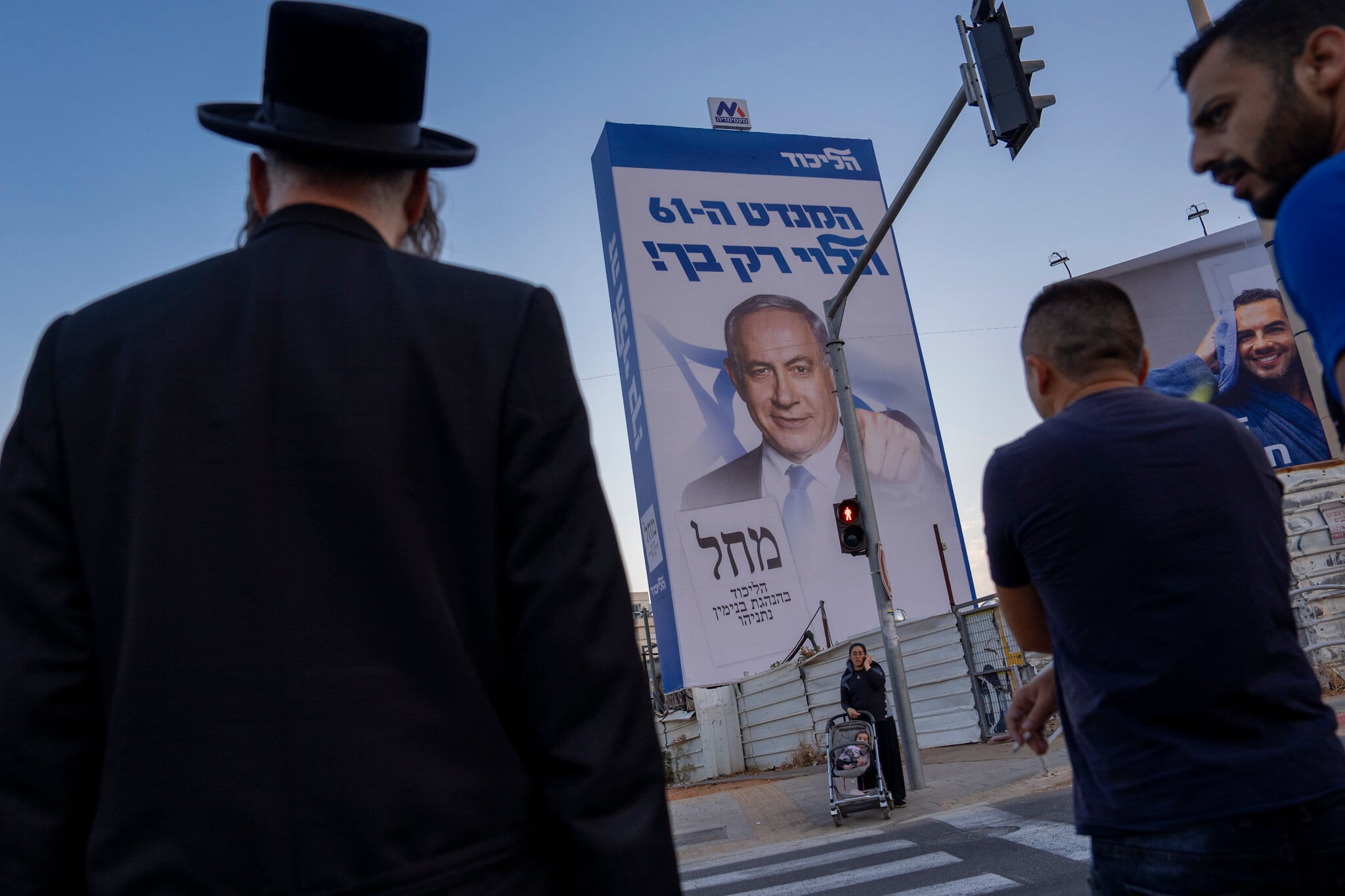
Opposition leader Benjamin Netanyahu has been conducting a concerted campaign over the last several days to energize ultra-Orthodox voters and maximize the electoral potential of the Haredi community ahead of the general election on Tuesday.
The former prime minister sat down to speak with ultra-Orthodox journalists over cholent on Thursday evening, met with a controversial figure from the Breslov Hasidic community to secure his endorsement for the Shas party on Friday, and held a rally in the ultra-Orthodox city of Bnei Brak on Saturday night.
The push to boost his allies from the ultra-Orthodox Shas and United Torah Judaism parties came amid worries among some of the community’s politicians and rabbinic leaders that community members may not show up to the polls in large numbers.
A large pre-election rally traditionally staged by UTJ was recently called off, reportedly due to a concern that not enough people would show up. Instead, the party organized a series of smaller rallies.
Last week Rabbi Gershon Edelstein, aged 99 and one of the community’s leading rabbis, warned specifically of ultra-Orthodox voter apathy in comments that UTJ turned into a campaign advertisement.
As in previous years, the community is also dealing with ongoing factionalism. Some groups, like the hardline Jerusalem Faction, do not vote at all, while others, such as a breakaway group from the large Gur Hasidic community, are no longer behind UTJ.

Outgoing UTJ leader MK Moshe Gafni recently denied there was widespread apathy among the ultra-Orthodox, telling JDN, a Haredi news site, that the community had “woken up in recent days,” following the Jewish holiday season and general election fatigue in Israel.
“Today the awakening is great and everyone is paying attention,” said Gafni.
Both UTJ and Shas are key members of Netanyahu’s right-wing religious bloc, which is forecast to win 60 seats of 120 in the upcoming election. Boosting turnout among staunch ultra-Orthodox allies will be key to scraping together one more seat, while any fall in voting numbers among ultra-Orthodox could threaten his chances to retake power.
On Thursday evening, Netanyahu sat down with several ultra-Orthodox journalists to tell them he was concerned about apathy in the community, in particular among UTJ voters.
On Saturday night Netanyahu turned up in Bnei Brak in his “Bibi is Coming” truck and addressed several hundred people in the streets of the city.
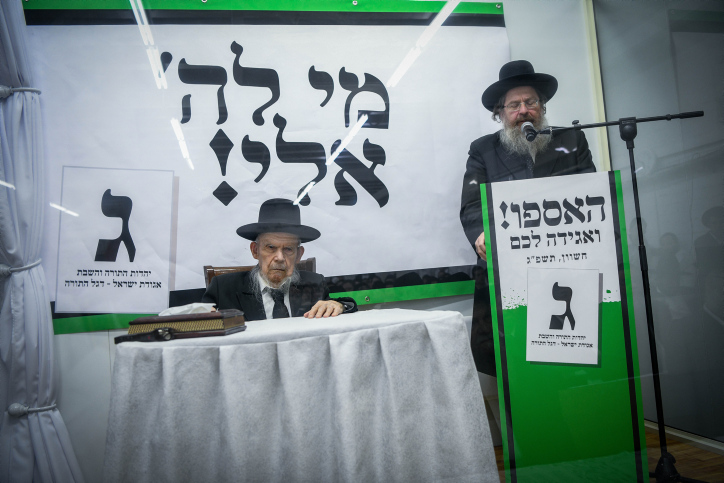
“According to our statistics there is a Knesset seat’s worth of ultra-Orthodox voters who will sit at home and not go out to vote,” Netanyahu told the crowd, echoing a pitch that has become familiar during the home stretch of every recent campaign, with various groups as the target.
“The left is counting on the ultra-Orthodox not coming out to vote en masse. We are likely to lose the elections to [Prime Minister Yair] Lapid,” he claimed.
On Friday, Netanyahu met with Shas chairman Aryeh Deri together with Rabbi Shalom Arush, a prominent leader in the Breslov Hasidic community who was a student of the disgraced leader of the Shuvu Banim Breslov sect, Rabbi Eliezer Berland, who has been convicted on charges of sexual assault and money laundering, among other crimes.
פרסום ראשון: סוף למשבר בין גוש הימין לחסידות ברסלב!
בשישי האחרון התקיימה פגישה סודית בין נתניהו ודרעי להרה״צ רבי שלום ארוש. בסרטון שיפורסם מהפגישה מברך הרב ארוש את נתניהו שיהיה רה״מ הבא וקורא לכל חסידי ברסלב להצביע ש״ס. pic.twitter.com/6vBg2QOMWz— ישי כהן (@ishaycoen) October 29, 2022
Unlike most Hasidic groups, Breslov is a diverse community with no single leader, and different rabbis within the community call on their congregants to back different parties, or not to vote at all.
Arush, who commands the support of likely only a few thousand voters, backed Shas in the 2021 election, and Netanyahu met with the rabbi on Friday seeking to guarantee his support again for the ultra-Orthodox party.
The rabbi, who runs a network of charitable institutions, is a highly controversial figure who publicly backed Berland before his multiple criminal convictions and has failed to repudiate him ever since.
Arush prayed for Berland to be released from jail while the Shuvu Banim leader was serving a prison sentence for fraud, money laundering, and other crimes in 2021. “He should have wonders and miracles and leave prison immediately, immediately, without further delays,” Arush can be heard praying for Berland at the tombstone of Rabbi Yehudah Ze’ev Leibowitz in Bnei Brak.
At the beginning of the COVID-19 pandemic, Arush said in a video address that the virus only infects non-Jews and that Jews should simply strengthen their faith “and give a smile” in order to avoid the disease.
In an op-ed column for the Merkaz Hainyanim ultra-Orthodox newspaper published on Monday, Netanyahu referenced controversial comments made by political chat show host Eyal Berkowitz last week.
Berkowitz had said that the ultra-Orthodox “don’t care about our people, read Torah all day, don’t go to work, don’t pay taxes, and don’t go to the army. Idlers!”
“There is an opportunity here to show to the ‘journalist’ Eyal Berkowitz, who called the ultra-Orthodox community ‘idlers’ and disparaged the Torah of Israel and those who study it, how to protect the dignity of religion, tradition, and Jewish identity,” he wrote.








The Times of Israel Community.