

Newly discovered cartoons show picturesque British camp that held hardened Nazis
Illustrations depict a placid life for inmates: The only successful escapee came back after a day at the movies, and decades later bequeathed 400,000 pounds to locals
 Add ToI as a Preferred Source on Google
Robert Philpot is a writer and journalist. He is the former editor of Progress magazine and the author of “Margaret Thatcher: The Honorary Jew.”

LONDON — For five years, it was home to some of the most fanatical and hardline Nazis — members of the Waffen SS, Afrika Corps and Fallschirmjäger Luftwaffe paratroopers — who fell into Britain’s hands during World War II.
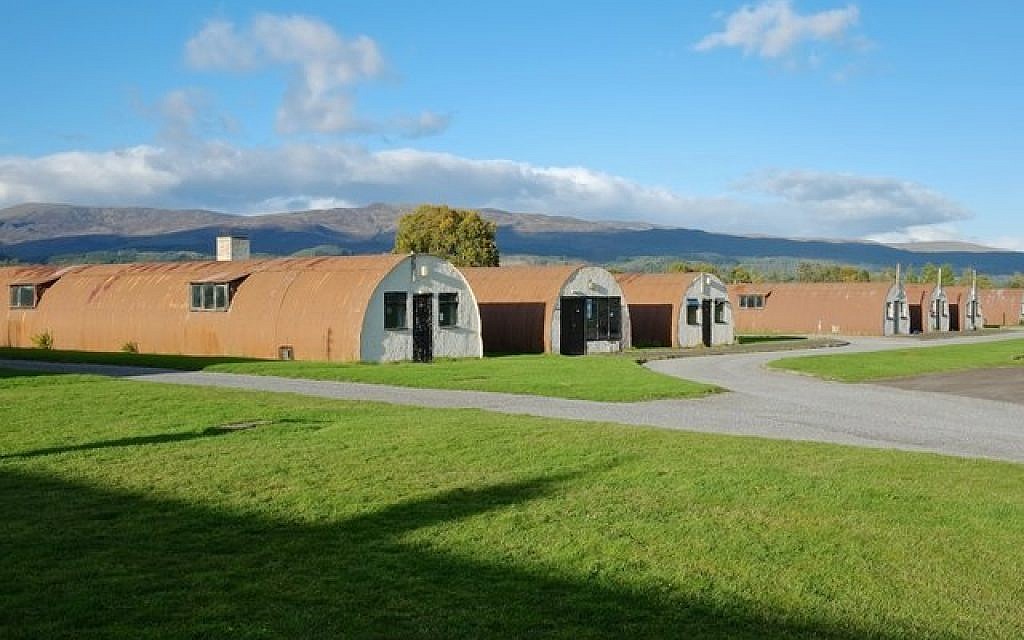
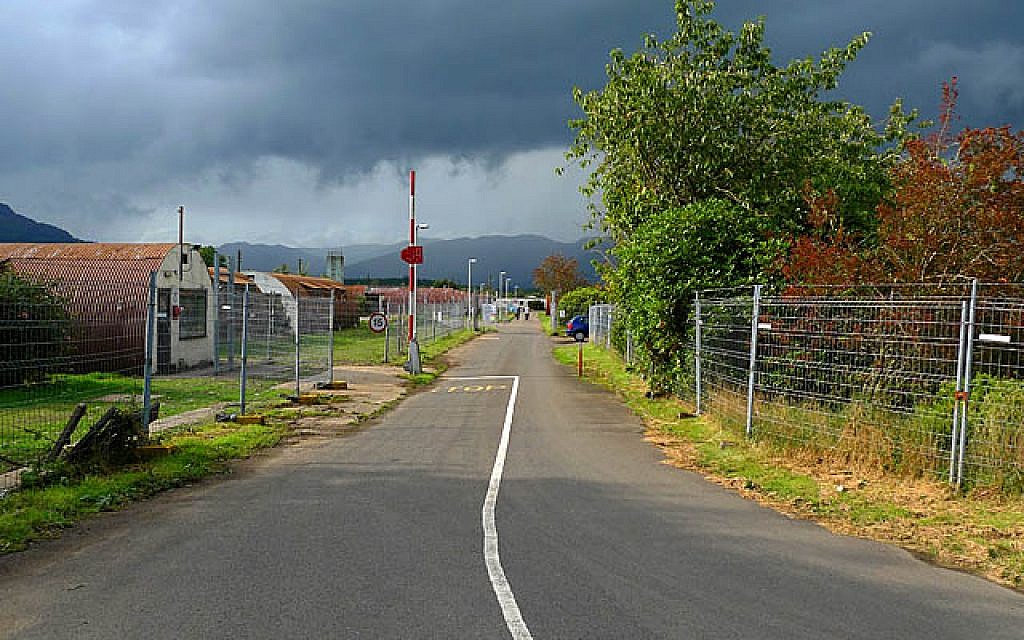
Scotland’s Cultybraggan, a so-called “black camp” because of the danger posed by its inmates, housed up to 4,000 of the 250,000 German soldiers who were captured and brought to the UK.
Hitler’s deputy, Rudolf Hess is widely believed to have spent a night at Camp 21, as it was known, after his dramatic flight to Britain in 1941, though some local historians dispute this.
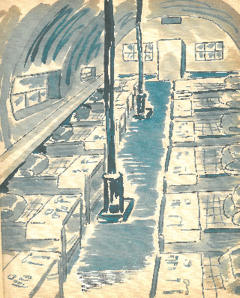
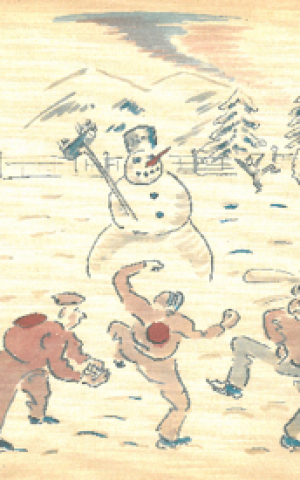
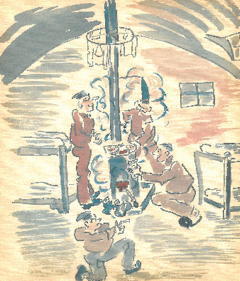
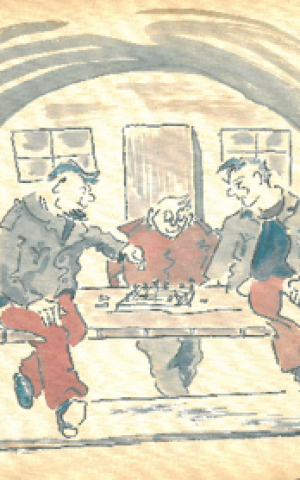
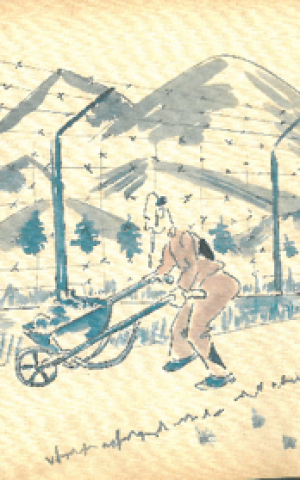
Recently, new light was shed on life at Cultybraggan with the release of 60 pen and ink drawings sketched by a German POW.
The images are, believes Dr. Iain Banks of Glasgow University, a “unique and internationally significant collection [providing] an unprecedented insight into the daily lives of German POWs in the UK.”
“But even more than this,” he adds, “they showcase the humanity and spirit which transcends nationalities and ideologies.”
The cartoons will go on public display at the former camp in May. In 2007, the site was sold by the Ministry of Defense to the local community, who wished to see its heritage preserved. Locals have now established a charity to maintain it.
While the cartoonist signed his work, the name has yet to be fully identified. It is believed that he worked for the camp adjutant, who kept the sketches and gave them to his daughters.
The cartoons show the prisoners engaged in manual labor, but also playing games, enjoying concerts and having a snowball fight.
One former inmate, Heinrich Steinmeyer, later recounted that Camp 21 was “a holiday camp compared to fighting or being a POW in Russia.”
Set beneath the shadow of Scotland’s southern Highland mountains, close to the small and picturesque village of Comrie in Perthshire, “the whole place was so beautiful. It went straight to my heart, and I thought, ‘Why have I been fighting this bloody war?’” said Steinmeyer.
Steinmeyer was a 19-year-old member of the notorious 12th SS Panzer division when he was captured in Normandy shortly after D-Day in August 1944. He was designated a Category C prisoner — meaning he was considered a committed Nazi and dangerous — and dispatched to Camp 21.
He stayed in Scotland for a number of years after his release and returned to Comrie many times. When he died in 2014, his ashes were scattered in the hills above the camp and his will bequeathed his life savings of nearly £400,000 to the village.
“I would like to express my gratitude to the people of Scotland for the kindness and generosity that I have experienced in Scotland during my imprisonment of war and hereafter,” his will stated.
He had good reason to be grateful. As he admitted in an interview in 2010, Steinmeyer’s life was saved by the Scottish soldiers who apprehended him on more than one occasion as he was being transported to Britain. Both the French civilians and Polish soldiers he encountered on his journey had ample cause for wishing ill a young man still dressed in an SS uniform.
Steinmeyer’s division, which was infamous for its fanaticism, committed a series of war crimes in Normandy, including the Ascq and Ardenne Abbey massacres.
‘The most wonderful thing he had seen’
Another former inmate returned to Cultybraggan, the last remaining example of a purpose-built camp in the UK, on an open day eight decades later. A volunteer guide recalled Ernst Krebs telling her that he spent his 21st birthday at Camp 21.
“He said that he had arrived at night and when he woke up in the morning and came out one of the Nissen huts that he slept in, and [saw] the view. He thought he was in heaven, it was the most wonderful thing he had seen,” Fiona Davidson told The Scotsman.
But not all prisoners would have remembered Camp 21 as fondly as Krebs and Steinmeyer.
Britain deliberately deployed Polish soldiers to guard the perimeter of the camp, knowing that they would give the inmates little quarter.
“They tended to be harsh on their German prisoners,” said Valerie Campbell, the author of a history of the camp. If prisoners from different compounds within the camp attempted to speak to each other through the wire, the Polish troops often fired warning shots. On one occasion, a German POW, Heinrich Schwarz, was shot dead by the Poles for such an infraction.
It was the Germans themselves, though, who were responsible for the most brutal killing at Camp 21. Its origins rested several hundred miles south of Cultybraggan in the English market town of Devizes in Wiltshire.
There, too, was a prisoner of war camp at the Le Marchant barracks. Just before Christmas 1944, a group of SS soldiers hatched a daring plot to break out of the prison. Then they planned to steal tanks from a local army depot, as well as armed vehicles and planes from a nearby Royal Air Force base. As they made towards London, the 7,000-strong squadron of escaped prisoners hoped to attack other camps and release their inmates.
The plot was foiled when German-speaking Americans visiting the camp overheard a conversation by one of the ringleaders. Once alerted, the British authorities reactivated hidden microphones at the camp, discovered the date of the planned escape and apprehended the principal plotters.
They were swiftly moved to Camp 21 where tragedy then struck. In error, among those sent north was Wolfgang Rosterg. Rosterg was neither a fanatical Nazi nor one of the conspirators. Instead, he had bravely made clear his opposition to Hitler.
The day after his arrival at Cultybraggan on December 22, 1944, Rosterg was hauled before a kangaroo court comprised of a group of his fellow POWs, sentenced to death and savagely beaten. They wrongly believed that Rosterg had betrayed the Devizes breakout to the British and had then been sent to Camp 21 to spy on them.
So brutally was he attacked that it was later found that Rosterg was dead even before a group of them hanged him in the camp toilets in a failed attempt to make it appear that the death was a suicide.
Eight prisoners were charged with Rosterg’s murder. Appearing before a Scottish court in the late summer of 1945, the accused men pleaded not guilty and rested their defense on the fact that Rosterg was a traitor who deserved his fate.
At their request, the British officer appointed to defend them also cited what they believed to be an important precedent for their actions: that British POWs in Germany had allegedly executed one of their fellow prisoners in 1943 for betraying an escape attempt and that their action had gone unpunished.
At the close of the trial, two of the Germans were cleared and one sentenced to life imprisonment. The remaining five were hanged at Pentonville prison in London in October 1945.
David McKie, a journalist who has written about the case, has argued that with their deaths some awkward questions were also conveniently put to rest. “No one seems to have asked how it was that Rosterg had been allowed to fall into their hands at Comrie,” McKie wrote.

Unlike Rosterg and his murderers, however, most of Cultybraggan’s inmates ended their war incarcerated but in safety.
Absconded to the movies
Attempts to tunnel out of the escape invariably ended in failure, defeated as much by the heavy glacial rock under the camp as by the guards who patrolled it.
Only Steinmeyer appears to have successfully escaped — and then only for a visit to the local cinema.
After his death, it was revealed that Steinmeyer had been sprung from Cultybraggan by local schoolgirls who had made friends with him through the camp’s fence.
As the son of one of them told the BBC in 2016, “I’m not how they communicated, but during these conversations they discovered that Heinrich had never seen a moving picture.”
“So they went up with their push bikes one morning, and one of the girls had taken her brother’s school uniform and they smuggled him out of the camp through the chainlink fence and into the cinema, where he saw his first film — and he was absolutely blown away by the whole experience,” said George Carson.
Few of Steimeyer’s fellow prisoners — nor, more importantly, any of the victims of his former SS comrades — had a war-time experience quite like it.










The Times of Israel Community.