

Poland’s president, Jewish leaders light Hanukkah candles at palace
Andrzej Duda says he is happy to be with a ‘community of people who jointly build up Polish society’
 Add ToI as a Preferred Source on Google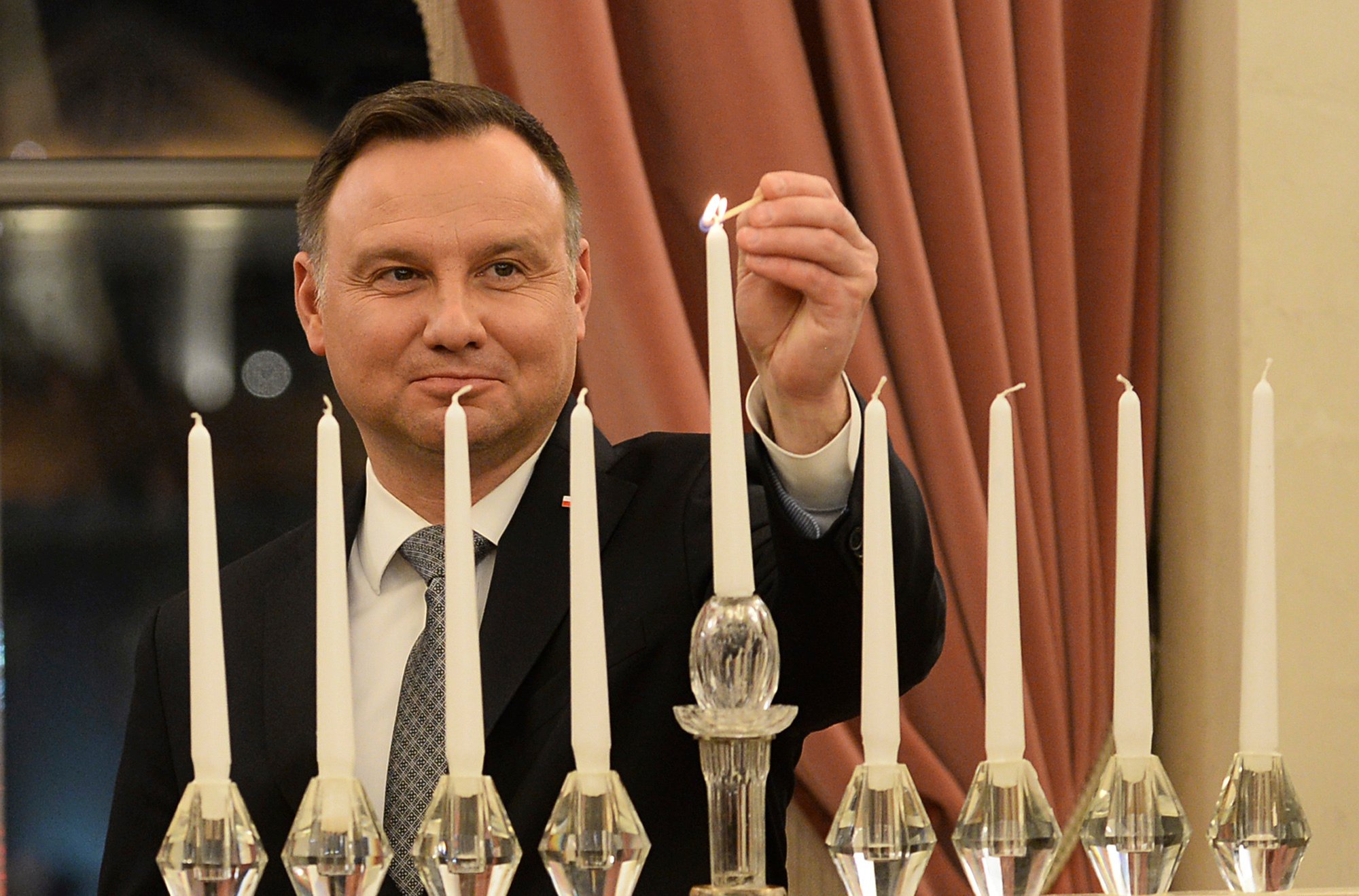
Polish President Andrzej Duda and Jewish community members on Sunday evening lit a menorah at the Presidential Palace to jointly mark the last night of the Jewish festival of Hanukkah.
Hanukkah candles are lit each year at the palace in Warsaw.
Duda, alongside former Israeli ambassador to Poland Shevah Weiss and leaders and young members of Warsaw’s Jewish community, lit the marble-and-crystal menorah.
Accompanied by first lady Agata Kornhauser-Duda, the president told the gathering of a few dozen people that he was happy to be at the joint meeting of a “community of people who jointly build up the Polish society, who want to be together.”
Last week Rabbi David Lau, Israel’s chief Ashkenazi rabbi and the son of a Holocaust survivor, lit Hanukkah candles at the Polish parliament in what he called the “closing of a circle.”
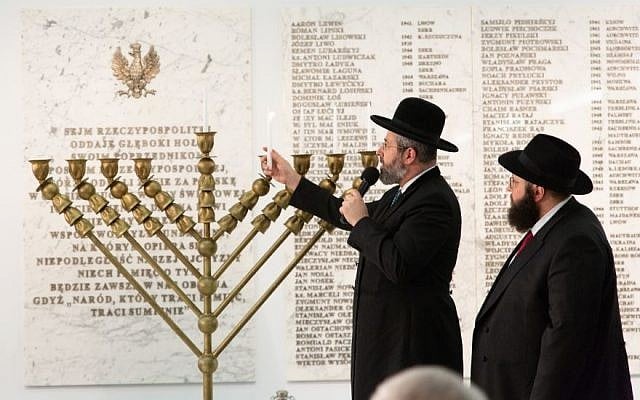
Lau said the event was the first time that a chief rabbi of Israel has lit Hanukkah candles at a public event in Poland.
Earlier this year Poland passed a controversial, now-amended, law, which had stipulated fines for people accusing the Polish people of complicity in Nazi Holocaust crimes.
In late June, Prime Minister Benjamin Netanyahu and his Polish counterpart, Mateusz Morawiecki, signed an agreement that officially ended the spat over the controversial law.
Warsaw agreed to annul criminal sanctions for individuals who accuse the “Polish nation or the Republic of Poland” of having been complicit or co-complicit in the Holocaust, though they can still be find fined.
Jerusalem agreed to issue a joint Israeli-Polish declaration that critics said adopted Warsaw’s skewed narrative of the Holocaust.
Controversially, the statement condemned “every single case of cruelty against Jews perpetrated by Poles during…World War II,” without specifying that there were many such cases, but hailed “heroic acts of numerous Poles, especially the Righteous Among the Nations, who risked their lives to save Jewish people,” who, according to the historical record, were a relative few in number. It also appeared to equate anti-Semitism with “anti-Polonism,” critics said.
The Yad Vashem Holocaust memorial center harshly criticized the joint declaration, saying it would stifle free research on the subject. Furthermore, the text “contains highly problematic wording that contradicts existing and accepted historical knowledge in this field,” the institution lamented.
Raphael Ahren contributed to this report.









The Times of Israel Community.