

The art (or lack thereof) of negotiations
Lifting of gag order on 2 Israelis held in Gaza opens a floodgate of criticism against government; Iranian nuke talks miss another deadline
 Add ToI as a Preferred Source on Google
Joshua Davidovich is The Times of Israel's Deputy Editor

For 10 months, the press faithfully kept to a gag order keeping the disappearance of one, and then two Israelis in Gaza under wraps. The lifting of the gag order Thursday, though, let loose with a volcano of news coverage and commentaries both on the government’s handling – or mishandling – of the case thus far, and what the state should do to get the captives out of Gaza.
The battle lines of what Israel should do to gain the freedom of Avraham Mengistu and a second unnamed man from the Bedouin community are drawn bright and clear, with Israeli officials being quoted across the board as saying that they will not release terrorists as part of an exchange deal.
But it seems the press is mostly interested in what happened over the 10 months prior, as top ministers were kept in the dark, the defense community dragged its feet on looking into the matter, and top negotiator Lior Lotan apparently threatened the Mengistu family to keep their mouths shut and follow the government’s lead if they wanted to see their son.
Alongside all that, creeping at the edges, and sometimes dashing into the center, is the inevitable racial tensions surround the case.
In Haaretz, Amos Harel calls the government’s handling of the case “strange,” which is putting it diplomatically.

“The 10-month long blanket gag order is a manifestation of a very problematic policy. Once again the courts seem willing to too hastily approve the demands of the security establishment, answering its needs fully. Hovering in the background, the color of Mengistu’s skin cannot be ignored, especially in light of the protests of young Israelis of Ethiopian origin over the past two months. Would the security establishment have dared (and succeeded) in making a similar move if the family were veteran Israelis like [Gilad] Shalit’s, Ehud Goldwasser’s or Eldad Regev’s,” he writes, referring to previous cases where Israel had to negotiate for abductees, or in the case of Goldwasser and Regev, their bodies.
“True, there is a difference. Mengistu, as noted is a civilian, who crossed the border of his own free will from unclear motives. It is also known that he suffered from various personal problems. And yet, not only in any other case would the state have found it difficult to spread such a broad smokescreen over the case, but the public silence — and apparently a certain innocence on the part of the family of the missing man — made it possible for the security establishment to deal slowly with the matter and even to delay the first meeting with the family.”
Yedioth Ahronoth drives home the point even further, with a portrait of Mengistu’s mother on the front page and a headline reading “The transparent captive,” employing a euphemism often used in Israel to denote those ignored by society.
The paper’s Sima Kadmon takes issue with Lotan’s tactics, writing that one doesn’t even need to hear the tape of him revealed Thursday night apparently bullying the Mengistu family to understand that he’s not a man to mess with, alleging that he was able to pull it off because the family of poor immigrants was easily cowed, and a real Israeli family “would have booted him from the house after the first sentence.”
“If I were Netanyahu,” she writes, “I would throw the representatives for captive affairs from any level. The very fact that a man like that represents the prime minister on such sensitive affairs, which demand tact and sensitivity, constitutes a black mark for a prime minister who never lets anyone forget that he comes from a bereaved family. But the beastly behavior of the representative isn’t needed to paper over the facts. And the facts show that we are talking here about a collection of failures, starting with the hiding of information from people and committees that are supposed to be involved, via the gag order, all the way to the way the family was handled.”
To get an idea of what the prime minister might actually be thinking, one need only look at Israel Hayom, often seen as a Netanyahu mouthpiece, which is much less critical of the handling of the affair.
The paper’s Dan Margalit saves his criticism for the press, whom he says have gone overboard with their second-guessing of the government’s handling of the incidents, even to the point of incitement.
“It’s sad, it’s heavy. But yesterday – 10 months after the deed – the media, suffering from boredom amidst cucumber season – started to deal with the case as if we were talking about the kidnapping of two soldiers or Mossad or Shin Bet agents,” he writes. “No and no. Immediately we recognized the signs of an illegitimate battle to place the blame on the army.”
The battle over the government’s handling of the two Israelis held in Gaza will likely soon fade amid negotiations with Hamas over how to get them out. Hundreds of miles away, in Vienna, another set of negotiations is still making headlines, after world powers and Iran failed to reach another deal, passing yet another deadline – the fourth that’s gone whooshing by, according to Israel Hayom’s count.
Despite US Secretary of State John Kerry’s promise that negotiations are not open-ended, Yedioth Ahronoth dubs what’s happening “talks without a deadline,” which seems to be accurate after the sides dropped any pretense of trying to reach a pact by a predetermined date.
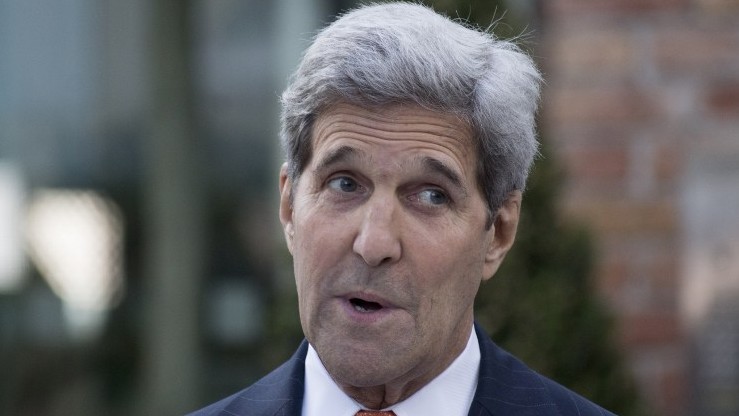
Yet the paper seems pretty sure we are witnessing the final throes of the talk, no matter which way they go.
“In the unwritten lexicon of negotiations, in the chapter on crisis management, a top spot is reserved for ‘the handshake before zero-hour.'” This is exactly what happened yesterday in Vienna, as representatives of the world powers and Iran tried to either get to a deal or declare failure,” the paper writes.
In Israel Hayom, Boaz Bismuth sees the continuing of talks as a joke at Israel’s expense, writing that it might even be funny to watch the sides try so hard to reach a deal they’ll have trouble selling back home if the results weren’t so disastrous for Israel.
“There’s no doubt that the Iranians have improved upon the Persian bazaar,” Bizmuth writes sarcastically. “Usually that’s when the seller goes to the buyer, thus lowering the price. But here, the seller is getting almost everything he asked for. Now all that’s left is for him to move a tiny bit, but God forbid not to concede anything, and return home with the maximum he could get. “The Iranian are asking to reduce to a minimum ‘the military implications of the deal.’ Tzadiks.”
In Haaretz, Anshel Pfeffer uses another analogy to explain why the talks are going on and on, writing that much like banks bailed out by taxpayer money, the Americans believe the talks can’t just be left to rot.
“The prevailing assumption is that they cannot go home without an agreement,” he writes. “The administration has devoted too much time, effort and prestige to the project. Like the big banks, the Iranian deal is too big to fail.”










The Times of Israel Community.