

‘Why are you leaving me?’: 4 soldiers killed in Beit Hanoun attack laid to rest
Hundreds mourn Meir Shimon Amar, Moshe Nissim Frech, Noam Aharon Musgadian and Benyamin Asulin, slain Monday night in Gaza; Staff Sgt. Moshe Shmuel Noll to be buried Wednesday
 Add ToI as a Preferred Source on Google
Ben Sales is a news editor at The Times of Israel
Four of the five soldiers killed in a roadside bombing in northern Gaza were laid to rest on Tuesday in ceremonies at the Mount Herzl and Haifa military cemeteries.
Hundreds of mourners gathered at the funerals of Staff Sgt. Meir Shimon Amar, 20, Sgt. Moshe Nissim Frech, 20, and Staff Sgt. Noam Aharon Musgadian, 20, all from Jerusalem, as well as Sgt. First Class (res.) Benyamin Asulin, 28, from Haifa.
The funeral of the fifth soldier, Staff Sgt. Moshe Shmuel Noll, 21, from Beit Shemesh, is scheduled to be held on Wednesday in Jerusalem.
The five soldiers were killed on Monday night when Hamas operatives detonated a series of bombs in Beit Hanoun in northern Gaza, near the border with Israel. The bombs, according to an Israel Defense Forces investigation, were planted ahead of the troops’ arrival. The first was detonated, hitting several soldiers, and then the second targeted those who rushed to help them.
The soldiers were also hit with live fire. The attack also injured 14 troops.
Asulin’s mother, Aida, described him in a eulogy at the Haifa cemetery as “smart, diligent, good-hearted to the heavens,” and said he demonstrated “respect for parents, brother and sisters.” She described calling him repeatedly after hearing of the ambush, with no answer.
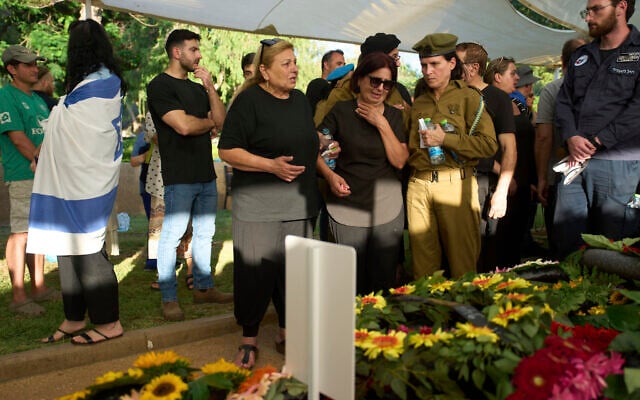
Asulin, who served in the Northern Brigade, had done eight months of reserve duty following Hamas’s October 7, 2023, attack. He is survived by his parents and siblings.
“Love of my life, I can’t believe I won’t see you again,” his mother said through tears, according to Ynet. “You would bring happiness home. Why are you leaving me, my son?”
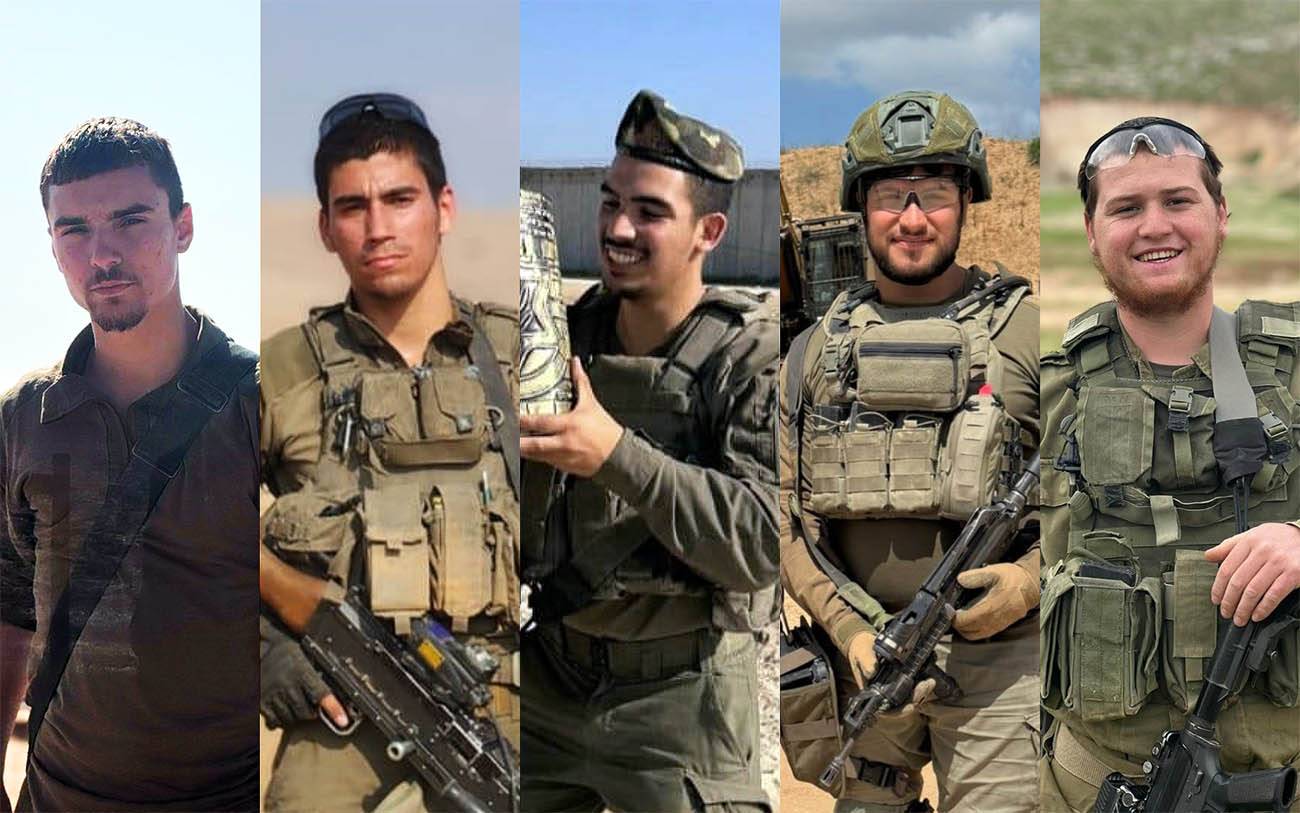
Amar, Frech, Musgadian and Noll all served in the Kfir Brigade’s Netzah Yehuda Battalion, which is geared toward ultra-Orthodox and religious soldiers. Frech, who studied at a hesder yeshiva in Haifa, where young men combine Torah study with a shortened term of military service, was laid to rest on Mount Herzl in Jerusalem.
His father, Yaakov, eulogized him as someone “who was, for me, a son and also a true friend, and for your family a powerful and strong support,” according to Makor Rishon. He is survived by his parents and five siblings.
Frech’s rabbi, Avner Hazut, said fellow students recognized him as “the tall, modest kid who radiated a good heart and an infinitely gentle soul. You were so measured, so humble, that even if you wanted to stand out you wouldn’t have. Your good and your humility were a source of inspiration and imitation for us.”
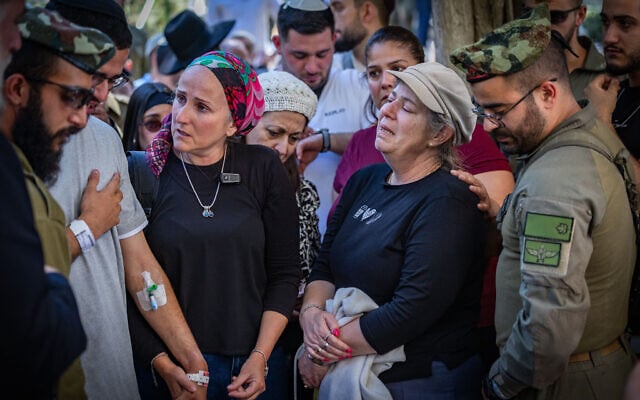
Musgadian was also laid to rest at Mount Herzl, where his father, Ofer, eulogized him as someone who “strived not to be a burden on anyone, always the one who wanted to give and do for others,” according to Walla. He is survived by his parents and four siblings.
His mother, Ilanit, said in her eulogy that Musgadian was “so connected with the family.”
“You sacrificed your life for others and my heart is broken,” she said. “No word and no hug will really comfort us.” She recalled that “your smile that was never wiped away. When we visited you… your friends said that your smile would fill them up.”
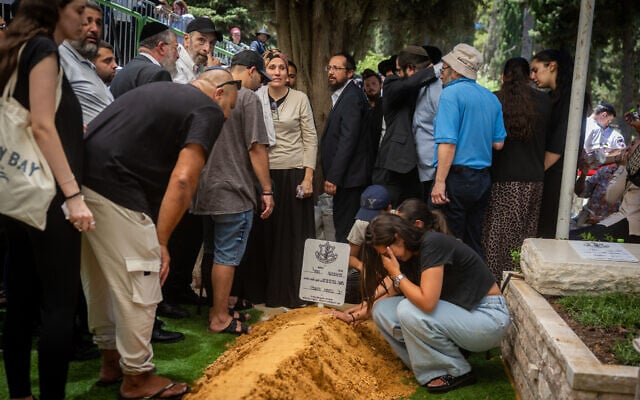
Amar was likewise buried on Mount Herzl. He is survived by his parents and four siblings. His sister, Talia, recalled how close they were as children.
“How is it possible to take leave of a brother, friend, half of my soul?” she asked, according to a report in the publication Davar. “We were inseparable in childhood, sharing everything. As we got older we grew apart a bit, but you always loved so much.”
Noll, whose funeral is slated for Wednesday, hailed from Beit Shemesh, and the city’s mayor, Shmuel Greenberg, mourned him as “a role model of dedication and heroism. A true warrior who fell… while on his mission for the people of Israel. The entire city mourns with the Noll family and embraces them at this difficult time.”
Sam Sokol contributed to this report.


The Times of Israel Community.